

Hire by Technology
SERVICES



Software development looks clean from the outside, with no factory emissions and no visible waste, but the infrastructure behind it tells a different story.
Electricity demand from data centers, AI systems, and cryptocurrency operations seems to be growing every year, bringing more attention to sustainability in the software development industry.
For fintech companies in particular, this conversation has a second dimension.
Financial services firms face mounting ESG disclosure obligations, and regulators in both the EU and the UK are tightening expectations around sustainability reporting.
The software your company runs, the data centers it depends on, and the code its engineers write all have a carbon cost, and stakeholders are increasingly expecting it to be measured and managed.
This guide covers the core principles of sustainable software development, the practices that deliver the most meaningful reduction in environmental impact, and why fintech teams have additional reasons to take green software engineering seriously.
Our senior fintech developers can help you make the best possible decisions for your financial applications to ensure that you balance performance with additional factors like sustainability, which might not be as prevalent in other industries.
Sustainability in software development covers the systems, practices, and design decisions that minimize the environmental impact of software throughout its entire lifecycle.
In a nutshell, this could be anything from the energy consumed writing and testing the code to the resources required to run it in production, and eventually to the infrastructure needed to maintain and evolve it over time.
From what we are observing at the moment, the major concerns around the digital economy's carbon footprint can be broken down into three main components: data centers, networks, and user devices.
Data centers in particular have grown rapidly in the last few years, accounting for around 1.5% of global electricity consumption, with that figure being expected to double by 2030.
Every database query, every redundant API call, every piece of data stored longer than it needs to be, and every computation running inefficiently on a server somewhere contributes to the load on infrastructure that consumes real energy and produces real emissions.
The Green Software Foundation defines sustainable software as applications that are carbon-efficient, energy-efficient, and hardware-efficient. Each of those dimensions involves specific engineering decisions, not just policy commitments.
For most software companies, sustainable development has been primarily an ethical and cost consideration.
However, when you are considering sustainability for fintech companies, it has become a regulatory and commercial one as well.
The EU's Corporate Sustainability Reporting Directive (CSRD) now requires large financial companies to report on environmental impact, including Scope 3 emissions that cover software infrastructure and technology supply chains.
The UK's Financial Conduct Authority has its own sustainability disclosure requirements for financial services firms.
These aren't voluntary frameworks by any means. Instead, they're compliance obligations, and the software your company runs contributes to the emissions your company needs to account for.
We’re seeing investors and institutional capital applying ESG screening criteria more and more often. "Sustainable" in that context includes how a company's technology infrastructure operates.
If you can demonstrate quantified carbon reduction in your software operations, you have an advantage over a competitor that can't.
The EU Digital Operational Resilience Act, which came into effect in January 2025, requires financial institutions to assess and manage the environmental and operational risks of their ICT supply chains.
Practically, this means that cloud providers, co-location data centers, and critical software vendors all fall within that scope, so the environmental credentials of those providers now carry regulatory weight.
Code that runs fewer cycles, stores less redundant data, and scales efficiently costs less in compute and storage.
This applies to all development projects, regardless of industry regulations, since sustainability and operational cost efficiency tend to point in the same direction.
The most direct lever a software team has on its environmental impact is the efficiency of the code it writes.
Inefficient algorithms, unnecessary computations, redundant data processing, and poorly managed memory all translate directly into energy consumption.
Here’s how you can fix that:
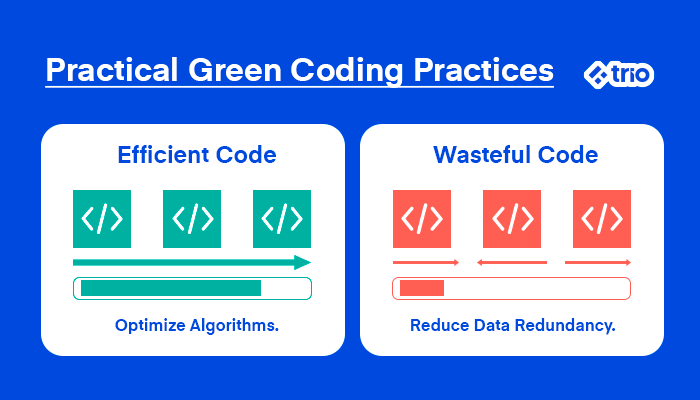
Architecture decisions made early in a project determine its resource efficiency ceiling. A well-designed architecture can scale efficiently as load increases. It can be difficult to change later, so it is best to get an expert on your team to advise you as soon as possible.
In a monolithic architecture, scaling one component under load means scaling the entire application, allocating compute resources to components that don't need them.
Microservices, on the other hand, allow individual services to scale independently, so a payment processing spike scales the payment service without spinning up additional instances of the reporting service or the user management layer.
Looking beyond environmental efficiency, this pattern also reduces the PCI DSS compliance surface for fintech applications by containing sensitive data flows to specific services.
Serverless architectures allocate compute resources dynamically based on demand. They then release them immediately when demand drops.
If your workloads have significant idle periods, like batch reconciliation jobs, scheduled reports, or event-driven notification systems, serverless eliminates the energy cost of keeping infrastructure running at low utilization.
We strongly recommend cloud providers, as they allocate shared infrastructure more efficiently than dedicated servers running at 10% capacity.
Event-driven patterns, built on tools like Apache Kafka or AWS EventBridge, decouple producers and consumers of financial events.
This means that each component can process its workload asynchronously at efficient utilization levels rather than polling or running synchronously.
For high-volume transaction systems, this approach also improves throughput and reduces the latency spikes that come from synchronous processing under load.
Storing data indefinitely when it's only needed for a defined period wastes storage resources and increases the energy cost of backups, redundancy, and retrieval.
Instead, designing data retention policies into the system from the start and structuring data storage to match actual access patterns is a far better approach that reduces the storage footprint without compromising compliance obligations.
For fintech companies operating under GDPR, data minimization is both a sustainability practice and a legal requirement.
Cloud computing provides the tools for significantly more energy-efficient infrastructure than most companies could achieve with on-premises hardware. But those tools need to be used intentionally.
Major cloud providers have made substantial commitments to renewable energy, but their track records vary by region.
AWS, Google Cloud, and Azure all publish carbon footprint data and offer tools to track the environmental impact of your workloads.
Running workloads in regions where the provider sources more renewable energy reduces the carbon cost of the same compute without any changes to the application.
Over-provisioned infrastructure running at low utilization represents waste.
Auto-scaling groups, managed Kubernetes clusters, and serverless architectures ensure that compute capacity matches actual demand rather than the theoretical peak.
If you have relatively predictable daily patterns (transaction volumes during business hours, lower overnight activity), this generates meaningful efficiency gains.
Carbon-aware frameworks like MAIZX optimize workload placement by dynamically ranking data centers and compute resources based on real-time and forecasted carbon intensity.
Essentially, this allows you to schedule heavy operations during periods when renewable energy makes up a larger share of the local grid.
Good examples we have seen of clients implementing this include things like overnight batch reconciliation, machine learning model training, or data warehouse refresh jobs, where shifting execution timing by a few hours can significantly reduce the carbon cost.
Tools like AWS Cost Explorer, Google Cloud's Carbon Footprint tool, and third-party solutions like Datadog provide visibility into how infrastructure is being used and where utilization is inefficient.
If you already run observability tooling for compliance and incident management purposes, extending that monitoring to include resource utilization and emissions data adds sustainability reporting capability on top of existing infrastructure.
The practices above deliver the most benefit when they're built into how a team works rather than applied retrospectively to finished systems.
Sustainable software development, like performance optimization, benefits enormously from measurement.
Trio's developers bring production experience building fintech systems where efficiency has always mattered, like payment processing code that runs at scale, data pipelines that handle large transaction volumes, and API layers that handle peak load without over-provisioned infrastructure.
If you are navigating ESG reporting requirements or looking to reduce operational costs alongside environmental impact, we can help with the engineers to build systems that do both.
Our LATAM nearshore sourcing means we offer rates of $40–$80/hr, without sacrificing US time zones.