

Hire by Technology
SERVICES



Peru's tech community has been drawing real attention from companies across North America.
The country has a growing pipeline out of universities like the Universidad Nacional de Ingeniería, and a developer base with solid depth in JavaScript, Java, Python, and the usual mobile stack.
But knowing a region is worth considering and actually getting the right developer onto your team are two different problems.
Hiring somewhere unfamiliar carries real risk, and the margin for a costly mis-hire is wider than most teams expect going in.
Let’s look at some top strategies for hiring software developers in Peru that you can utilize to minimize overall risk and increase the chances of finding the right person quickly.
Here at Trio, our Peruvian software developers go through thorough vetting before they ever reach you, which makes working with us one of the more reliable paths to finding a developer for your next web app or mobile app development project.
Government programs like Startup Peru have funded more than 300 startups, and roughly 30% of Peruvian graduates now pursue STEM degrees, according to UNESCO figures.
That combination signals tech becoming a genuine long-term economic pillar rather than a passing trend, with Lima solidifying its position as the country's clear hub.
Peru also ranks 8th among 21 economies in Latin America and the Caribbean on the Global Innovation Index, sitting above the regional average specifically on business sophistication and human capital.
Related Reading: Offshore Software Development: Latin America’s Growing Role
The hardest part of hiring in Peru usually is sourcing developers who are actually reliable if the local market is unfamiliar territory.
LinkedIn works well for developers with more generalized skills.
Searches like "JavaScript developer in Peru" or "Python developer in Lima," filtered by experience and skill tags, are a reasonable starting point.
You can also join relevant groups, which surface candidates who aren't actively applying to postings but would consider the right opportunity.
Looking at who's connected to whom can widen a pool quickly if a specific kind of project experience matters.
A neobank build is a good example of this, and seeing which developers have worked together points toward people who've actually done that specific kind of work before.
These carry real reach here.
Computrabajo, Bumeran, and Telempleo are the most commonly used local boards, and university career fairs at technical programs tend to attract candidates already interested in development roles specifically, which speeds up initial filtering considerably.
Being specific in a job description matters a lot too. Vague requirements pull in a wider pool but slow screening down proportionally.
Building relationships within the local tech community, sponsoring hackathons, and showing up at events create a referral network that surfaces candidates before they ever reach a job board, while building a reputation worth having as an employer.
Agencies make sense particularly where the cost of a wrong hire is high, fintech being the clearest example.
Working with a staffing partner familiar with Peru specifically means candidates arrive already matched to a project's actual requirements, which cuts down considerably on the screening time otherwise spent before the final interview and confirmation step.
When you work with Trio, we hand-pick developers based on your specific project and requirements. This means you are incredibly likely to get a suitable candidate immediately.
You also limit the amount of time spent dealing with screening, and only need to do the final interview and confirmation.
We take care of everything on your behalf, from sourcing to legal. You deal with a US-based company.
If you are hiring on your own, there are several steps you can take to prepare for difficulties before they arise.
Do you need a single mobile or web developer, or a dedicated team for something larger?
Do you need fintech specialists for compliance-heavy work, or is a generalist fine?
Are you developing front-end, back-end, or full-stack applications, and does the role genuinely need senior depth? Or would a junior developer be able to do the job?
The more specific this gets upfront, the easier every downstream decision becomes.
A vetted nearshore partner provides pre-screened candidates with a track record, faster matching, and an escalation path if something doesn't work out.
Generally, this is the lowest-friction path for a US company unsure of the legal side or hiring in Peru for the first time.
Independent contractor arrangements can work for clearly scoped, project-based work, but they carry real compliance risk that compounds in regulated industries like fintech.
For example, Peruvian labor courts apply a "substance over form" test, meaning a contractor relationship that functions like employment can be reclassified as one. This leaves your company liable for statutory benefits it may not have budgeted for.
An Employer of Record handles payroll, EsSalud health insurance contributions, and labor law compliance directly.
Setting up a local entity (typically a Sociedad Anónima Cerrada) gives full control and lower costs over the long run, but usually only makes sense once a team is planning to hire ten or more people since it carries its own costs.
Technical interviews, coding tests, and portfolio reviews each reveal something different about how a candidate codes, but how a candidate explains their reasoning through a problem tends to be more essential, since they give you an indication of what you can expect when they encounter issues.
Soft skills matter just as much.
You’ll want to look at communication quality, how someone handles ambiguous requirements, and whether they ask good clarifying questions to get a better idea of whether they'll actually integrate with a team.
For senior candidates specifically, we recommend asking them to walk through a past architectural decision and what they'd change in hindsight, as this tends to surface more information than a coding exercise.
We have already mentioned that it’s important to assess both technical and soft skills properly. When doing so, there are some key factors to consider.
Language proficiency, timezone overlap, and cultural fit shape an engagement's success well past the initial technical screen.
In our experience, English proficiency runs generally high among Lima-based tech professionals who've already worked with international teams. Having said that, it's not safe to assume across the board.
A structured writing task or a video interview gives you an accurate read. Language proficiency matters more for remote work specifically, since a developer will face communication friction daily that an in-office hire wouldn't.
Work culture in Peru also tends to value personal relationships more than a purely transactional US default might expect.
Including developers in team rituals and not skipping informal check-ins builds the kind of trust that pays off over the length of an engagement.
Cost is one of the clearer advantages here. Lower cost of living translates directly into lower developer salaries relative to North America, and employer overhead runs among the lowest in the LATAM region.
| Seniority Level | Annual Salary (USD) | US Equivalent |
| Junior (0-2 years) | $23,000-$41,000 | $70,000-$100,000 |
| Mid-Level (2-5 years) | $41,000-$63,000 | $110,000-$160,000 |
| Senior (5+ years) | $63,000-$87,000 | $150,000-$220,000 |
Even at the senior level for genuinely complex work, the savings versus an equivalent US hire typically land around 60-65%.
If you are employing the developer directly, keep in mind that you will need to budget for statutory costs beyond base salary, including employer social security contributions in the neighborhood of 9-13% depending on the specific scheme, two mandatory bonus payments each year (in July and December, adding roughly 16.67% to annual cost), and a severance savings fund (CTS) at approximately 8.33% of salary.
Companies with more than 20 employees also owe profit-sharing, typically 5-10% of pre-tax profits depending on industry.
Peru's developer community has real strengths shaped by the local market.
JavaScript and TypeScript (React, Node.js) remain the most requested stack by volume, driven largely by Lima's startup ecosystem.
Node.js specifically shows up often in backend and API work, since it's become a default choice for teams building alongside a JavaScript frontend already.
Java carries real depth too, driven by enterprise demand that hasn't gone anywhere even as newer stacks get more attention elsewhere.
Python has grown quickly and specifically across fintech and analytics work, which tracks with where a lot of Lima's newer technical hiring demand actually sits.
Mobile expertise concentrates in React Native and Flutter, alongside a solid base of AWS skills for cloud infrastructure work.
Knowing which stack a project actually needs before starting the search, and being specific about it in a staffing request or job posting, saves real time during screening.
Nearshore development works particularly well for US companies specifically because of the time zone relationship.
Peru runs UTC-5 year-round with no daylight saving. That matches US Eastern Standard Time exactly during the winter months. Once the US shifts to daylight saving each spring, Eastern moves to UTC-4, putting Peru an hour behind for roughly eight months of the year.
In our experience, that's still a small enough gap for real-time standups and same-day code review, just not the literal full-year overlap sometimes claimed.
Cultural compatibility and geographic proximity make real-time collaboration and integration with an existing team more straightforward than most offshore alternatives further afield.
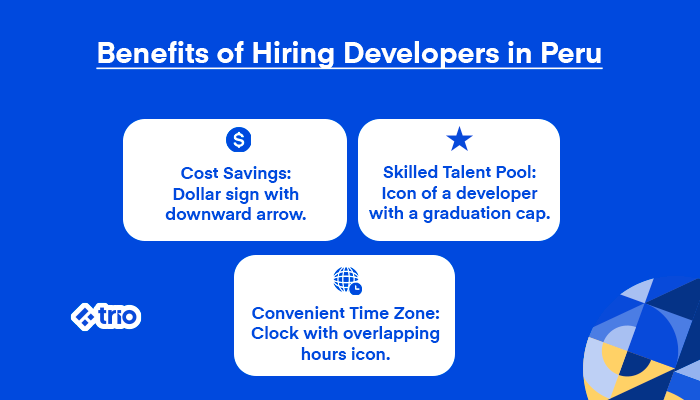
Hiring software developers in Peru offers a real combination of cost efficiency, growing technical depth, and workable timezone alignment for US companies willing to get the sourcing and compliance details right.
At Trio, we specialize in connecting companies with vetted Peruvian developers matched to both technical requirements and team fit.
Whether the need is a single developer or a full team, talk to us.