
Hire by Technology
SERVICES

Full-stack developers are in popular demand these days. Startups and small businesses looking to digitize their products look for full-stack developers to kick-start their product development.
The title itself is very appealing, as it implies that the developer is competent with working on both the front-end and back-end of an application.
Depending on the size and complexity of the application, this can be a major time saver. In other cases, a full-stack developer may slow things down a little if they have not worked on similar systems before.
It is not usually about talent as much as it is about timing, context, and whether the person can navigate both sides of the stack without losing momentum.
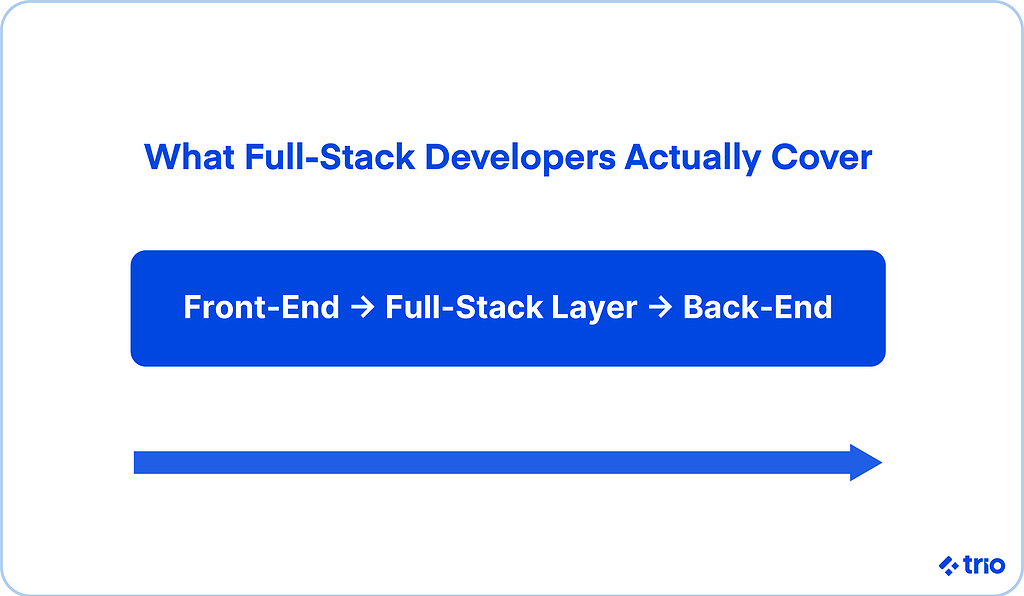
So what makes a full-stack developer particularly valuable to your development initiatives? What would they need to know in order to make your idea a reality?
Well, it depends on many factors, and full-stack developers aren't always in the position to make architectural decisions. That's a process for higher-level roles such as a software architect, VP, or even a CTO.
Does this mean that full-stack developers can't offer valuable insights? Of course not! Full-stack developers worth their salt have enough years under their belt to know their strengths and weaknesses.
They have also picked up some insights on what clean code and architecture actually mean, and are able to apply high-level principles to their work.
Unfortunately, good full-stack developers are hard to find.
Trio has invested time and resources into training software developers to think and work more like senior developers. Our clients enjoy a level of professionalism that many tech startups and SMBs miss out on.
That part of the equation still stands, but hiring teams may want to look for a few additional signals.
A strong full-stack developer today usually has some exposure to cloud services, an understanding of how their work fits into CI or CD pipelines, and at least a passing familiarity with modern JavaScript tooling.
I sometimes describe it as looking for someone who can tell you why a solution might work, but is also comfortable saying when it probably will not.
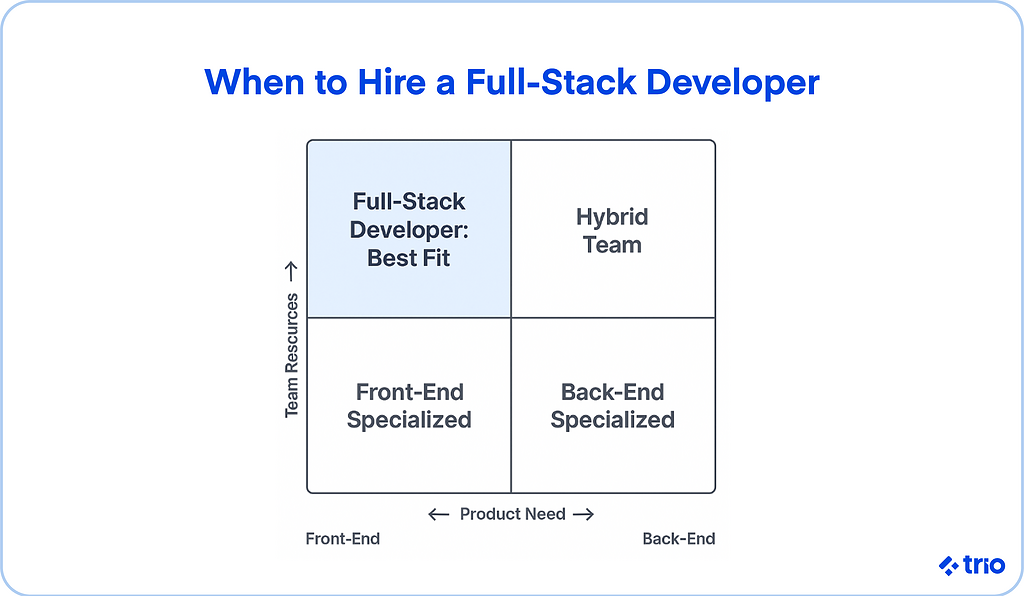
If you are building a team, it's common to hire at least one full-stack developer. If you are a startup and can only afford one developer on the project, the chances are you will need one. However, full-stack developers are humans with preferences and opinions, and therefore, not all are the same.
Full-stack essentially combines front-end and back-end expertise into one job role; however, a developer often will be stronger in one area than the other.
They will also enjoy one side of the process more than the other. As a manager, it's your job to take a hard look at the product you wish to build and determine what's more important, the front-end or the back-end.
If you are building a product that is highly visual and requires a UI that captivates your end-user, you will need a full-stack developer with considerable front-end knowledge. On the other hand, if your product is reliant on back-end technologies, then you will need a developer who loves back-end.
There is a middle ground that hiring teams occasionally overlook. Some products are neither visually complex nor backend-heavy.
They simply need someone who can get an MVP out the door without tripping over environment setup, deployment, or the strange bugs that appear only in production. A full-stack developer with a bit of DevOps awareness may save you more time than a beautifully specialized hire.
In the case that you have enough resources to hire 2-3 developers and make a small team, you can use the following combinations based on your needs.
Optimizing for back-end
Optimizing for front-end
If you are unsure where to start, a quick rule of thumb is to look at your next three months of work rather than the full roadmap.
Short-term priorities often reveal whether you need someone who can polish interfaces or someone who can untangle API or data flow issues.
Hiring a full-stack developer may look simple at first glance, but most founders eventually realize there are a few moving parts worth slowing down for. The steps below reflect what we often see in the field.
They are not rigid instructions, just a practical baseline that may stop you from picking someone who appears versatile but struggles once things get real.)
Some teams use the term loosely, and that can cause misaligned expectations.
Write down the frameworks or languages you plan to use, the repos or services the person will work with first, and whether they need experience with things like Docker, CI pipelines, or cloud functions. Even a short list helps.
This can feel obvious, but teams often skip it. If your product requires intricate UI behavior, pick someone with strong front-end instincts.
If your product revolves around data structures, integrations, or performance, you are probably leaning toward a backend-minded developer.
A simple process works fine for most smaller teams. It might include a resume check, a quick technical call, a short coding exercise, and a conversation about architecture.
Avoid making the process too long. Most full-stack developers will quietly walk away if the step count becomes unclear.
Full-stack engineers are often problem solvers by necessity. Ask questions that show how they break down issues, how they weigh tradeoffs, or how they navigate unfamiliar parts of the stack.
The person who admits uncertainty is usually more reliable than the person who sounds certain about everything.
Since full-stack developers often translate ideas between design, product, and engineering, see how clearly they explain decisions.
If they cannot talk through a concept with clarity, that may suggest trouble when things get complex.
Full-stack developers come in many different flavors, but perhaps the most common proficiency is JavaScript and technologies that use it. More on that later.
Many web applications can be summed up by their frameworks. There are a number of different application frameworks that all use different programming languages. Below are some popular ones:
Rails is a very popular framework developed by David Heinemeier Hansson. Developers can build applications with incredible speed compared to other frameworks like Java.
Rails include everything you need to create a database-driven application, using the MVC design pattern along with SQLite. Additionally, because it's built on Ruby, you have access to a vast gem library that can add further functionality to your application.
Language: Ruby
Framework Link: https://rubyonrails.org
Github Link: https://github.com/rails/rails
These days, teams using Rails also tend to lean on cloud services, background job systems, and testing libraries. When hiring, it often helps to check whether a candidate has shipped features in production rather than only walking through tutorials.
Django is the Python equivalent of Rails that follows the model-template-view architectural pattern. It encourages rapid development and clean, pragmatic design. For Python developers, it's the most popular framework in use next to Flask.
Language: Python
Framework Link: https://www.djangoproject.com
Github Link : https://github.com/django/django
Django developers who can also handle light front-end work or API tuning may save you days of integration time.
Many teams pair Django with React or a minimal front-end stack, which creates a nice rhythm between the two layers.
Related Reading: React Native Interview Questions
Angular is a framework by Google that helps developers build large-scale and high-performance web applications. It's also very opinionated when it comes to what design patterns it accepts; however, this isn't a bad thing.
Being a Google-backed framework, one can expect a level of care that has been given to building the framework.
Language: JavaScript
Framework Link: https://angular.dev
Github Link: https://github.com/angular/angular
If you choose Angular for your project, you may want a full-stack developer who genuinely enjoys structured systems.
Angular has its quirks, and developers who love it tend to be the ones who thrive inside those conventions rather than push against them.
Powered by Microsoft, ASP.NET is a high-performance and lightweight framework for building Web Applications using .NET. While it might not have the same level of appeal as JavaScript or Ruby frameworks, ASP.NET comes with a number of benefits as it extends the .NET Developer Platform and offers free hosting with Microsoft Azure.
It's a great choice for applications that want real-time bi-directional communication between the client and the server, microservices that live in Docker containers, and the ability to build out REST APIs for a range of clients, including browsers and mobile devices.
Language: C#
Framework Link: https://dotnet.microsoft.com/en-us/apps/aspnet
When evaluating ASP.NET developers, it can help to check whether they have experience with cloud deployment or containerized setups. The ecosystem often leans that way in real projects.
{ visibility: hidden; } #our-talent-section [data-bullet-list-item-wrapper].bullet-list-item-visible { visibility: visible; } #our-talent-section .bullet-list-item { display: flex; gap: 2.5rem; flex-direction: row; } #our-talent-section .bullet-list-image { width: 3rem; height: 3rem; flex-shrink: 0; background-color: var(--color-primary-200); border-radius: 0.6rem; padding: 0.5rem; align-items: center; justify-content: center; } #our-talent-section .bullet-list-image img { width: 100%; height: 100%; -o-object-fit: contain; object-fit: contain; } /*!---- TECH-PAGE-WHY-TRIO ----*/ #why-trio-grid { --border-color: var(--infinite-border-color); --border: 1px solid var(--border-color); --transition: 0.3s ease-in-out; display: grid; grid-template-columns: repeat(3, 1fr); grid-template-rows: auto auto auto; } #why-trio-grid #grid-item-01 { grid-area: 1/1/2/3; height: 166px; border-right: var(--border); } #why-trio-grid #grid-item-02 { grid-area: 2/1/4/2; border-top: var(--border); border-right: var(--border); } #why-trio-grid #grid-item-03 { grid-area: 3/2/4/4; height: 166px; border-top: var(--border); display: flex; flex-direction: column; } #why-trio-grid #grid-item-04 { grid-area: 1/3/3/4; display: flex; flex-direction: column; align-items: end; } #why-trio-grid #grid-item-05 { grid-area: 2/2/3/3; border-top: var(--border); border-right: var(--border); } #why-trio-grid .why-trio-grid-text-item { padding: 2.5rem; min-height: 10rem; } #why-trio-grid .why-trio-grid-central-item { width: 36.25rem; height: 20.625rem; background-color: var(--color-neutral-0); z-index: 20; pointer-events: none; } #why-trio-grid p, #why-trio-grid .why-trio-grid-cta { z-index: 10; } #why-trio-grid p { transition: color var(--transition); } #why-trio-grid .why-trio-grid-cta { opacity: 0; transform: translateY(-1rem); transition: opacity var(--transition), transform var(--transition); } #why-trio-grid #grid-item-03 .why-trio-grid-cta, #why-trio-grid #grid-item-04 .why-trio-grid-cta { align-self: end; } #why-trio-grid #grid-item-04 { display: flex; justify-content: end; } #why-trio-grid #grid-item-01, #why-trio-grid #grid-item-02, #why-trio-grid #grid-item-03, #why-trio-grid #grid-item-04 { position: relative; } #why-trio-grid #grid-item-01::before, #why-trio-grid #grid-item-02::before, #why-trio-grid #grid-item-03::before, #why-trio-grid #grid-item-04::before { content: ""; position: absolute; inset: 0; opacity: 0; background-color: var(--color-primary-600); transition: opacity var(--transition); z-index: 0; } #why-trio-grid #grid-item-01:hover::before, #why-trio-grid #grid-item-02:hover::before, #why-trio-grid #grid-item-03:hover::before, #why-trio-grid #grid-item-04:hover::before { opacity: 0.2; } #why-trio-grid #grid-item-01:hover p, #why-trio-grid #grid-item-02:hover p, #why-trio-grid #grid-item-03:hover p, #why-trio-grid #grid-item-04:hover p { color: var(--foreground-actionable); } #why-trio-grid #grid-item-01:hover .why-trio-grid-cta, #why-trio-grid #grid-item-02:hover .why-trio-grid-cta, #why-trio-grid #grid-item-03:hover .why-trio-grid-cta, #why-trio-grid #grid-item-04:hover .why-trio-grid-cta { opacity: 1; transform: translateY(0); } #why-trio-grid #why-trio-grid-central-image { position: absolute; bottom: 0; max-height: unset; max-width: unset; aspect-ratio: 456/331; } #why-trio-grid #why-trio-grid-central-image img { height: 100%; width: auto; -o-object-fit: contain; object-fit: contain; } /*!---- TECH-PAGE-ROUNDED-STATUS ----*/ .rounded-status.e-con { display: flex; flex-direction: row; align-items: stretch; position: relative; width: 100%; background-color: var(--color-neutral-50); border-radius: 0 0 1.5rem 1.5rem; overflow: hidden; } .rounded-status.e-con > .e-con-inner { display: flex; flex-direction: row; align-items: stretch; } .rounded-status.e-con:nth-child(1) .rounded-status-number { background-color: var(--color-primary-100); } .rounded-status.e-con:nth-child(2) { border-radius: 0 0 1.5rem; } .rounded-status.e-con:nth-child(2) .rounded-status-number { background-color: var(--color-secondary-500); border-radius: 0 0 1.5rem 0; } .rounded-status.e-con:nth-child(3) .rounded-status-number { background-color: var(--color-secondary-300); } .rounded-status.e-con .rounded-status-number { display: flex; justify-content: center; align-items: center; flex-shrink: 0; align-self: stretch; aspect-ratio: 1/1; min-width: 4.25rem; } .rounded-status.e-con .rounded-status-text { display: flex; flex-direction: row; align-items: center; padding: 0.625rem 1rem; } /*!---- TECH-PAGE-WHY-STAFF-TABS ----*/ #why-staff-tabs { width: auto; min-width: 12rem; } #why-staff-tabs li.elementor-icon-list-item a { padding: 0.62rem 0.75rem; color: var(--foreground); border-radius: 0.375rem; background-color: transparent; transition-property: color, background-color; transition-duration: 0.4s; transition-timing-function: ease-in-out; } #why-staff-tabs li.elementor-icon-list-item a.is-active, #why-staff-tabs li.elementor-icon-list-item a:hover { color: var(--foreground-actionable); background-color: var(--surface-hover-actionable-secondary); } #why-staff-tabs a[data-icon-right] > span { padding: 0 !important; } #why-staff-tabs a[data-icon-right] .elementor-icon-list-icon { order: 1; } #why-staff-tabs a[data-icon-right] { gap: 0.38rem; } .why-staff-augmentation-section { opacity: 1; transition: opacity 0.3s ease-in-out; } .why-staff-augmentation-section.is-hidden { opacity: 0; pointer-events: none; position: absolute; visibility: hidden; }/* End custom CSS */