

Hire by Technology
SERVICES


Fintech engineering roles take 45 to 120 days to fill through direct hire in 2026, well above the general software engineering benchmark of roughly 35 to 60 days.
The gap comes down to the rarity of domain knowledge.
Fintech teams need engineers who understand payment systems, KYC/AML workflows, and PCI DSS, not just people who can write clean code.
Let’s look at the time-to-hire benchmarks for fintech engineers so you can get a better idea of how long in advance you need to start looking for the right people so you don’t end up lacking talent as you approach regulatory deadlines or product releases.
Specialist fintech staffing partners can bring that down to 3 to 5 days by giving you access to talent that is already vetted and guaranteed to have production experience in financial environments.
From what we have observed, the average time-to-hire for a general software engineer is somewhere in the 35 to 60 day range, depending on seniority and how the metric gets measured.
Of these general roles, senior and staff-level roles tend to land at the higher end of that, sometimes pushing past 60 days on their own.
For fintech, that range is closer to a starting point than a ceiling, and four structural factors explain why.
A senior backend engineer with solid Node.js or Java experience isn't hard to find, whereas a senior backend engineer who's actually built payment retry logic with correct idempotency handling, or designed a KYC pipeline as a proper state machine rather than a status flag, is a much rarer find.
Every additional domain requirement, like PCI DSS scope management, AML transaction monitoring, or ledger reconciliation, narrows that pool a bit more.
When you stack a whole bunch of specific requirements together, they eliminate most of the general engineering candidate pool before a recruiter even starts sourcing.
Many of our clients have commented that hiring teams are conducting noticeably more interviews per hire than they were a few years ago.
This is partly because companies are being more deliberate about who they bring on.
In fintech, that extra scrutiny gets doubled up.
A candidate has to clear a general engineering bar and a domain-knowledge bar.
Fintech teams often have a PCI DSS audit, a Fedwire ISO 20022 migration, or a DORA operational resilience requirement sitting on the calendar.
None of those deadlines make more qualified candidates appear. Instead, we see companies settling for someone who isn't quite ready, or the work gets piled onto whoever's already there.
Larger platforms are prioritizing compliance readiness alongside scalable infrastructure, which puts them in competition for the same narrow slice of engineers who can do both.
Compliance and regulatory engineering talent has been described as one of the most consistently undersupplied functions in fintech right now, and with DORA already in force across the EU and MiCA continuing to expand the regulatory perimeter, demand on both sides of the Atlantic isn't easing up anytime soon.
The table below estimates realistic time-to-hire figures for fintech engineering roles through direct internal hiring. These numbers apply the domain-knowledge filter to general software engineering benchmarks and adjust for what we're seeing in the 2026 market.
| Role Type | Junior (0–2 yrs) | Mid-level (2–5 yrs) | Senior (5+ yrs) | Domain Difficulty |
| General backend (payments-familiar) | 30–45 days | 40–60 days | 55–80 days | Moderate, large general pool, but the domain filter still applies |
| Payment systems/ledger engineer | 40–55 days | 55–75 days | 70–100 days | High, requires idempotency, reconciliation, and decimal precision depth |
| KYC/AML engineer | 45–60 days | 60–80 days | 75–110 days | High, combines regulatory knowledge with engineering depth |
| PCI DSS / security-aware engineer | 40–55 days | 55–75 days | 70–100 days | High compliance posture plus an engineering background are needed |
| Fraud detection/ML engineer | 50–70 days | 65–90 days | 85–120 days | Very high, ML expertise plus fintech context plus production experience |
| AI/ML credit scoring engineer | 55–75 days | 70–95 days | 90–120+ days | Very high, same constrained pool driving long AI/ML timelines industry-wide, with the fintech layer on top |
| Fintech DevSecOps/compliance CI/CD | 45–60 days | 60–80 days | 75–110 days | High, needs DevSecOps skills plus PCI DSS scope in the CI/CD pipeline |
Two other hiring models change the math considerably.
| Hiring Model | Typical Timeline | Domain Vetting | Fintech Specificity |
| Direct internal hire | 45–120+ days | Happens during the process, which extends the timeline | Depends entirely on whether the recruiter has fintech context |
| General staffing agency | 25–50 days | Minimal, often just candidate self-reporting | Rarely strong, most agencies don't assess fintech domain knowledge |
| Specialist fintech partner (Trio) | 3–5 days | Done before the candidate is ever presented | Built in, since the firm works exclusively in fintech |
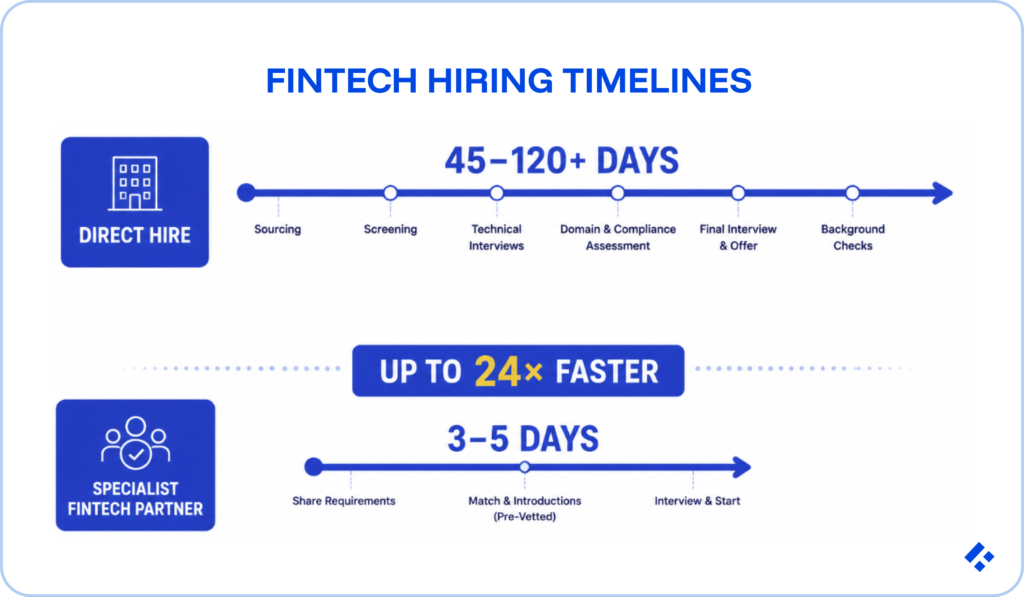
An agency can move faster than direct hire because it's pulling from a pool that already exists.
The catch is that most general agencies can't tell the difference between a candidate who says they have "payments experience" because they understand idempotency and reconciliation, and one who says it because they once wired up a Stripe integration.
The specialist fintech partner model front-loads the vetting instead of deferring it.
Trio, for example, maintains a pool of LATAM-based fintech engineers who've already been assessed against five core domain competencies: monetary precision (storing amounts as integers, not floats), payment idempotency, KYC state machine design, PCI DSS scope management, and general regulatory awareness.
For a fintech company, the consequences of running a regulated engineering team short-staffed go well beyond what you're not paying in salary.
Here's how that cost actually breaks down in a fintech context:
Putting some rough numbers on this, here's what a vacancy might look like at 30, 60, and 90 days for a senior engineer at around $175,000:
| Vacancy Duration | Direct Salary Cost | Overload + Velocity Cost (est.) | Compliance Risk |
| 30 days | ~$14,400 | $10,000–$25,000 | Low to moderate |
| 60 days | ~$28,800 | $20,000–$50,000 | Moderate to high |
| 90 days | ~$43,200 | $30,000–$75,000 | High, most fintech compliance cycles run quarterly |
These overload and velocity figures are estimates, since they depend heavily on team size and how much slack exists elsewhere.
But even at the conservative end, a 60-day vacancy in a senior role can realistically run somewhere in the $50,000 to $80,000 range once you add everything up.
Instead of trying to hire as fast as possible, focus on removing dead time, the gaps in the process where nothing productive is happening but the calendar keeps moving.
Spelling out the actual requirements upfront (payment idempotency knowledge, KYC state machine experience, PCI DSS scope work) cuts down the volume of candidates who self-select based on a vague "financial services" label but don't have the specific depth.
The more specific you get, the fewer applications you will have to sift through, which may not have the right skills.
Adding a four-person hiring committee can stretch what should be a 72-hour feedback loop into 7 to 10 days, just from scheduling.
Trimming the committee down to the minimum needed for each stage and using automated scheduling tools removes a surprising amount of this.
Running a candidate through general coding assessments before checking their fintech domain knowledge wastes interview slots.
Putting the domain assessment earlier in the sequence means you filter on the thing most likely to disqualify someone before investing more time.
The teams that seem to manage fintech hiring well start looking before they have to.
Teams that keep an active pipeline running, or maintain a relationship with a specialist partner who already has one, can fill roles in days rather than months when the need actually shows up.
Given everything above, here's roughly how to think about which model fits your situation.
Use direct internal hiring when your timeline is 60+ days and reasonably flexible, the role is junior-to-mid general backend without an acute domain specialization requirement, you've got an internal recruiter who actually understands fintech and an active pipeline already, or you're building toward long-term team composition where cultural fit matters as much as the skill match.
Use a general staffing agency when your timeline sits in the 30 to 50 day range, the role is mid-level general backend where you're comfortable doing the domain vetting yourself, and you have a process in place for assessing that domain knowledge once candidates start coming through.
Use a specialist fintech partner when your timeline is under 30 days, or tied to a compliance deadline, the role needs real fintech specialization (payments, KYC/AML, fraud or ML), you need certainty on domain competency before someone starts rather than discovering gaps during onboarding, or you want to stop the vacancy clock while a longer internal search runs in the background.
At Trio, we maintain a pre-vetted pool of LATAM fintech engineers, assessed against the five domain competencies covered earlier (monetary precision, payment idempotency, KYC state machine design, PCI DSS scope management, and regulatory awareness).
Since these developers are already vetted, they can be placed in as little as 3 to 5 days. All you need to do is the final interview.
And, thanks to our LATAM sourcing, you don’t have to deal with massive time-zone gaps like you would in other outsourcing agreements.
This is embedded staff augmentation, so the engineer becomes part of your team, working in your sprint under your compliance processes, rather than someone whose domain knowledge leaves with the contract when the engagement ends.
Rates run $40 to $80 an hour, or roughly $7,000 to $14,000 a month, depending on what you need, with replacement guarantees.