

 Read Client Stories




 Alex Kugell
 Key Takeaways
- Fintech QA should be budgeted at 25–35% of total development cost, compared to 20–30% for general software.
- The first-year QA investment for a seed-stage fintech building a payment-enabled product typically reaches $80K–$150K.
- KYC state machine testing costs $20K–$45K to build and carries the highest ongoing maintenance cost (20–25% annually) because KYC regulatory requirements evolve continuously.
- Playwright-based test automation for a payment-enabled fintech product costs $15K–$40K to set up correctly.
- The hidden cost of poorly architected automation suites runs $75K–$120K/year in senior developer time for a 10-engineer team.
Fintech QA costs 25–35% of the total development budget. This is considerably higher than the 20–30% general software benchmark.
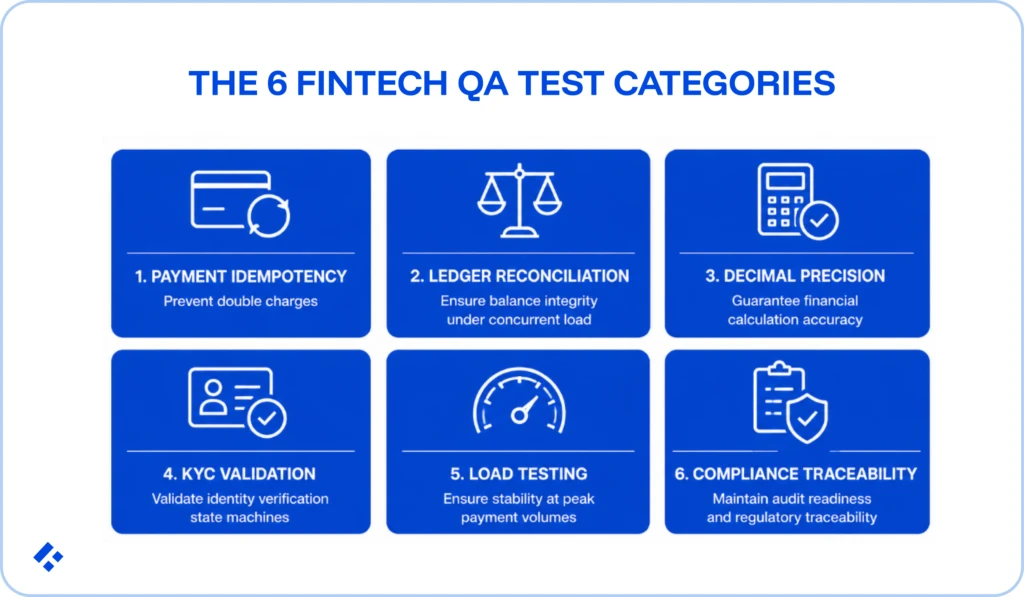
This is largely due to 6 fintech-specific test categories:
- Payment idempotency edge cases.
- Ledger reconciliation under concurrent load.
- Decimal precision regression.
- KYC state machine validation.
- Compliance traceability overhead.
- Load testing calibrated to peak payment volumes.
Each adds a cost that standard QA budgets don’t account for. Failing to budget correctly leads to misallocated funds, which end up forcing you into tech debt that shows up during compliance audits or results in costly client remediation and loss of reputation.
This article prices each fintech-specific test category, provides a complete QA budget model by company stage, and explains where the typical fintech QA underinvestment occurs.
At Trio, our QA developers are pre-vetted for fintech production experience and can assist you in the relevant testing both retrospectively and throughout the development process.
Why Fintech QA Costs More Than General Software QA
General software QA benchmarks (20–30% of development budget) apply to products where a production bug degrades user experience, but nothing else.
Fintech QA benchmarks run higher because a production bug may simultaneously degrade user experience, double-charge customers, corrupt ledger balances, violate AML monitoring obligations, or trigger a regulatory finding.
Since these are unique to fintech, the test coverage required to prevent them doesn’t appear in general QA frameworks either.
- Failure modes carry financial and regulatory consequences: A broken UI component costs the user experience. An idempotency failure in a payment retry costs real money.
- Compliance traceability adds overhead to every test cycle: Regulated fintech environments require documented traceability between test cases and the regulatory requirements they validate.
- Test data management is expensive and constrained: Testing a payment system requires realistic financial data in the form of transaction histories, account states, and card-like numbers that cannot be production PII. Synthetic test data that accurately reflects production distributions requires active engineering to create and maintain.
- External system integration complexity multiplies edge case surface: A fintech product integrates with PSPs, banking aggregators, card networks, KYC providers, and AML screening services, requiring purpose-built test infrastructure that general API testing tools don’t provide.
The 6 Fintech-Specific Test Categories (and What Each Costs)
As we have already mentioned, six test categories in fintech require purpose-built suites that general software QA frameworks don’t generate automatically.
Each adds to the QA budget above the general software baseline because the failure modes being guarded against are different from anything a general testing approach anticipates.
1. Payment Idempotency Testing
Idempotency testing validates the payment retry scenario.
This is where a charge is processed at the PSP, but the confirmation response is lost in transit, and without a correct idempotency implementation, the customer gets double-charged on retry.
Testing this failure mode requires deliberately triggering it by simulating PSP acknowledgment without database write completion. You need to verify that the retry produces a record lookup rather than a new charge.
This isn’t a standard API integration test, since it requires infrastructure that can simulate partial failures at specific points in the payment execution sequence, namely, between PSP confirmation and database write, between webhook receipt and processing, and between ledger entry and confirmation response.
Building that infrastructure requires QA engineers who understand payment system architecture.
What it includes:
- Infrastructure for injecting failures at specific payment pipeline stages.
- Test cases for every retry scenario (client timeout, network failure, PSP partial response).
- Test cases for concurrent payment submissions (same customer, same amount, close timing).
- Regression coverage to verify idempotency holds after every code change that touches the payment flow.
Typical cost to build: $15K–$35K in engineering time (3–6 weeks of senior QA or backend engineering).
Annual maintenance: 10–15% of initial build cost.
What it prevents: Customer double-charge incidents costing $50–$500 per affected transaction in remediation, plus regulatory scrutiny overhead.
2. Ledger Reconciliation Testing Under Concurrent Load
Ledger reconciliation testing verifies whether the financial ledger maintains integrity under concurrent write load.
It checks for correct balances, ensures no floating-point arithmetic errors, and makes sure there is no race condition balance drift.
A ledger that balances correctly in single-threaded testing may produce discrepancies under the concurrent write patterns of real production traffic.
What it includes:
- Load scenarios at 2×, 5×, and 10× expected peak concurrency.
- Balance sheet assertions after each scenario.
- Concurrent write conflict detection (optimistic locking validation).
- Partial failure scenarios (transaction initiated, interrupted before commit).
Typical cost to build: $10K–$25K initial (2–4 weeks of QA and DevOps engineering for test infrastructure).
Load test infrastructure: $500–$2,000/month in cloud compute during active test cycles.
3. Decimal Precision Regression Testing
Decimal precision testing covers every financial calculation path in the codebase for floating-point arithmetic errors.
This specific failure occurs because monetary amounts stored as FLOAT or DOUBLE cannot represent many decimal fractions exactly in IEEE 754 arithmetic.
Testing for it requires QA engineers who know how to look for it, test cases designed around specific IEEE 754 edge cases, and coverage across every calculation path.
What it includes:
- Test cases for edge-case decimal amounts (0.1, 0.2, 0.3, and specific amounts that expose IEEE 754 error accumulation).
- Multi-currency conversion precision regression with rounding rules per currency.
- Fee calculation precision tests across transaction volume.
- Coverage for every arithmetic path in the codebase.
Typical cost to build: $8K–$18K (1.5–3 weeks of senior QA engineering), largely as a one-time investment with low ongoing maintenance costs.
4. KYC State Machine Validation
KYC state machine testing covers the completeness and correctness of the identity verification lifecycle.
Specifically, it ensures that every state transition is tested, invalid transitions are rejected, EDD triggers fire correctly, and ongoing monitoring re-screens customers when risk indicators change.
A kyc_verified boolean has two states and two tests.
A proper KYC state machine with 8–12 states, multiple valid and invalid transition paths, and ongoing monitoring triggers has hundreds of test scenarios.
Missing test coverage for an invalid KYC state transition is a regulatory gap that surfaces in an AML examination, often 12–18 months after the code was written.
What it includes:
- Coverage for every valid state transition with boundary conditions.
- Coverage for every invalid transition (must be rejected, must produce an audit record).
- EDD trigger tests (transaction patterns, PEP screening hits, high-risk jurisdiction flags).
- Ongoing monitoring re-screening tests, including sanctions list update propagation.
- Regression coverage after every KYC state machine code change.
Typical cost to build: $20K–$45K (3–7 weeks of senior QA and compliance-aware engineering).
Annual maintenance: 20–25% of initial build cost.
5. Load Testing Calibrated to Payment Peak Volumes
Payment load testing verifies system behaviour under the load patterns specific to payment processing, like massive spikes around weekends and holidays.
General load testing generates uniform requests, while payment load testing requires realistic transaction volume distributions, correlated spike scenarios, and SLO validation against financial thresholds.
What it includes:
- Spike scenarios calibrated to the product’s specific peak patterns.
- Steady-state baseline tests at 1× and 3× expected average load.
- Payment API latency SLO validation (p50, p95, p99).
- Authorisation success rate under load (target: >99.5%).
- Database connection pool exhaustion tests.
- PSP rate limit behaviour under peak load.
Tooling: k6 (open source, preferred for scripting complexity), Gatling (JVM-based, preferred for enterprise), Artillery (lightweight, API-focused).
Typical cost: $10K–$25K initial build. $500–$3,000/month for load generation infrastructure during test campaigns. $5K–$15K per quarterly load test campaign ongoing.
6. Compliance Traceability and Audit Evidence Testing
Compliance traceability testing verifies that the system’s audit trail is complete, correct, and queryable.
You need to confirm that every logged record needs to contain the fields required by the applicable compliance framework (PCI DSS, SOC 2, SR 11-7) and ensure that the log infrastructure functions as a compliance control.
It requires engineers who understand the regulatory requirement being tested, who understand what immutability looks like.
What it includes:
- Test coverage mapped to specific compliance requirements (PCI DSS, SOC 2, SR 11-7).
- Log field completeness assertions per framework.
- Immutability testing (attempted record modification must fail at the database level).
- Log retention policy validation.
- Query performance testing for audit log retrieval (regulators generally expect sub-5-second responses).
Typical cost to build: $12K–$28K (2–4 weeks of QA and compliance-aware engineering).
Annual maintenance: $5K–$15K/year as compliance requirements evolve.
The Automation Investment: Build Cost, ROI, and the Automation Tax
Without automation, a fintech regression cycle takes roughly 10 working days of manual testing.
However, with a properly built automation suite, the same cycle can run in approximately 3 hours, with 2 days of residual exploratory testing.
This means that each regression cycle saves approximately 7 working days of QA engineering time, which at a LATAM nearshore rate of $50–$80/hr translates to $2,800–$4,480 per cycle.
At bi-weekly releases, automation pays for its initial build cost within as little as 4–6 months.
Automation framework comparison (2026):
| Framework | Licensing | Best for | Fintech suitability |
| Playwright | Free (open source) | Web UI, API, cross-browser | Best overall. 42% faster than Selenium, 67% fewer flaky tests per TestDino 2025. Actively maintained. |
| Cypress | Free; Cloud $67+/month | Web UI, component testing | Strong for UI, but limited to Chrome-based browsers without the Cloud tier. |
| Selenium | Free (open source) | Web UI, legacy browser support | Mature but 2× flakier than Playwright. Highest maintenance overhead. |
| Appium | Free (open source) | Mobile (iOS/Android) | Standard for mobile fintech. Requires device farm (BrowserStack $15–$100/month) |
| REST Assured / Postman | Free / $14–$149/month | API testing | Essential for payment API regression. |
| k6 | Free; Cloud from $49/month | Load testing | Best developer experience for payment load test scripting. |
Initial automation investment
While the automation framework itself carries a cost, you also need to take into account the engineering investment in setting up this automation.
For example, setting up a Playwright-based test automation framework for a payment-enabled fintech product costs $15K–$40K in engineering time (2–6 weeks of senior QA automation engineer).
This cost covers framework architecture, CI/CD integration, test data management, parallel execution configuration, and a first regression suite covering core payment and KYC flows.
The cost of poorly architected automation suites
A poorly architected automation suite increases your need for maintenance at the senior engineer level.
When tests fail intermittently or break on UI changes, junior QA engineers escalate to senior backend engineers, who end up spending time on test maintenance rather than feature development.
This maintenance concentration can cost $75K–$120K/year in senior developer time for a 10-engineer team.
Alternatively, investing $15K–$30K in a QA architect for the first 2–3 months of framework setup saves 30–50% on long-term maintenance by producing a correctly structured framework from the start.
Annual automation maintenance
Beyond the initial costs, we recommend that you budget 15–25% of initial test suite build costs for maintenance.
A $30K initial framework requires $4,500–$7,500/year in ongoing maintenance engineering.
Total QA Budget by Company Stage
The QA budget for a fintech product combines QA engineering labour, test tooling and infrastructure, and the six fintech-specific test category builds.
Here is what that looks like when you use LATAM nearshore rates for engineering labour:
| Cost component | Seed | Series A | Series B |
| QA engineering labour | 0.5 FTE: $1.5K–$3K/month | 1–2 FTE: $3K–$8K/month | 3–5 FTE: $8K–$20K/month |
| Automation framework + CI/CD | $10K–$20K one-time | $20K–$40K build + expansion | $40K–$80K build + scale |
| Payment idempotency test suite | $15K–$25K | $20K–$35K | $30K–$50K |
| Ledger reconciliation + load testing | $10K–$20K | $15K–$30K | $25K–$50K |
| KYC state machine test suite | $15K–$30K | $20K–$40K | $30K–$60K |
| Compliance traceability testing | $8K–$15K | $12K–$25K | $20K–$40K |
| Test tooling (BrowserStack, Postman, k6) | $200–$500/month | $500–$2K/month | $2K–$5K/month |
| Load test infrastructure | $500–$1K/month | $1K–$3K/month | $3K–$8K/month |
| QA as % of dev budget | 25–30% | 25–35% | 28–35% |
The Cost of Not Investing in QA
QA is expensive, but the fintech QA investment case is stronger than in most other industries. Production defect costs carry real financial consequences:
- Idempotency failure (double charge): $50–$500 per affected transaction in customer remediation (refunds plus support cost).
- Ledger precision error discovered in audit: $30K–$100K in forensic accounting and remediation engineering to reconstruct correct balances and correct historical records.
- KYC state machine defect surfaced in AML examination: $50K–$200K in remediation engineering plus regulatory response cost.
- Payment processing failure under peak load: Thousands of dollars in losses per hour of downtime at growth-stage scale, plus SLA penalties to banking partners if availability commitments are breached.
The Fintech QA Team: What Domain Knowledge Actually Costs
Everything we have mentioned requires QA engineers who understand fintech domain conventions, not just test framework operation.
A QA automation engineer who can write Playwright tests for a general web application cannot necessarily design an idempotency test suite for a payment retry scenario.
This means you will either need to put each candidate through an extensive fintech screening process or provide 4–8 weeks of fintech ramp-up time before they can contribute.
The QA engineering profiles that a fintech product needs
Here are the different roles that you will need to fill:
- QA Automation Engineer with payment domain knowledge: Designs and implements the payment idempotency and ledger reconciliation test suites and understands payment pipeline architecture.
- QA Engineer with compliance traceability experience: Writes the compliance requirement-to-test-case mappings, validates audit trail completeness, and maintains the traceability documentation required for SOC 2 and PCI DSS evidence. This person needs to understand both the test framework and the specific regulatory requirements you fall under.
- Performance/Load Test Engineer: Designs and executes load scenarios calibrated to payment peak volumes. This engineer often operates as a shared resource across your teams.
Most seed-stage fintechs that we have worked with have none of these profiles in-house and end up with massive testing debt that inevitably surfaces in the first production incident.
By the time they start hiring, the cost is already elevated, with timelines that do not allow for conventional hiring or ramp-up time.
Trio places pre-vetted QA engineers and software engineers who write compliance-aware tests from the start, preventing unnecessary tech debt, and dealing with it as quickly and efficiently when they are brought on to your teams.
Since our developers are pre-vetted, they simply need to be matched to you based on your requirements and can be placed in as little as 3-5 days.