
Hire by Technology
SERVICES



Nvidia has reportedly agreed to pay $12.9 billion for a company most people outside AI development have never heard of.
The deal isn’t signed yet, and there is still time for the whole thing to fall apart, but the fact that it has gotten this far at all can teach us a lot about how tech giants are thinking, and what the future of the industry may hold.
Let’s take a look at what Hugging Face does and why a chipmaker wants to own it.
At Trio, our developers sit at the forefront of the industry and are able to keep an eye on exactly these kinds of developments, so they are prepared for rapid changes in user expectations and regulations in regulated fields like fintech.
Hugging Face runs an open-source platform where developers and researchers share, download, and run AI models, datasets, and demos.
It’s all free, and you don’t even need an account to browse for the most part.
The comparison to GitHub shows up often, and really makes sense. GitHub is where people share code; Hugging Face is where people share trained models and the data used to build them.
Founded in New York in 2016 by Clément Delangue, Julien Chaumond, and Thomas Wolf, Hugging Face started as a consumer chatbot app, nothing like what it's known for today.
The name itself comes from the 🤗 emoji, which the founders picked for that early chatbot to signal something approachable rather than clinical.
Their first step in their current direction occurred when the founders open-sourced the code behind the chatbot, which eventually became the actual business. Over the years, it’s grown to be the infrastructure layer that a huge share of modern AI development now runs on.
So how does this company actually earn money? Hugging Face isn't open-source top to bottom.
What's actually open is the content sitting on top of that infrastructure, the millions of user-contributed models and datasets anyone can download and use freely. The company's own infrastructure and some enterprise features stay proprietary, allowing them to generate revenue.
The Hub has grown incredibly quickly, with more than a million models added between 2025 and 2026, alongside hundreds of thousands of datasets.
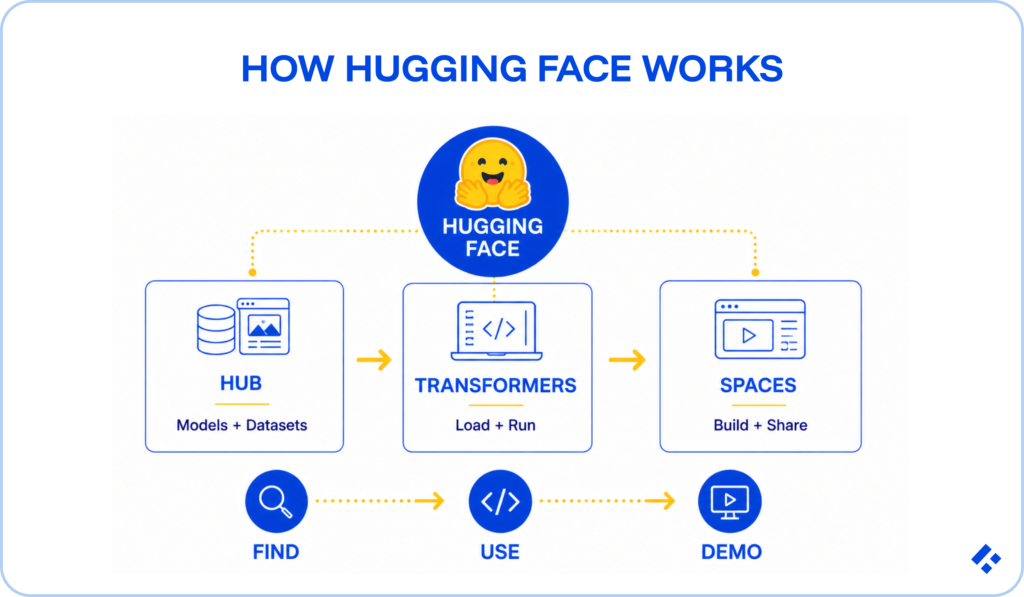
One possible reason for this is the fact that the Hub itself functions as the repository, a place to upload, browse, and download models.
The second possible reason is the Transformers library, a Python package that lets a developer load and run one of those models with a small amount of code rather than building the surrounding infrastructure from scratch.
A third piece, Spaces, gives developers a place to build and share interactive AI-powered demos directly, without needing separate hosting.
Hugging Face serves a wide range of users:
The platform supports both major machine learning frameworks, PyTorch and TensorFlow, which keeps it from locking users into one technical approach.
Realistically, training a serious model from scratch takes serious money and dedicated infrastructure, often more than a small team or an individual researcher has access to. Hugging Face removes a meaningful chunk of that barrier by making pre-trained models available.
According to reporting from The Information, Nvidia has agreed to acquire Hugging Face for $12.9 billion. As we have already mentioned, the deal hasn't been formally signed as of August 2026.
The price is striking. Hugging Face’s annualized revenue climbed from roughly $100 million to about $150 million in just two months this year. That would put the price at roughly 80 times current revenue.
That kind of multiple would not make sense under normal circumstances, and signals a strategic bet. Nvidia isn't just buying a business, but influence over the infrastructure the open-source AI world runs on, which would be greatly beneficial for Nvidia's own business.
Developers downloading open-source models from Hugging Face need somewhere to run them, and that usually means Nvidia GPUs.
As major AI labs increasingly build their own custom chips to reduce dependence on Nvidia, a thriving open-source ecosystem may keep a meaningful share of the market anchored to Nvidia hardware regardless of what the biggest labs decide to do.
Hugging Face already runs its own paid hosting and compute services too, which would hand Nvidia a path back into cloud computing.
None of this really appeared out of nowhere either. Google, Amazon, and Nvidia had all already made strategic investments in Hugging Face before acquisition talks became public, so this builds on an existing relationship.
Hugging Face has functioned as neutral, broadly accessible infrastructure, and a lot of teams have built dependencies on that neutrality without fully realizing it.
If a major AI infrastructure company ends up owned by a major hardware company, questions about pricing, access, and long-term platform priorities start to matter quickly.
This connects to a broader pattern in the same market.
Weeks before this news, Stripe closed its own roughly $7 billion acquisition of OpenRouter, another piece of AI infrastructure sitting between developers and the models they call.
The infrastructure layer of AI is consolidating fast, and the terms a team builds against today may not be the terms available in a year.
For fintech teams specifically, this matters because models pulled from an open hub like Hugging Face increasingly power fraud detection, customer-facing chat, and document processing inside regulated products.
A shift in who controls that hub, or how it's priced and governed, is exactly the kind of dependency to review before it becomes urgent rather than after.
Our developers, with several years of experience, can help set you up for success, taking all of these factors into account.
To see if we have the specialist for you, book a consult.