

 Read Client Stories




 Alex Kugell
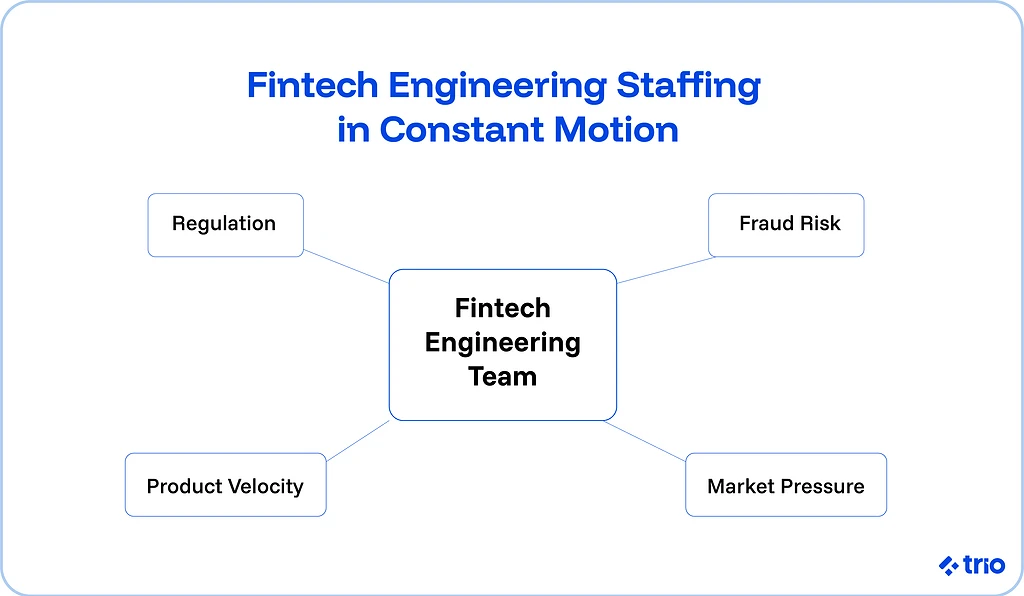
Finding engineering talent in fintech may feel a bit like trying to keep your footing on shifting ground.
Regulations evolve, fraud patterns change, and new financial technologies appear fast enough that teams barely have time to adjust their roadmaps.
You are expected to hire quickly without sacrificing compliance, stability, or user trust. It is no surprise that fintech companies often turn to specialist recruitment partners or fintech recruiters who promise to ease the pressure.
Some partners do a decent job. Others force you through long interview cycles or send candidates who barely understand payments or risk management.
The noise in the market may leave you wondering what a genuinely effective fintech engineering staffing solution looks like.
Why fintech hiring strains most teams
Fintech startups and scaleups compete with global fintech giants, financial institutions trying to modernize, and niche apps that sprint through product cycles.
Those conditions shape every part of the hiring process.
The pressures behind the struggle
- Compliance expectations tighten as products touch regulated data.
- Candidates often lack real experience with financial technologies.
- Fraud and risk management concerns introduce added scrutiny.
- Hiring timelines clash with roadmaps that shift weekly.
Even blockchain work is rarely simple.
Teams need people who understand security principles and operational considerations, not just enthusiasm for the concept.
The mismatch becomes obvious once interviews begin.
Many candidates can explain a typical API call but struggle to reason about reconciliation, settlement, or how a lending model can influence downstream data.
This is where fintech firms often burn time restarting searches from scratch.
What strong fintech recruiters bring to the table
A recruitment team with real industry expertise tends to evaluate candidates differently.
They filter for engineers who can build inside regulated systems, collaborate with compliance officers, and support features that handle financial data with care.
A capable partner knows how to spot subtler issues, like limited exposure to risk controls or too little experience with secure architectural patterns.
Those weaknesses matter when you are building authentication layers or deciding whether a new feature could expose an operational risk.
Good recruiting services avoid the typical drag of the hiring process.
Instead of flooding your inbox with resumes, they slow down long enough to ensure candidates align with your company’s expectations, both technically and contextually.
When fintech staffing breaks down
Most teams can recall moments when staffing did not go well.
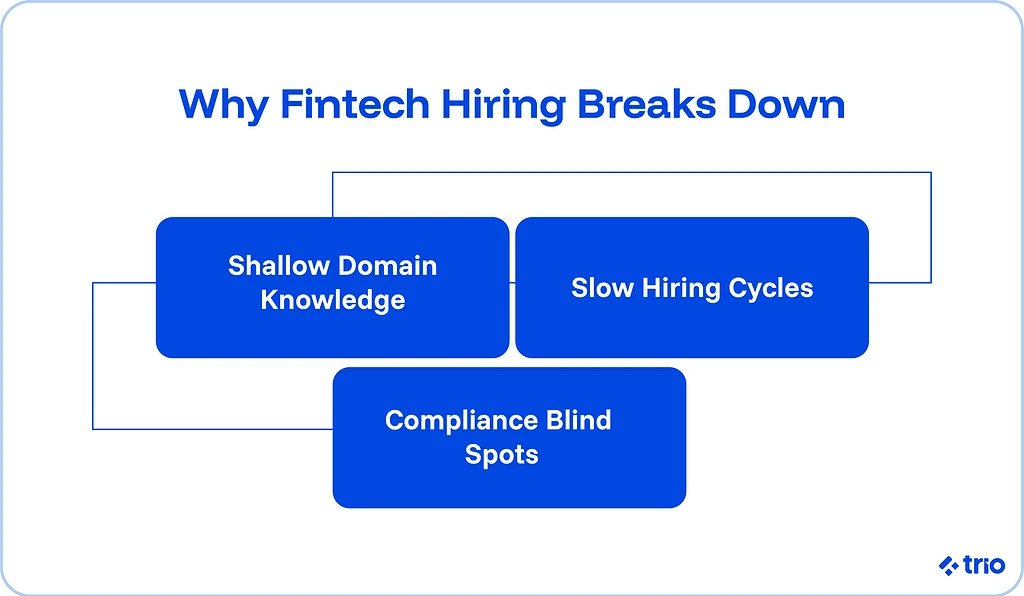
You invest cycles into interviews only to discover the candidate has never dealt with regulatory requirements. Or a generalist recruiter brushes aside the realities of compliance because they believe engineering is engineering everywhere.
These patterns usually appear when staffing firms lack a deep understanding of the financial technology industry.
You feel it when they repeatedly ask for clarification about basic workflows or when you must remind them why even minor errors in financial services can create expensive failures.
Delays take a toll. Onboarding slows. Timelines stretch. Fintech projects fall behind. And the cost of fixing rushed hiring can be far higher than the cost of doing it right.
Skills that separate strong fintech engineers
Fintech engineers need more than technical skills. They need situational awareness shaped by regulated environments.
This often includes experience with:
- Financial data structures and reporting chains.
- Risk management patterns that protect user funds.
- Secure system design that withstands audits.
- Cross-functional decision making with compliance and operations.
A typical software engineering hire may understand distributed systems, yet still struggle to evaluate a payment settlement flow or loan underwriting logic.
Those gaps slow progress and introduce risk.
The goal is to secure the right talent who can maintain product momentum without exposing the company to compliance or operational issues.
What a specialized fintech recruitment partner actually does
Specialized fintech recruiting supports your team by aligning the entire hiring process with the realities of regulated systems.
This includes screening for industry experience, testing reasoning in financial contexts, and understanding which roles require depth in payments, digital banking, lending, wealthtech, or blockchain components.
When the partner is doing their job well, you feel it immediately.
Interview rounds shrink. Candidate quality rises. Your team spends less time explaining basics and more time evaluating genuine strengths.
Recruitment services that focus on fintech talent also help you balance the workload across engineering, compliance, infrastructure, and product.
Hiring needs tend to shift quickly within fintech, so flexibility and clarity matter just as much as technical skill.
Where Trio fits into fintech engineering staffing
This is where Trio tends to stand out.
We work exclusively within fintech and screen engineers for regulatory awareness long before an interview ever reaches your team.
Our talent pool includes people who already understand payments, lending, identity, banking logic, and the compliance expectations that shape how financial institutions operate.
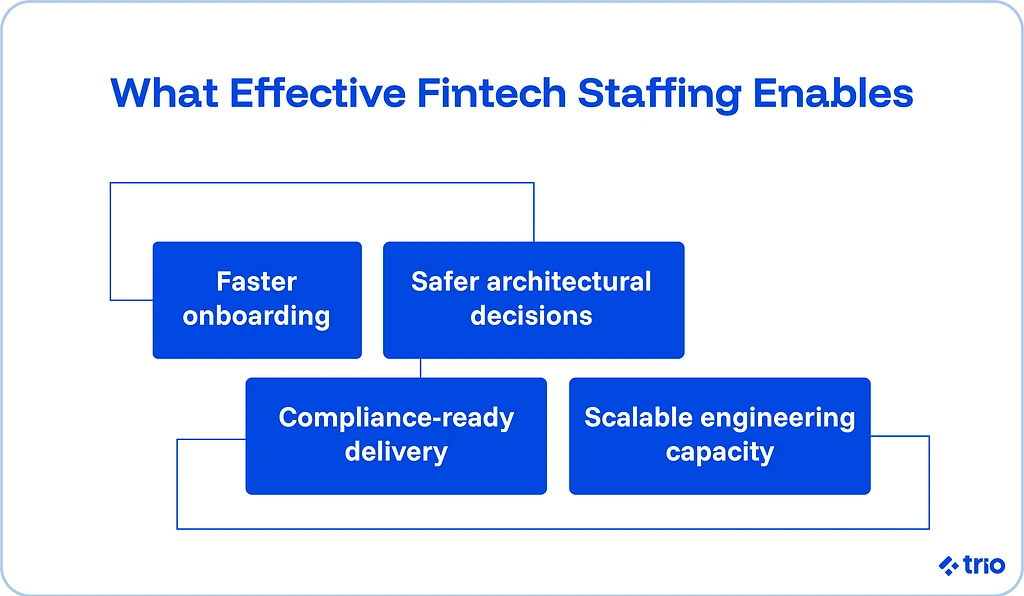
That focus means Trio engineers usually arrive ready to work with minimal onboarding.
They step into existing architectures, contribute during audits, and support teams under pressure to stay ahead of competitors. For leaders dealing with unpredictable hiring cycles, that level of readiness can feel like a relief.
Trio also adapts to shifting headcount needs.
Some fintech companies use our support during build sprints. Others rely on us during compliance reviews or major integrations.
The model is flexible enough to scale capacity up or down without slowing delivery.
How to evaluate the right candidates inside fintech
Identifying the right fintech professionals requires deeper evaluation than typical interviews.
You may get a clearer view of a candidate’s fit by discussing real challenges like:
- Handling sensitive user data across APIs.
- Designing systems that maintain audit trails.
- Working with external payment partners.
- Navigating financial regulations without creating bottlenecks.
- Responding to fraud signals or operational incidents.
These questions may reveal whether a candidate can support fintech hiring goals in the real world. They also expose whether someone has practical experience or only surface-level exposure to financial services.
Some teams also benefit from exploring how a candidate collaborates with non-technical groups.
Engineers who have worked with compliance officers, finance teams, and business partners usually flourish in fintech startups where everyone must stay aligned.
Why Trio’s approach resonates with fintech teams
Trio leans heavily into domain expertise because they understand how difficult hiring in fintech can be.
Our recruitment process filters deeply for experience inside the financial services industry, which helps teams avoid slow onboarding and common hiring risks.
We also support scalability in a way that fits fintech’s pace.
Whether you are pushing through a product launch or stabilizing an architecture after a rapid release cycle, you can adjust engineering capacity without locking into rigid commitments.
For many teams, this blend of speed, familiarity with financial regulations, and clarity around expectations finally creates hiring momentum instead of constant setbacks.
The advantage of a predictable hiring process
Once the hiring process becomes predictable, everything else tends to move more smoothly.
You can plan long-term architecture changes, respond quickly to compliance reviews, and experiment with new features that help you stay ahead of competitors.
A mature hiring strategy also reduces technical debt. Because engineers arrive with real fintech experience, they make decisions that hold up under scrutiny.
That stability matters when your work touches payments, lending, or other sensitive financial workflows.
In the end, fintech recruiting should help you optimize delivery. It should strengthen your team rather than increase overhead.
And it should filter for candidates who support long-term growth within fintech.
Securing the right talent within fintech
Fintech staffing will only get more competitive as digital banking grows, financial institutions modernize, and fintech startups explore new opportunities around blockchain and other emerging technologies.
You need top-tier talent who can adapt to these shifts while maintaining practical awareness of compliance and risk.
If you want support from a partner who specializes exclusively in engineering talent within fintech, Trio may be the steady resource you rely on. We combine industry knowledge with vetted engineering skills so you can scale confidently.
If you are ready to hire fintech engineers without slowing your roadmap, get in touch.
FAQs
What is fintech engineering staffing?
Fintech engineering staffing refers to hiring engineers with experience in financial technologies, and it focuses on staffing people who already understand compliance, risk, and regulated systems.
Why is hiring fintech engineers so difficult?
Hiring fintech engineers is difficult because the roles require technical skill plus knowledge of financial data, compliance expectations, and how regulated environments shape system design.
How does a fintech recruitment agency help?
A fintech recruitment agency helps by managing the recruitment process and by filtering for engineers who can operate inside financial services without a long onboarding process.
What should I look for in fintech recruiters?
You should look for fintech recruiters who understand regulated workflows, evaluate domain experience carefully, and avoid sending candidates who lack real exposure to financial technologies.
How fast can a fintech staffing partner fill roles?
A fintech staffing partner can usually fill roles faster because they keep a pipeline of engineers familiar with the fintech industry and reduce the time your team spends on early screening.
What roles are most commonly hired in fintech?
Common fintech hiring needs include software developers, platform engineers, compliance officers, data specialists, and people who can support payments, lending, or digital banking features.
How does fintech experience change the hiring process?
Fintech experience changes the hiring process by requiring additional checks around compliance, risk management, and an engineer’s familiarity with financial data structures.
Why choose Trio for fintech engineering staffing?
Choosing Trio helps because their engineers already understand fintech systems, which shortens onboarding and keeps your team moving without slowing down for basic domain training.
How does fintech staffing support fast-changing roadmaps?
Fintech staffing supports changes by giving teams flexible capacity so they can add engineering talent quickly when product, compliance, or integration work shifts suddenly.
What makes a strong fintech engineering candidate?
A strong fintech engineering candidate combines technical skill with awareness of financial regulations, data behaviors, and how decisions inside code affect downstream financial operations.