

Hire by Technology
SERVICES


Regulatory compliance for digital banks can be incredibly complex because they get the same obligations layered onto newer infrastructure, often without the compliance headcount a legacy bank has already built up.
Mistakes can show up during audits and may result in anything from fines to the complete halting of services, and often a major loss in user trust.
Understanding what's actually required, and what changed in 2026 specifically, matters more than ever. Especially if your neobank will pursue full banking licenses rather than operating purely through a BaaS partner.
Let’s take a look at everything you need to know.
For expert developers who not only have experience with building compliance into digital banks from the ground up, but have spent time staying up to date with the latest developments, Trio can assist.
Book a security-ready consult.
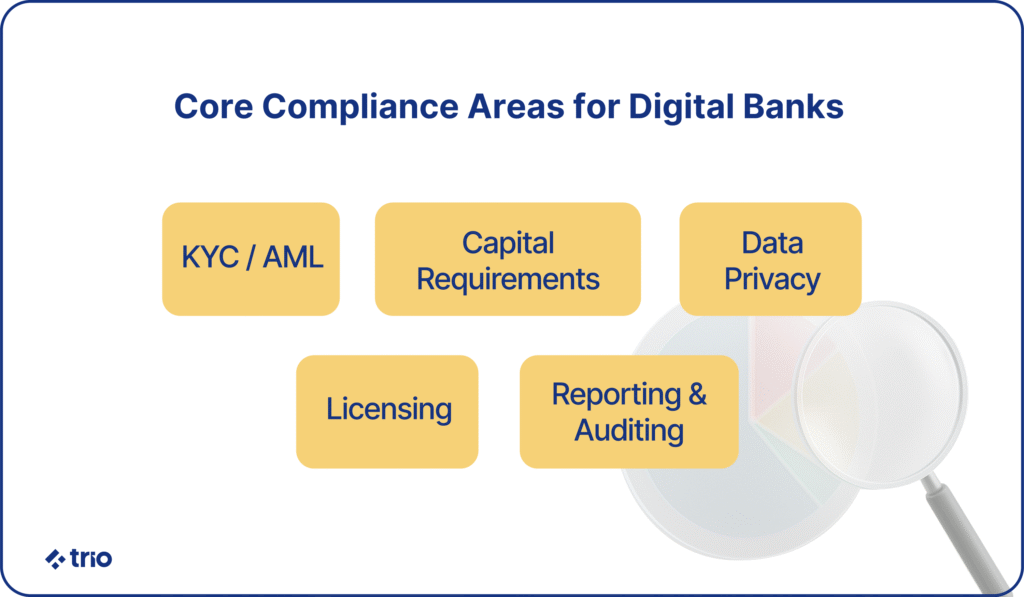
Digital banks answer to the same core obligations as traditional banks. They need AML and KYC, data protection, capital and liquidity requirements where applicable, and increasingly operational resilience and AI governance.
However, the job is made more difficult for them because they often inherit these obligations on infrastructure that's newer, more automated, and more dependent on third parties than a legacy institution's.
That combination makes it difficult and expensive to bolt compliance afterwards.
Neobanks pursuing full banking licenses are also being pulled directly into established prudential regulation, AML frameworks, and operational resilience requirements.
TD Bank's $3 billion AML penalty remains one of the starkest recent reminders that gaps in monitoring and controls carry real financial consequences.
The EU has restructured its entire AML framework for 2026. Now, there is a directly applicable AML Regulation (AMLR), a sixth AML Directive (AMLD6), and a new Anti-Money Laundering Authority (AMLA).
The AMLA specifically will directly supervise selected high-risk institutions.
While many specific requirements will not take full effect until 2027, you need to be prepared now, especially in anything affected by the tightened rules on beneficial ownership, cash payments, and transactions involving high-risk third countries.
Internationally, the FATF's crypto "travel rule" continues expanding into more jurisdictions, and beneficial ownership reporting regimes keep growing, though access and privacy constraints still differ meaningfully by country.
In terms of engineering, be aware that transaction monitoring, sanctions screening, and beneficial ownership tracking increasingly need to be built as systems that can absorb regulatory change without a full re-platform.
The EU's Digital Operational Resilience Act (DORA) became enforceable on January 17, 2025, applying a harmonized ICT risk and incident-reporting framework across roughly 20 categories of financial entities and their critical service providers.
It is, by far, the biggest change in recent years affecting digital banks. The UK and US have moved in a similar direction as well.
Digital operational resilience is now a formal requirement in all three major markets, and third-party risk management and incident response expectations have risen considerably in recent years too.
In January 2026, the UK's FCA, Bank of England, and PRA signed a memorandum of understanding with EU supervisory authorities specifically to strengthen cooperation on overseeing critical third parties.
In doing this, they extended coordination on incidents like cyberattacks or major operational disruptions across borders.
For a digital bank, this means the BaaS providers, cloud infrastructure, and payment processors underneath the product are now part of the regulatory conversation directly, and you need to be able to demonstrate resilience across that whole chain.
Most banks are now using AI in some way. The European Banking Authority reports 92% of EU banks already deploying AI, trending toward near-total adoption in 2026, with the UK close behind at 94% as of 2024 and Asia-Pacific institutions around 90% at least beta-testing generative AI applications.
US adoption seems to be a little more conservative, with roughly half of large banks reporting live AI use cases.
That adoption has triggered serious regulatory attention, specifically around explainability and fairness.
We have already briefly mentioned the EU AI Act. Its high-risk obligations cover things like creditworthiness assessments directly. Although a delay of up to a year for some obligations is being discussed, this is more to allow time for regulators to finalize technical standards, and it isn’t settled yet.
The UK is leaning on existing model risk, data protection, and operational resilience rules rather than a dedicated AI statute, and US supervisors similarly emphasize model risk management and fair lending compliance over entirely new AI-specific rules.
Either way, if a model you are using denies someone a loan or flags an account, you need to be able to explain that decision in terms a non-specialist can follow. Capturing that decision is an architecture requirement.
The data-sharing obligations that started with basic account access are expanding into a much broader set of financial products, with the EU's proposed Financial Data Access Regulation (FiDA) creating a unified legal framework for data access and sharing across financial products.
In the US, open banking is being covered more and more in the Consumer Financial Protection Bureau's rulemaking. Our developers have also noted that Singapore and Australia are implementing their own open banking and open finance regimes independently.
For a digital bank operating, or planning to operate, in more than one market, this means API and consent architecture increasingly needs to account for multiple data-sharing regimes from the design stage, sometimes scoped very differently.
Regulatory clarity around stablecoins and tokenized assets has moved incredibly quickly. The GENIUS Act established a formal federal framework for payment stablecoins, administered principally through the OCC alongside the FDIC, Federal Reserve, and Treasury.
MiCAR has already established uniform stablecoin rules, with countries including the Netherlands, Malta, and Germany among the first to issue licenses after the December 2024 implementation deadline.
The UK is advancing a phased regime for fiat-referenced stablecoins through HM Treasury and the Bank of England, and several US states have also moved on their own digital asset banking frameworks specifically covering custody and fiduciary services.
Compliance, cybersecurity, and AI governance are converging. This means your compliance function and your engineering function need to be talking continuously.
Building systems that can absorb regulatory change (a new AML rule, an AI explainability requirement, an operational resilience obligation) without a full re-platform is more valuable than building the fastest possible version of today's requirements.
But, in order to do this, you need to have the right talent on your team. Our developers have extensive experience building applications that can shift rapidly to meet changing user expectations without affecting users.