

Hire by Technology
SERVICES



Every chargeback costs more than the sale it reverses.
There are several reasons for this, but the primary factors are the lost goods or delivered service, the dispute fee, the processing you already paid, and the staff hours spent fighting it, all of which are added on top of the actual refund amount.
What we have noticed, though, is that the damage tends to run even deeper than the monetary value.
Most teams already treat chargebacks as a fraud problem that they need to minimize, but very few actually think about how to handle disputes at scale without the handling itself eating away at your margins.
Zero chargebacks or a perfect win rate is an unrealistic goal, but a targeted dispute-handling system that spends effort where it pays back and avoids other instances can greatly reduce unnecessary losses.
Let’s take a look at how fintech and payments teams are building those systems. We’ll go over everything you need to know, like why chargebacks hit margin so hard, the lifecycle in plain terms, the layers of a dispute-handling operation that actually matter, the use of network monitoring programs, and the build-versus-buy-versus-staff decision underneath all of it.
If you want to consult with experienced fintech developers, or get someone who has worked on similar projects on your team without months of sourcing and vetting, we can assist.
Trio specializes in financial software development, and we keep a pre-vetted pool of developers on hand who can be matched to your project in a matter of days.
When a customer disputes a transaction, the money leaves your account almost immediately, and you carry the loss until and unless you win it back.
This means that chargebacks instantly become a cash and margin issue.
As we have already mentioned, you lose the transaction amount, then add the product or service, which in most cases has already shipped or been delivered and cannot be recovered.
After that, you need to think about the dispute or chargeback fee your processor charges, as well as the interchange and processing you already paid on the original sale.
Finally, we often see companies forget to factor in the operations time, but someone has to review the case, gather evidence, and decide whether to fight, and that labor scales with volume.
Once you stack all of these together, the fully loaded cost could be as much as two to three times the original amount.
Unfortunately, that’s not the end of the downsides either.
Your dispute ratio, the share of transactions that turn into chargebacks, is watched by the card networks. If you let it drift too high, you could move into monitoring programs that add fees and may even put your ability to process at risk.
In the last couple of years, everyone in the fintech industry has watched the nature of disputes change.
While it used to be dominated by things like stolen-card fraud, we are now seeing a lot of first-party misuse, widely called friendly fraud, where a legitimate customer disputes a charge they actually made.
Sometimes this is a mistake, but sometimes it’s not.
Practically, this changes your job, since you are less often blocking an obvious criminal and more often proving that a real customer received what they paid for, which is more of an evidence and process problem.
To build handling that protects margin, you need to know the path a dispute travels. While the specifics vary by card network, there are a couple of things that we have seen stay consistent.
The entire process begins when a cardholder contacts their issuing bank to dispute a charge. The issuer assigns a reason code, which is usually just a short label for why the transaction is being challenged, such as fraud, product not received, or product not as described.
Once all of that is in place, the issuer reverses the funds, and the chargeback lands on you through your acquirer or processor.
At that point, you have a choice: you can accept the chargeback and move on, or you can contest it through representment.
We almost always recommend the former option for low-value or clearly unwinnable cases.
Contesting requires you to submit evidence to your acquirer that argues the transaction was valid and the disputed reason does not hold. The issuer reviews that evidence and either upholds your case or sides with the cardholder.
If the two banks still disagree, some networks allow escalation to arbitration, which has its own fees. All of these additional costs mean it probably isn’t worth it unless you have a clear case and the amount being contested is quite large.
To figure out your margin, the reason code is one of the first things you should consider. This code dictates what evidence counts and how likely you are to win, so triaging by reason code is the first filter in any efficient operation.
Second, there is a growing set of mechanisms that let you resolve or prevent a dispute before it ever becomes a formal chargeback. This is usually where a well-built system focuses its attention.
A dispute-handling operation that protects the bottom line has three different layers that all need to work together, with measurement wrapped around them.
Think of it as stop the dispute, resolve it early, and win the ones worth fighting.
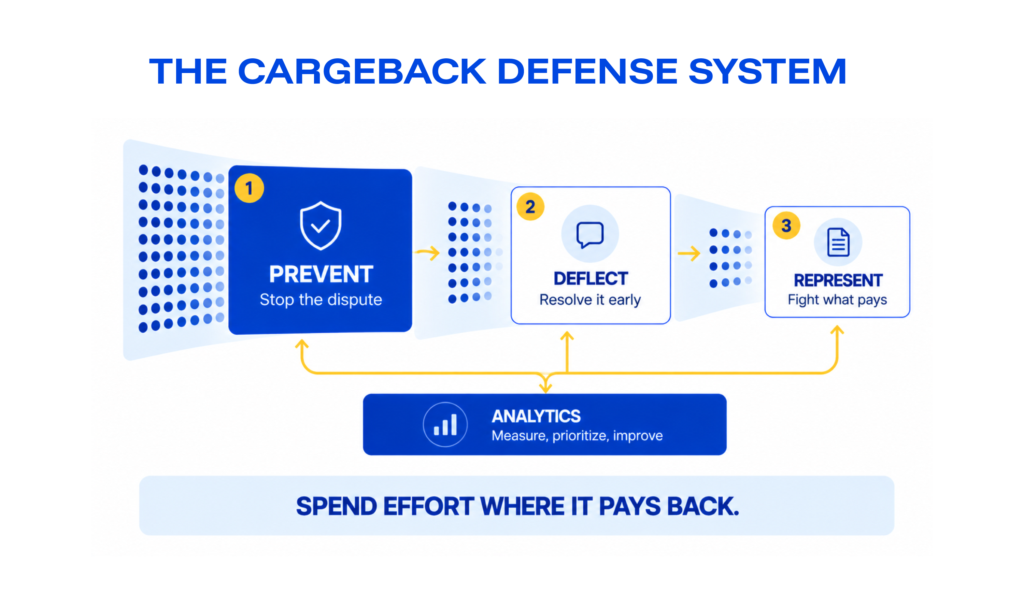
The cheapest chargeback is, of course, the one that never happens. This means that prevention earns the highest rate of return.
Practically, it’s rather simple. Clear, recognizable billing descriptors can help you make sure that customers recognize a charge on their statement, preventing disputes from uncertainty.
Accurate product descriptions and delivery confirmation are also essential, as they cut the not-as-described and not-received categories. Sensible refund and cancellation flows give unhappy customers a path that does not run through their bank.
While this does not prevent the refund itself, it does prevent the additional expenses that come with a chargeback.
On the fraud side, prevention means scoring transactions for risk before they settle. You could use signals like device, velocity, and behavior, all analyzed with the assistance of emerging technology like AI and ML.
Applying authentication such as 3-D Secure can also help you shift liability in some instances, and has the added benefit of filtering bad actors.
The primary engineering goal here is to catch genuinely risky transactions without adding friction.
When a dispute is already forming, a set of network and third-party mechanisms can help you resolve it before it becomes a full chargeback. This helps you minimize damages by keeping it off your ratio and out of your ops queue.
Transaction-detail sharing tools, such as Visa's Order Insight and the Ethoca and Verifi networks, push your order information to the issuer at the moment of inquiry.
By utilizing these tools, a customer who, for example, just did not recognize a charge will get an answer instead of immediately filing a dispute.
Rapid dispute resolution mechanisms are also a great tool that can automatically refund qualifying disputes below a threshold you set. In using these, you are trading a small, controlled refund for the higher cost of a full chargeback plus its hit to your ratio.
From what our developers have observed, deflection is where a lot of margin is quietly saved, because it converts expensive, ratio-damaging chargebacks into cheap, predictable refunds or avoided disputes.
The catch is that it requires a fair amount of integration work, since your systems have to feed accurate, timely order data into these networks.
For the disputes that do become chargebacks, representment is how you win back the ones worth fighting.
In order to fight anything, you are going to need evidence like transaction records, delivery confirmation, customer communications, device and login history, and anything else that proves the transaction was legitimate and the reason code does not apply.
Card networks have also introduced evidence frameworks. Visa's Compelling Evidence 3.0 is a great example that lets you rebut certain first-party fraud disputes by showing a history of prior undisputed transactions from the same customer.
It is also particularly useful against friendly fraud.
The discipline here is selectivity, since fighting every chargeback is a sure way to lose money. The labor on unwinnable cases can quickly exceed what you recover.
Often, the most efficient pattern is to triage by reason code and value, automate evidence gathering and submission for the categories you tend to win, and route only the ambiguous, high-value cases to a human.
Measuring these layers can help you improve them. You need to see disputes broken down by reason code, by product, by traffic source, and by outcome, so you can tell whether a spike is fraud, a broken checkout, a confusing descriptor, or a single bad SKU.
Reason-code analysis often surfaces problems that belong upstream in the product.
In short, the queue is a diagnostic. The recurring patterns in it tell you what to fix so the disputes stop arriving.
One of your biggest goals might be staying under the thresholds the card networks enforce, because crossing them is its own margin hit.
Visa consolidated its older dispute and fraud monitoring programs into the Visa Acquirer Monitoring Program, known as VAMP, and the thresholds tightened through 2026.
VAMP measures a ratio built from fraud and dispute activity against your transaction volume, and merchants and acquirers who exceed the defined levels face escalating fees and remediation requirements.
Mastercard runs its own excessive chargeback monitoring with comparable intent.
The exact ratios and effective dates shift all the time, but the principle is fairly consistent: there is a line, and being on the wrong side of it costs money and can jeopardize processing.
For teams scaling volume quickly, the link between dispute ratio and processing terms is worth designing around early.
There is a healthy market of chargeback platforms, alert networks, and representment services. Many teams could greatly benefit from using a variety of these tools, but buying a tool does not remove the engineering and operations work.
Every one of the layers depends on your own systems doing something well.
Prevention needs your risk signals and checkout wired correctly. Deflection needs accurate order data flowing into alert networks in near real time. Representment needs evidence assembled from across your systems into a submission that meets each network's format.
Finally, your analytics require all of that data to be unified enough to see patterns.
While a vendor can provide the rails, the integration, the data quality, and the decision logic that decides which cases to fight are yours to build and maintain.
That is where the staffing question lands for many of the teams we have worked with.
Chargeback and dispute engineering is incredibly specialized since the developers require a mixture of payments domain knowledge, data integration, and financial accuracy, and it is not usually where a product team has depth.
Pulling your core engineers onto a dispute-handling build stalls the roadmap while they learn, but hiring full-time payments specialists is slow in a competitive market.
This is where staff augmentation comes in. You can benefit by bringing in engineers who have built dispute and payments systems before, having them assist you with shipping the capability, and then transferring the knowledge to your team.
The teams that keep chargebacks from eating margin tend to share a few habits.
First, they measure the right thing, avoiding useless metrics like raw win rate, and instead focusing on things like what you recover and prevent, minus what handling costs you. That number tells you whether the operation is actually protecting the bottom line.
Successful teams also tend to triage ruthlessly. Every dispute gets sorted by reason code and value, and effort flows only to cases that pay back. Unwinnable low-value disputes are accepted quickly rather than fought out of principle.
These developers also push problems upstream, making sure to fix the cause so the disputes stop arriving, instead of processing the same break forever.
And lastly, they automate the routine wherever possible, allowing you to reserve people for judgment.
Chargebacks, and the costs associated with them, can really eat at your margin from several directions at once: hard per-case losses, wasted ops hours, and the slow tax of a rising dispute ratio that threatens your processing terms.
The teams that stay ahead of it tend to be the ones who built dispute handling as a system. These teams focus on prevention to stop disputes, deflection to resolve them early, representment to win back what is worth fighting, and analytics to keep improving all three.
The work is mostly engineering and operations.
If chargebacks are starting to strain your margins or your roadmap, whether you need to build the dispute-handling system properly or add experienced payments engineers to your team, Trio can help. Talk to us about fintech developers who have done this before.