

 Read Client Stories





 Alex Kugell
 Key Takeaways
- Modern PHP (8.x, with Laravel or Symfony) is a meaningfully different skill set from legacy PHP or basic WordPress theming.
- Security questions (SQL injection, XSS, CSRF) should get an instant, specific answer from a genuinely strong candidate.
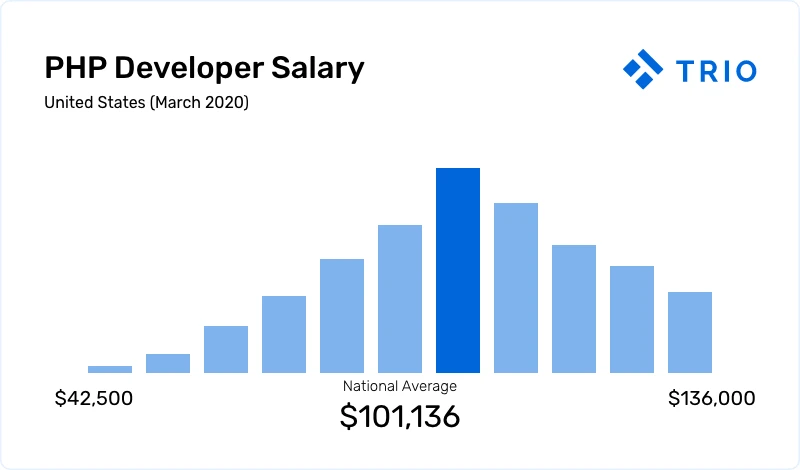
- Rates vary heavily by region: roughly $80-150/hr in the US, $60-120 in Western Europe, and $30-65 through experienced nearshore and offshore talent, for comparable skill levels.
- A short paid trial task on a realistic problem is consistently the best single filter available, better than a resume, a portfolio, or a longer interview alone.
- Freelance marketplaces work well for small, well-scoped tasks and poorly for anything requiring long-term ownership, since the incentive structure doesn’t reward the kind of continuity a real product needs.
- PHP shows up in fintech in payment gateway integration and the e-commerce platforms (WooCommerce, Magento) that process real transaction volume, both genuinely useful signals to screen for.
While PHP is not as popular as some newer alternatives like Node.js, it still runs the backend of roughly three-quarters of websites with a known server-side language, which means the talent pool is genuinely large.
The incredible quantity of PHP developers unfortunately means that there is a large gap between someone who lists PHP on a resume and someone who’s actually current on modern PHP.
Fortunately, thorough vetting can ensure that you get the right person on your team.
Let’s take a look at everything you need to know about how to hire PHP developers.
If you need these developers quickly, or do not have the skills in-house to assess them on your own, we can assist. At Trio, we pre-vet developers for a variety of skillsets, including PHP, Node.js, Python, and Go, allowing companies to find the right people in 3-5 days.
We also look for production experience in heavily regulated environments like fintech.
What to Actually Screen For
The single biggest mistake in PHP hiring is treating generic experience as one undifferentiated skill.
Modern PHP 8.x, typed properties, enums, and match expressions are a genuinely different tool from legacy PHP 5.x or 7.x, and a developer who’s only worked in the older versions will need real ramp time on a current codebase.
We have also noticed that this gap exists between framework depth and basic familiarity.
Laravel now anchors the large majority of new PHP projects, with Symfony remaining the common choice for larger, more structurally complex enterprise builds. You need to make sure the developer has the right skillset for your requirements.
Security fluency is close to non-negotiable for this role specifically, since PHP’s history includes enough real-world security incidents that the ecosystem has strong, well-known answers by now, and there’s no excuse for a senior candidate not having them ready.
Ask directly about SQL injection prevention, cross-site scripting, and CSRF protection, and expect an instant, specific answer.
Database and query optimization matters too, since PHP applications live or die on how efficiently they talk to MySQL or PostgreSQL.
Finally, it’s worth looking at a couple of skills that aren’t necessarily PHP-specific, but that are quickly becoming essential across all development projects. Examples include things like comfort integrating AI and LLM-based features into a PHP backend, and familiarity with async-capable runtimes like Swoole or RoadRunner.
The latter is particularly important for teams that need PHP to handle high-concurrency workloads without falling back to a full framework rewrite.
What Fintech Projects Actually Use PHP For
PHP’s reputation skews toward general web and CMS work, but it has a real, specific footprint in regulated industries like fintech.
Payment gateway integration is the clearest case. Stripe, PayPal, and Braintree all maintain mature, well-documented PHP SDKs, and a large share of the world’s payment-processing integrations, particularly on the e-commerce side, run through them.
WooCommerce and Magento, both PHP-based, collectively power a significant share of global e-commerce, and both handle real payment processing at serious volume every day.
Looking beyond e-commerce, internal financial tooling is a quieter but genuinely common use case as well.
We’ve seen PHP used in reconciliation dashboards, reporting tools, and admin systems that finance and operations teams rely on daily.
In terms of hiring, a PHP candidate with real fintech experience should be able to speak specifically to PCI DSS considerations in a payment flow.
What This Actually Costs in 2026
| Region | Hourly Rate | Notes |
| United States | $80-150/hr | Senior full-time roles often run $130-200K annually |
| Western Europe | $60-120/hr | Comparable skill depth to US, somewhat lower cost |
| LATAM (senior, staff augmentation) | $40-68/hr | Strong timezone overlap with US teams |
| Eastern Europe | $30-65/hr | Deep Laravel/Symfony talent pool |
| India / South Asia | $20-45/hr | Widest rate range; vetting quality varies most here |
A full-time dedicated offshore PHP developer typically runs $2,800-6,500 a month depending on region and seniority, against $12,000-24,000 a month for an equivalent US in-house hire.
Just keep in mind that, while the savings are real, the actual value of a nearshore hire specifically comes from combining that cost gap with enough timezone overlap to run real-time collaboration.
Where to Actually Find Good PHP Developers
Generic job boards return volume, but the talent pool is broad so you’ll need to sift through applicants that aren’t suitable, particularly if your posting is vague.
A few sourcing approaches consistently work better:
GitHub
Rather than searching for “PHP developer” as a title, we recommend that you look for contributors to specific Laravel packages, Symfony bundles, or well-known WordPress plugins that match your actual stack.
Once you have a couple of options, look at contribution patterns over time, consistency, thoughtful commit messages, and real engagement in issue threads, since this filters specifically for developers who are still actively learning and building.
Framework-specific communities
The Laravel and Symfony ecosystems both have active communities, forums, Discord servers, and community hubs.
The developers actually spending time answering substantive technical questions tend to be the ones worth reaching out to directly. If they are not interested in the position themselves, they may be able to refer someone to you.
Referrals
If you have an existing team of PHP developers, or you are familiar with a team, asking them who they respect professionally in the PHP world, even if those developers are not necessarily looking for work, can produce good results.
Just keep in mind that the developers that referrals tend to produce are usually more senior, which means you will have to offer more competitive compensation. The overall cost-effectiveness may be greater, though.
A specialist staffing partner
This is particularly a good option once the role needs to be filled reliably and repeatedly rather than as a one-off.
Strong PHP developers are often already employed and only move for the right opportunity presented well.
A dedicated staffing partner, like an IT staff augmentation firm or a company that specializes in outsourcing software development, has the connections and the bandwidth to connect you with the right people in a matter of days.
Just be careful with general freelance marketplaces.
They tend to work fine for small, clearly scoped tasks where budget is the main constraint, but they’re a weaker fit for a senior, ongoing role, since the platform’s own incentive structure rewards developers who take on many short engagements rather than committing to one team for the long run.
How to Actually Evaluate a Candidate
In our experience, a short paid trial task on a realistic problem is the single best filter available.
We like to use options that include a secure file upload, writing a small set of unit tests against existing code, implementing authentication correctly, optimizing a slow database query, or designing a small REST endpoint.
Each of these reveals how someone actually writes code under normal, realistic constraints, which is something a resume and a conversation can’t show you.
Beyond the trial task, a real production story tells you a lot.
Ask about a specific problem they solved in production, and listen for whether they can explain why a past decision made sense at the time, even if they’d make a different call today.
The biggest factor that companies struggle with when evaluating a candidate is that they don’t have any PHP experience of their own to refer to.
That’s where someone like Trio can help. Our pre-vetted developers are hand-picked based on your requirements. You don’t need an existing team, and there is no long-term commitment while at the same time, you can rest easy knowing you could access the same developers later.