

Hire by Technology
SERVICES


Payment facilitation used to mean picking up a registration, a sponsor bank, an underwriting function, and a compliance team, then waiting a year.
These days, however, PayFac-as-a-service providers have compressed that into an integration.
The catch is that the label covers arrangements that differ enormously.
Two providers both selling "payfac-as-a-service" can leave you with completely different economics, completely different liability, and a go-live date six months apart.
Let’s look at ten PayFac-as-a-Service providers, and compare them on the things that actually vary.
At Trio, we have a pre-vetted pool of fintech specialists who are already familiar with the industry. These software developers can draw on their production experience to help you identify the right vendor for your product, and can assist with the integration.
A payment facilitator holds a master merchant account with an acquiring bank and onboards sub-merchants underneath it.
This means that, rather than each business opening its own merchant account, which traditionally took days and a credit review, the payfac underwrites them and lets them start processing payments almost immediately.
PayFac-as-a-service lets a software provider offer that experience without becoming a registered payment facilitator.
The provider holds the registration, the sponsor bank relationship, and the core compliance obligations. Your platform only handles merchant onboarding, sets pricing, and owns the customer relationship, but you can earn a share of the payment margin.
Our developers are assisting several firms with the technology behind PayFac-as-a-Service, because the reality behind becoming a full payfac means registration with Visa and Mastercard, a sponsor bank, PCI DSS compliance at the highest level, underwriting and risk management functions, and reserves against merchant losses.
For most software companies, the return does not justify it.
Payments have very quickly become a revenue line.
One 2025 industry study found embedded payments converting an average of 39% of platform volume within 18 months, rising above 50% for higher-volume vertical ISVs and to 57% in healthcare.
The size of the prize explains the rush.
The addressable embedded finance revenue opportunity for SaaS platforms across North America, Europe, and Australia sits at roughly $185 billion, with penetration still below 20%.
At the same time, the payment facilitation market itself is estimated at $5.62 trillion in 2026 and forecast to reach $10.39 trillion by 2031.
On top of the revenue argument, you need to think about the product one.
A merchant who onboards inside your software, gets paid through your software, and reconciles in your software has a considerably harder time leaving it.
Payments raise switching costs even further, in a way feature releases do not, which tends to show up in retention before it shows up in the P&L.
There are four parties involved in most payfac models.
Under payfac-as-a-service, your platform sits between the provider and the sub-merchants.
This means that you collect merchant information, trigger the underwriting the provider performs, and present the whole thing as your own payment system.
The only thing your customer experiences is your brand. The registration and much of the risk sit with your provider.
Three functions determine whether this works operationally.
Onboarding has to be fast enough that merchants do not abandon it, which usually means automated KYC and risk checks rather than manual review.
Risk management has to catch fraud and merchant misconduct before losses accumulate.
Payouts have to settle on a predictable schedule, because nothing erodes trust faster than a merchant not knowing when money arrives.
Teams building this usually need engineers comfortable with payments infrastructure, KYC and AML pipelines, and ledger reconciliation, which is a narrower skill set than general backend work.
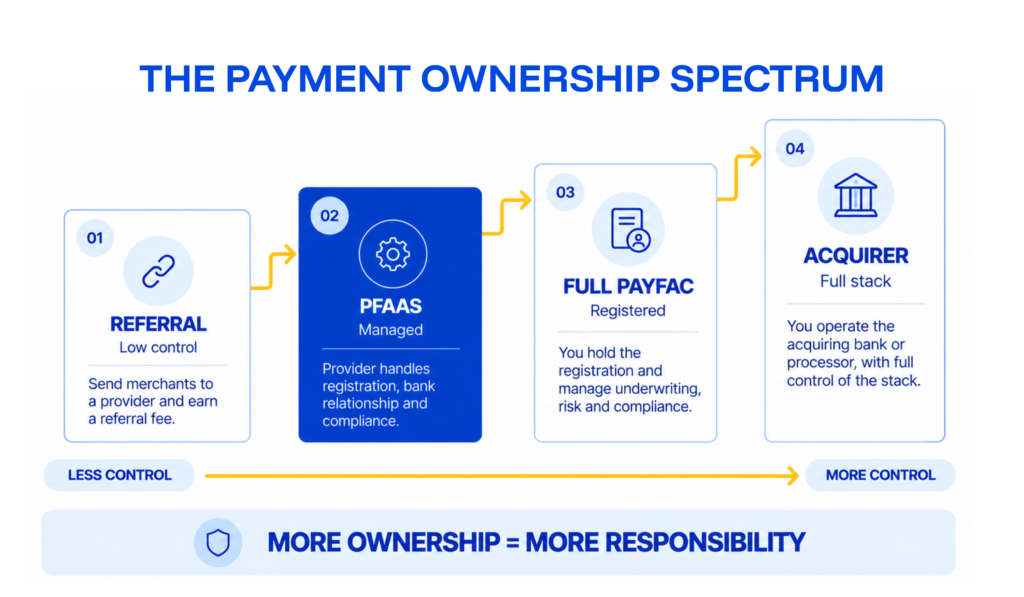
In order to compare them accurately, we can start by placing providers on a spectrum in terms of payment ownership level:
| Provider | Model | Economics | Typical go-live | Geography |
| Stripe Connect | Platform-managed, configurable | Flat rate plus Connect fees | 1-3 weeks (Express), 4-12 weeks (Custom) | 46 countries, 135+ currencies |
| Adyen for Platforms | Enterprise PFaaS | Interchange-plus, spread ownership | 2-4 months | Global |
| Finix | PFaaS with path to full payfac | Wholesale rates, you set pricing | Weeks to months | US, Canada |
| Worldpay for Platforms | Three tiers incl. PayFac Developer | Negotiated, revenue share or spread | Months | Global |
| Rainforest | Purpose-built PFaaS | Interchange-plus buy rate, revenue split on spread | 2-6 weeks | US (Canada planned) |
| Tilled | PFaaS, published pricing | Revenue share, no platform fees | Weeks | US, Canada |
| Infinicept | Enablement plus managed option | Spread above cost | Weeks (Launchpay), 3-4 months (full) | US-focused |
| Payabli | Developer-first PFaaS | Negotiated | Days to weeks (no-code) | US |
| Stax Connect | Managed PFaaS | Custom | Weeks to months | US |
| Payroc | PFaaS with registration path | Negotiated, aggressive on buy rate | Weeks to months | US, Canada, UK |
This is usually the default starting point, and there are many reasons why.
Documentation is excellent, the embeddable components do most of the onboarding work, and you can be processing quickly.
Shopify and DoorDash both run on Stripe Connect, proving that it can be used successfully.
The trade-off sits in the economics.
Flat-rate pricing at 2.9% plus 30 cents is predictable and generous at low volume, but it can very quickly become one of the most expensive options as you scale.
Published analysis puts the annual delta against interchange-plus providers at roughly $12,000 to $75,000 or more a year once volume is meaningful.
For international coverage, though, nothing on this list competes.
Adyen is one of the best enterprise options, with genuine global acquiring and depth in card-present alongside online.
You benefit from spread ownership rather than revenue share, so the economics work in your favor at scale.
The main issue here is that it expects more of you.
Integration runs to months, and Adyen's commercial process assumes a platform with real volume already.
Below roughly $150,000 to $200,000 a month in processing volume, this is usually more platform than the problem requires.
With Finix, you can start on payfac-as-a-service and migrate to full payfac registration later without changing providers.
For a platform that expects to own its payments eventually, that removes a painful migration from the roadmap.
Developer experience is strong, wholesale rates are negotiable, and you set sub-merchant pricing.
We also like that Finix handles higher-risk verticals that several competitors decline.
Payrix was folded into Worldpay for Platforms, which now operates under the Global Payments for Platforms brand following Global Payments' completed acquisition of Worldpay on 12 January 2026 in a deal reported at around $24.25 billion.
The product runs three tiers: Integrated Payments, PayFac-as-a-Service, and PayFac Developer.
This variety means you can choose how much underwriting and compliance risk to carry.
The platform offers enterprise depth, omnichannel coverage, and serious risk tooling. Implementation timelines reflect that.
Rainforest was built specifically for vertical SaaS, with interchange-plus buy rates in the 20 to 30 basis point range and a revenue split that lets the platform keep the spread above cost.
Go-live takes roughly two to six weeks through a single API with pre-built components.
The platform’s services are currently offered in only the US, with Canada expansion planned, which rules it out for international platforms today.
For a US vertical SaaS business that wants real payment economics without a long build, it is among the strongest options available.
Tilled publishes its pricing and charges no monthly platform fees, minimums, or setup costs, which is unusual enough in this market to matter.
This is another option that utilizes revenue share rather than spread ownership, so your upside is capped relative to Rainforest or Finix.
For early- and mid-stage B2B software platforms wanting to monetize payments quickly without upfront cost, that trade is frequently worth taking.
Infinicept is incredibly explicit about the path to full payfac registration, which it has built its positioning around.
Launchpay gets you live in weeks on a managed arrangement; the full enablement program runs three to four months and leaves you considerably closer to owning your own registration.
We have found that it is best suited to platforms that have decided ownership is the destination and want help getting there.
Developer-first, with a no-code onboarding option that can get a platform live in days.
Payabli is smaller and newer than most of this list, which cuts both ways. It is more responsive commercially, but less proven at scale.
A managed PFaaS offering aimed at software companies that want someone else handling the operational load.
It offers custom pricing and moderate timelines.
Overall, it is a reasonable fit for platforms without a payments team.
Payroc has far less brand recognition than Stripe or Adyen, and platforms running competitive processes report it negotiates more aggressively on buy rate as a result.
It does offer a documented route toward registration, though, and may be worth including in an RFP specifically to put pressure on the incumbents' pricing.
PayFac-as-a-service providers typically net 20 to 40 basis points on volume flowing through your platform. What happens to the rest depends entirely on your commercial model.
Under revenue share, you receive an agreed percentage of the payment margin.
This is very simple and predictable, but it caps your upside permanently. As we have mentioned, Tilled and the Worldpay revenue-share tier operate this way.
Under spread ownership, you buy processing at a wholesale interchange-plus rate and set your own merchant pricing. The result is that everything above your cost is yours.
Rainforest, Finix, and Adyen work this way. Just keep in mind that it demands more of you operationally in exchange.
Flat-rate arrangements also exist, but while they could look generous up front, we have found that considering the first 3 years, rather than just the first year, can drastically change that.
The switching cost once merchants are onboarded is real, so we have found that flare-rate arrangements are rarely worth the risk.
A sequence that tends to surface the right answer:
While payfac-as-a-service is great, there are definitely some issues that it does not solve.
Choosing a provider completes maybe half the work. Reconciling payouts into your ledger, handling webhooks idempotently so a retried event never double-credits a merchant, building the merchant-facing reporting, and designing the failure paths all land on your engineering team.
At Trio, we place payment engineers, fintech integrations engineers, and ledger specialists who have shipped this work inside regulated environments, through staff augmentation, dedicated teams, or our fintech engineering practice.
You can see how we work or book a call.