

Hire by Technology
SERVICES


Software platforms have become the distribution channel for a lot of financial services.
Bain & Company puts US embedded finance transaction volume at roughly $7 trillion for 2026, up from about $2.6 trillion in 2021, a jump that takes embedded finance from near 5% of US transaction value to more than 10% by Bain's own projection.
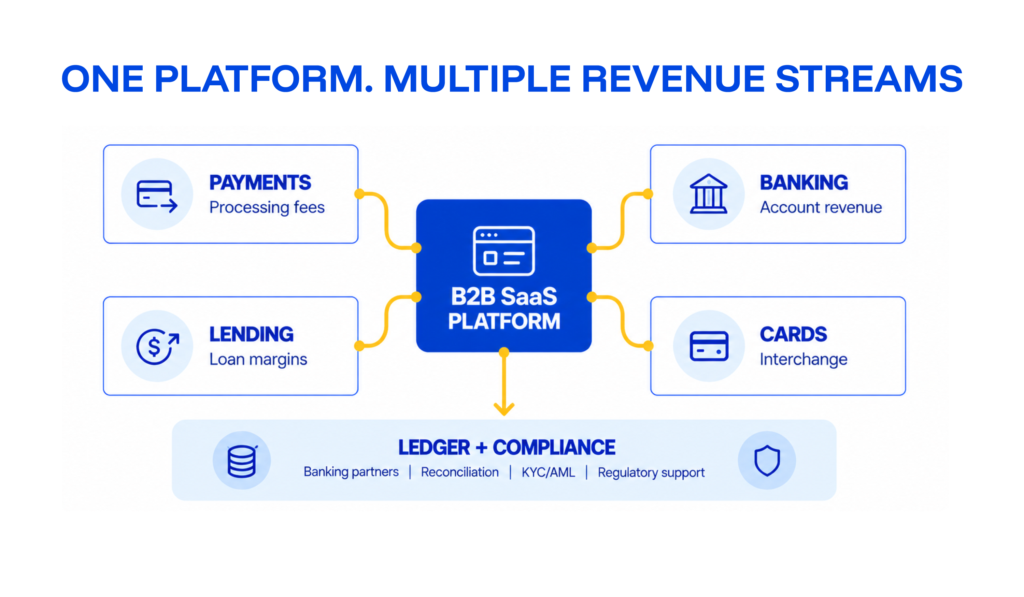
For a B2B SaaS platform, that shift turns a subscription business into something with several revenue lines.
One of the most difficult decisions that you need to make early on is picking who to build on, because the layer you choose determines your economics, your compliance load, and whether your customers can reach their money.
Below are twelve embedded finance companies grouped by the problem each one solves, with what the revenue actually looks like and what the model costs, including:
At Trio, we keep a host of pre-vetted developers who can be connected with your company in a matter of days, allowing you to get someone with production experience on your team to help you plan and execute compliantly.
B2B embedded finance is the integration of regulated financial products directly into non-financial software.
Typically, this is done so a business customer can open an account, accept payments, borrow working capital, or buy insurance without leaving the platform they already use to run their operations.
The platform never becomes a bank.
Funds sit at a chartered sponsor bank, a banking-as-a-service provider supplies the APIs, the ledger, and much of the compliance tooling, and the software platform owns the customer relationship and the interface.
This means there are three parties involved, with regulatory responsibility split between them.
What makes this work in B2B specifically comes down to context.
A field services platform that already holds the job, the invoice, and the payment history knows more about that contractor's cash flow than any bank underwriting from tax returns.
Embedding a working capital offer next to an unpaid invoice converts considerably better than a generic credit advert, and the underwriting is better informed.
The infrastructure has matured, so that what had previously required a multi-year bank partnership in 2018 now takes an API integration and a compliance program.
For example, Apideck's 2026 landscape maps more than 300 providers across 16 categories, with embedded payments the largest single category at nearly 90 providers.
This growth also happened very quickly.
Precedence Research put the global embedded finance market at $148 billion in 2025, reaching $197 billion in 2026 at around 31.5% annual growth, with Grand View Research, using a different model and base year, putting the broader figure at $588 billion by 2030.
Both of these estimates point in the same direction.
Finally, we have reached a point where economics beat the banks.
A community bank's onboarding cost, for example, barely changes whether the small business does $50,000 or $5 million in revenue.
On the other hand, a software platform acquiring that same customer pays nothing incremental, since they are already a subscriber.
Distribution is free, underwriting data is richer, and the offer arrives in context.
| Layer | What the business customer gets | How the platform earns | Typical providers |
| Embedded payments | Card processing, ACH, invoice pay | Share of processing margin, 0.3 to 1.0% | Stripe Connect, Adyen, Rainforest |
| Embedded banking | Insured account, debit card | Interchange, float interest, account fees | Unit, Treasury Prime, Column, Swan |
| Embedded lending | Working capital, invoice finance, B2B BNPL | Origination fee plus spread | Parafin, Kanmon, Pipe, Defacto |
| Embedded cards | Branded debit or charge cards | Interchange, spend rebates | Marqeta, Lithic, Stripe Issuing |
| Ledger and ops | Nothing directly; it is infrastructure | Cost line, not revenue | Modern Treasury, Formance |
Most platforms start with payments, because the compliance overhead is lowest and the revenue arrives soonest.
Stripe Connect is often the default first step, and justifiably so.
Their documentation is excellent, and Connect covers 46 countries and 135+ currencies, and a platform can be processing in weeks.
The trade-off is flat-rate pricing that stays generous at low volume and very quickly becomes the most expensive option at scale.
Related Reading: Top PayFac-as-a-Service Providers
Adyen is probably the best enterprise option, with genuine global acquiring and unusual breadth, since it covers acquiring, issuing, and banking in one platform.
Interchange-plus economics rather than revenue share, so margins improve as you grow.
This volume is so popular because it almost expects real volume from the side.
Rainforest is purpose-built payfac-as-a-service for vertical SaaS, with wholesale buy rates and the platform keeping the spread above cost.
At the moment, it’s still US-only, with Canadian coverage in progress, and go-live in a few weeks rather than months.
Overall, it’s a strong fit for a US B2B platform that wants real payment economics without a long build.
In our experience, Unit is the most common choice for mid-market vertical SaaS adding accounts and cards.
One API covers bank accounts, debit cards, ACH, and wires, working through sponsor banks including Thread Bank and Blue Ridge.
The multi-bank posture adds integration complexity and reduces the concentration risk that has bitten platforms elsewhere.
Treasury Prime connects platforms directly to a network of community and regional banks rather than acting as an intermediary.
What this means for you is heavier compliance lift in exchange for better unit economics at scale and genuine bank-direct relationships.
Our developers have commented that it suits larger platforms with a compliance function already in place.
Column is quite unusual in that it has its own national bank charter, so the provider and the bank are the same entity.
That removes a layer of counterparty risk and appeals to teams wanting tight bank-API integration.
It’s smaller than Unit or Stripe, which cuts both ways.
Swan is by far the European winner, offering IBANs, cards, and payments for platforms and marketplaces across the EU.
It’s worth knowing if your B2B customers are European, since the US-centric providers above mostly are not.
Parafin offers embedded working capital for platforms and marketplaces, underwriting from platform transaction data rather than credit files.
Massive companies like DoorDash and Amazon are just some examples of its customers.
Parafin finances the lending itself and pays the platform a revenue share, so the credit risk does not land on your balance sheet.
B2B lending and BNPL built specifically for the vertical SaaS motion is the primary product here, which makes it a closer fit than the marketplace-oriented providers if your customers are businesses buying from businesses.
Pipe offers revenue-based financing that advances future subscription revenue as upfront capital.
Our developers have commented that it is particularly relevant where your customers themselves run recurring revenue models.
Marqeta has to be the reference card issuing platform, with real-time spending controls and granular authorization logic.
Klarna runs card programs on it.
Block, historically Marqeta's largest customer, has been shifting new Cash App card business elsewhere since early 2026, a reminder that even a flagship logo can turn into concentration risk.
Lithic is the lighter developer-first alternative worth knowing if you are considering it.
Technically, Modern Treasury is not an embedded finance product, causing platforms to consistently underestimate it.
Payment operations and ledger infrastructure used by companies including Gusto.
Once money moves across several providers, reconciliation becomes the thing that breaks, and a proper ledger is what stops it. Teams building this in-house usually need ledger engineers who have done it before.
Neither company breaks out a single per-customer dollar figure, but both Toast and ServiceTitan report fintech and payments revenue outgrowing their core software subscriptions.
For a platform with real transaction volume, it can become comparable in size to the subscription line itself.
Adoption appears to vary sharply by layer, based on industry commentary rather than one disclosed benchmark.
On lending specifically, industry benchmarks suggest the margin runs thinner than headline take rates imply.
For example, take rates tend to run 2 to 8% of loan amount, defaults 3 to 12% annualized depending on segment, and cost of capital 6 to 12%.
Net margin after losses tends to land between 1.5 and 3% of loan volume, which means growth has to do all the work.
Embedded payments are quick, commonly two to four months, but embedded banking can take significantly longer.
We always recommend that our clients set aside anywhere from nine to fourteen months from signing a BaaS contract to a first live account, covering compliance buildout, KYC integration, and sponsor bank approval.
When it comes to budget, a realistic first-year range for a full banking stack runs roughly $1.2 million to $2.75 million once you count platform fees, sponsor bank minimums, two to four engineers, a compliance hire, and the legal program build.
From what we have seen, budgets below a million almost always achieve that by cutting compliance.
Unfortunately, the compliance hire is not avoidable.
Sponsor banks now require a named BSA/AML officer at the platform level, which is a six-figure annual cost before a single account opens.
One good example of counterparty risk is Synapse Financial Technologies, which was a banking-as-a-service provider connecting fintech platforms to partner banks. It filed for Chapter 11 in April 2024.
Customers of platforms built on it, including Yotta and Juno, lost access to their money. The shortfall between what partner banks held and what Synapse's ledger said they held was estimated at $65 to $95 million.
The bankruptcy case was dismissed on 12 November 2025 after the trustee found no viable buyer for the assets. Weeks later, the CFPB allocated $46.2 million from its Civil Penalty Fund toward affected consumers.
There are a couple of different things we can learn from this.
First, reconciliation is not a back-office concern. The proximate failure was a mismatch between the provider's ledger and the banks' records, which is an engineering and controls problem before it is a financial one.
Second, concentration matters. Platforms depending on a single provider and a single sponsor bank had no fallback.
Make sure that you understand how many sponsor banks sit behind a potential service provider, whether funds are held in a structure that protects your customers if the provider fails, who performs reconciliation and how often, and what happens to your customers if the sponsor bank receives a regulatory finding.
A sequence that tends to surface the right answer:
Worth stating plainly, because almost nobody writing about this does.
Once you have chosen a provider, you have only started the process.
Reconciling money movement into your ledger, handling webhooks idempotently so a retried event never double-credits an account, building the KYB onboarding flow, and designing what happens when a payment fails mid-flight all land on your engineering team.
At Trio, we place payment engineers, ledger specialists, KYC and AML developers, and fintech integrations engineers who have shipped this inside regulated environments, through staff augmentation, dedicated teams, or our fintech engineering practice.
See how we work or request a consult.