

 Read Client Stories




 Alex Kugell
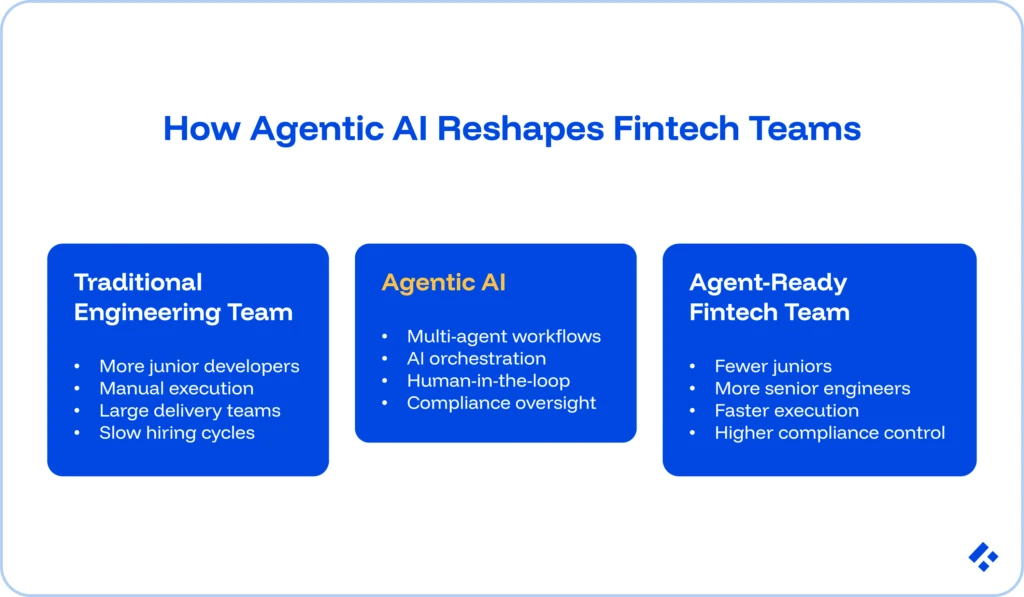
Agentic AI workforce development in fintech changes team composition for many companies of varying sizes. Senior engineers shift from code execution to agent orchestration, while we’ve seen a lot of junior roles absorb AI-literate oversight instead of execution tasks.
The hiring calculus is also moving from sheer volume to seniority and specialization, and outsourcing contracts shift from seat-based headcount toward outcome-linked models that reflect agent-augmented productivity.
Let’s take a look at each of these influences of applied AI in fintech workforces and how you should be restructuring your engineering teams to make the most of the tools available for you.
At Trio, we keep a host of pre-vetted fintech experts on hand at all times to help you take advantage of the latest technology in a way that is both secure and compliant.
Key Takeaways
- Senior fintech engineers now need both fintech domain knowledge and agentic AI engineering, pushing the cost per developer to as much as $250,000+ annually in the US domestic market.
- Agentic AI appears to increase the return on fintech domain knowledge. If engineers know what they are doing, then agents amplify productivity. Unfortunately, they also scale the error rate of engineers who don’t.
- A cold hiring search for the fintech-plus-agent profile in the US can take as long as 4 to 6 months.
- The fastest path to an agent-ready team involves developing existing senior fintech engineers into agent orchestrators, which takes around 60 to 90 days of structured work with frameworks like LangGraph or CrewAI.
4 Ways Agentic AI Is Changing Fintech Engineering Teams
McKinsey has found demand rising sharply for senior engineers, architects, and product managers who can orchestrate development across internal teams, vendors, and agents.
We have also noticed that the business case for hiring large numbers of junior developers is getting weaker, thanks to how agentic AI is absorbing much of the work that once justified those roles.
In fintech, this shift carries an additional layer of complexity that you may not have considered.
Fintech engineering already has a domain knowledge problem since developers need to be familiar with regulatory frameworks, financial data conventions, and compliance architecture patterns.
All of this knowledge takes time to build, and a continued effort on the part of the developer to stay up to date.
Agentic AI adds a second layer that fintech engineers now need to develop alongside their existing domain expertise. This layer is made up of agent orchestration, context engineering, multi-agent workflow design, and human-in-the-loop escalation architecture.
All of this has led to four major shifts in fintech workforce composition.
Shift 1: Senior Engineers Shift from Coding to Agent Orchestration
Senior fintech engineers who have previously spent the majority of their time writing and reviewing code are now spending more and more of their time designing what agents should do, configuring agent workflows, validating agent outputs, and managing the human-in-the-loop checkpoints required by regulations like the EU AI Act and SR 11-7.
In short, their work is basically moving up the abstraction layer.
Instead of their work being to “write the code that does X,” it is moving to “design the agent workflow that produces X, validate its outputs, and govern its decision-making.”
Shift 2: AI Agents Replace Many Junior Engineering Tasks
Junior engineers used to do a lot of tasks like data gathering, boilerplate code generation, routine transaction monitoring, and standard report production, which we are increasingly seeing get executed by agents.
The pyramid-shaped team structure (large junior base, small senior apex) is probably not going to be so severe in the future. Instead, we expect to see a stronger senior layer and a narrower junior base of AI-literate early-career engineers who ramp faster with agent assistance.
Shift 3: Demand Surges for Fintech + AI Hybrid Engineers
The fintech domain knowledge premium was already 10 to 12% above equivalent general engineering roles.
We’ve seen firsthand how adding agent orchestration on top of fintech domain knowledge has only compounded this premium.
This makes sense, though, as it is another very niche skill set that these developers need. and which is increasingly scarce to locate.
Shift 4: Outsourcing Moves from Headcount to Outcome-Based Models
Outsourced development contracts are increasingly linking compensation to results, delivery speed, quality, and modernization progress, rather than seat count.
This makes sense as, with a well-functioning agentic environment, a small team of senior engineers with agents can deliver what a large team without agents previously did.
New Skills Fintech Engineers Need for Agentic AI in 2026
The senior fintech engineer of 2026 and beyond needs two skill stacks that were previously independent careers.
They need fintech domain knowledge (payment systems, KYC/AML, PCI DSS, ledger engineering, regulatory frameworks) and agentic AI engineering (LLM orchestration, context engineering, multi-agent workflow design, evaluation, and governance).
Core Fintech Engineering Skills (Still Required):
- Monetary precision conventions (DECIMAL, not FLOAT; amounts as strings at API boundaries)
- Payment system idempotency: client-generated keys, three-layer enforcement, write-ahead log gap handling
- KYC/AML state machine design: not boolean flags, but ongoing monitoring with EDD triggers
- PCI DSS scope management: SAQ A vs. SAQ D, hosted vs. embedded card capture implications
- Regulatory framework awareness: SR 11-7, EU AI Act, ECOA, DORA, and their engineering implications
New Agentic AI and LLM Engineering Skills:
- Context engineering: Getting the best output from an LLM-based agent means designing the full information environment it operates in, structuring what the agent knows, what it can retrieve from memory, what tools it can call, and what constraints govern its behavior (compliance constraints and regulatory requirements).
- Multi-agent workflow design: Structuring orchestration patterns across specialist agents requires real architectural judgment of sequential pipelines for structured compliance processes, coordinator-team patterns for complex AML case investigations, and parallel execution for concurrent data retrieval across multiple financial systems.
- Agent output validation and governance: Any agent output that feeds into credit scoring, AML screening, or fraud detection requires a validation layer that meets the ongoing monitoring requirements of SR 11-7 and the EU AI Act’s human oversight obligations.
- Human-in-the-loop escalation design: EU AI Act Article 14 requires effective human oversight in high-risk AI systems.
Related Reading: Boost Approval Rates with Intelligent Payment Routing and Smart Retries
Why Fintech AI Engineers Are So Hard to Hire
IntuitionLabs’ 2025 job market analysis found 35% of companies identify high AI salary expectations as their top recruitment challenge. AI engineering salaries appear to be inflating at 15 to 20% annually as demand exceeds supply.
For fintech-domain-aware agentic AI engineers, the additional domain requirements that exist only make the problem worse.
What you essentially need is someone capable of two previously separate career paths: fintech backend engineering and AI/ML engineering. Neither path’s traditional hiring pipeline produces this hybrid profile at scale.
The practical consequence is that a cold hiring search for this profile in the US domestic market typically runs 4 to 6 months and pays $250,000 to $350,000+ annually for senior roles.
From what we have seen, there are three alternative paths you can consider to address this scarcity.
- You can develop existing senior fintech engineers into agent orchestrators.
- You can hire agentic engineers and invest in the fintech domain ramp.
- Or you can source through a specialist like Trio, who hires from the LATAM nearshore market, where you can expect to pay 40 to 60% of US compensation benchmarks.
Related Reading: Why Is It Hard to Hire Fintech Engineers Today
Best Team Structures for Agentic AI in Fintech
There are two structures we are seeing: the typical triangle (with many junior developers and a couple of seniors), shifting as the workforce adjusts to the new tooling.
There’s the diamond (fewer juniors, strong middle-layer managing agents, small leadership team) and the hourglass (expanded AI-literate entry-level cohort that ramps faster with agent assistance, smaller middle management layer, experienced specialist seniors at the top).
For fintech specifically, hiring takes longer than in many other industries, which has led to additional structure changes.
Senior engineers will ultimately become more leveraged since one senior fintech engineer with agent orchestration skills can direct multiple agents while remaining the accountable decision-maker for compliance-critical output.
Junior roles also change, as they shift from execution to AI-literate oversight. This means they need significant AI literacy and attention to compliance detail rather than primarily coding ability, which changes what you screen for when hiring.
The middle layer doesn’t disappear, though, as middle management becomes orchestration management, designing which tasks route to which agent, monitoring agent performance metrics alongside human productivity metrics, and maintaining the governance documentation.
Why Agentic AI Increases the Need for Fintech Domain Expertise
Agents produce outputs that reflect the instructions and constraints they’re given. If the engineer doesn’t know what is required, the agent will end up producing code that passes all tests and fails in production in precisely the same way a non-fintech engineer would without direction.
The compliance architecture knowledge that experienced fintech engineers carry, when to scope PCI DSS before architecture finalizes, how to design a KYC state machine with ongoing monitoring triggers, and how to instrument an AML workflow for SR 11-7 audit readiness, represents exactly the knowledge that needs encoding into the agent context.
In short, this means that the agentic AI increases the return on fintech domain knowledge rather than reducing it.
How Agentic AI Is Changing Fintech Outsourcing Models
The value of each senior engineer’s hour increases as agents extend their reach, which means the cost premium of senior-over-junior talent gets better justified than in a pre-agentic environment.
Ultimately, this means that the case for volume-based junior outsourcing weakens as that volume becomes increasingly agent-addressable.
When considering an outsourcing partner’s team, ask about whether they have the agent orchestration skills to use agents as productivity multipliers on your engagement, or whether you will be paying seat-based rates for engineers who aren’t yet operating in an agent-augmented way.
Trio’s fintech engineers arrive pre-vetted for both layers of the new skill profile.
Placement completes in 3 to 5 days at $40 to $80/hr ($7,000 to $14,000/month), compared to a US domestic market rate of $250,000+ annually for this profile combination.
How to Transition Your Fintech Team to Agentic AI
Most fintech engineering teams today have the first layer, fintech domain knowledge, but not the agent orchestration. The fastest path to an agent-ready team is to layer new developers with agent orchestration capability inside your existing team through staff augmentation.
- Step 1: Develop senior fintech engineers into agent orchestrators: These engineers already carry the compliance knowledge that must be encoded into the agent context. Expect 60 to 90 days of hands-on agent framework work (LangGraph, LangChain, CrewAI) with structured fintech use case practice.
- Step 2: Embed an agent orchestration specialist as a catalyst: A single senior agentic AI engineer without a fintech background, paired with a senior fintech engineer, produces faster results than training either in the other’s domain independently.
- Step 3: Redefine junior roles as AI-literate oversight positions: Screen for AI evaluation skill, output validation capability, and compliance attention.
Final Thoughts
A fintech-domain-fluent senior engineer who is capable of orchestrating agents can deliver incredible value. But finding those two skill sets together is very difficult.
Fortunately, they can be placed in 3-5 days through Trio’s nearshore LATAM network. Our developers integrate into your existing team, helping you to transition your entire team, at a cost savings of 40-60% compared to hiring the same talent in the United States.
Frequently Asked Questions
How does agentic AI change fintech engineering team composition?
Agentic AI workforce development in fintech changes team composition by shifting senior engineers from code execution to agent orchestration, while junior roles move toward AI-literate output validation rather than boilerplate development.
What skills do senior fintech engineers need for agentic AI in 2026?
Senior fintech engineers need agentic AI skills layered on top of existing fintech domain expertise, specifically context engineering, multi-agent workflow design, agent output validation under SR 11-7 and EU AI Act requirements, and human-in-the-loop escalation architecture.
Does agentic AI reduce the need for fintech domain knowledge in engineers?
Agentic AI does not reduce the need for fintech domain knowledge. Engineers who know what to tell agents to build see their expertise scale across agent-assisted execution, while engineers without domain knowledge produce non-compliant outputs faster.
How long does it take to hire a fintech AI engineer in 2026?
Hiring a fintech AI engineer through the US domestic market typically takes 4 to 6 months for the combined fintech-domain-plus-agent-orchestration profile, at $250,000 to $350,000+ annually. Nearshore LATAM sourcing through a pre-vetted network like Trio means you can get qualified engineers in 3 to 5 days at $40 to $80/hr.
What team structure works best for fintech engineering in an agentic AI environment?
A senior-weighted team structure works best for fintech engineering in an agentic environment, because the compliance ramp cost applies equally to junior humans and to new agents. One senior fintech engineer with agent orchestration skills can direct multiple agents while remaining accountable for compliance-critical decisions.
How do outsourcing contracts change when engineering teams use agentic AI?
Outsourcing contracts in an agentic AI environment are changing from seat-based headcount models toward outcome-linked engagements, because a small team of agent-augmented senior engineers can deliver what a larger team previously did.