

In financial applications, the stakes are higher, and the regulatory requirements stricter than in almost any other industry, with unique requirements around security and data handling.
While there are some very real benefits of using AI in FinTech—like real-time fraud detection, almost instant credit decisions, reductions in operational costs, hyper-personalized customer experiences at scale, 24/7 customer support without incremental headcount, RegTech compliance automation, and algorithmic trading with execution speeds no human team can match—there are still some very real risks that you need to consider as this technology becomes more widespread in the financial sector, which may be where the impact runs deepest.
Let’s dive into these use cases in more detail.
—
Having the right engineers, with deep FinTech knowledge, makes a significant difference. Here’s the primary benefits and use
At Trio, we specialize in FinTech development and keep a pool of pre-vetted developers on hand, familiar with the latest use cases of AI, as well as the risks and benefits. Since they are already assessed, we just need to match them to your project, and can provide hand-picked portfolios in as little as 48 hours.
Key Takeaways
- Financial institutions using AI have cut fraud response times drastically, and AI-powered lenders can approve loans instantly.
- GiniMachine’s AI credit scoring platform increased approval rates by as much as 30% while cutting default rates simultaneously.
- Over 70% of financial organizations already use AI in risk and finance functions (KPMG), making it closer to table stakes than a differentiator.
- The biggest barrier to realizing AI benefits in FinTech typically appears at the team stage.
Why AI Hits Differently in FinTech
Every industry claims AI changes everything. FinTech may be one of the few where that claim holds up against the data.
Data richness is one of the most affected areas. FinTech platforms generate an incredible amount of transaction-level behavioral data, and often do so at a scale and granularity most industries cannot approach.
A user’s payment history, transfer frequency, device patterns, and merchant preferences collectively form one of the most predictive data sets in consumer technology.
AI thrives on exactly this kind of input and has allowed it to be used, as well as collected, in ways that the sheer scale of it has never allowed before.
High-stakes real-time decisions are just one such example.
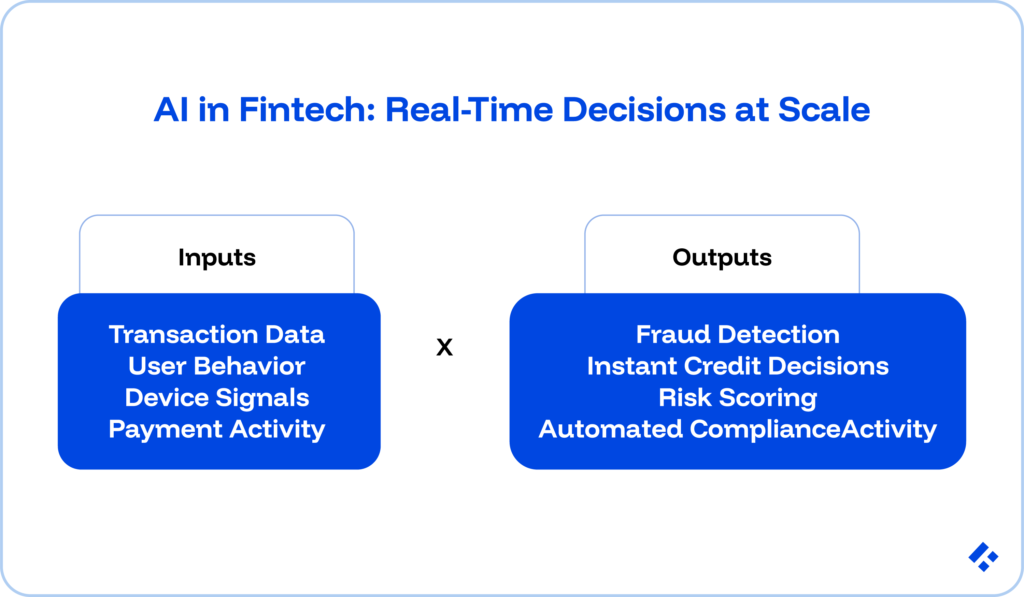
Loan approvals, fraud flags, trade executions, and credit limit changes all happen in seconds or milliseconds. Traditional rule-based systems cannot process enough signals fast enough. AI models can.
On top of that, the data richness that AI is able to process means that there is more information to base these decisions on.
Finally, regulatory pressure is very quickly becoming a performing function.
The compliance burden covering KYC, AML, PSD2, PCI DSS, and SOX creates both the need for automation and the data infrastructure that makes AI effective.
Requirements that cost human teams weeks of manual work become more manageable when AI handles initial screening, pattern detection, and reporting.
However, this AI is also very quickly becoming subject to regulatory pressure of its own. Automation is useful, but the automation itself needs to be carefully monitored. Decisions need to be explainable, and developers need to consider the future of the industry carefully.
8 Ways AI Is Transforming FinTech
There are many ways in which these factors have contributed to FinTech. We have organized these use cases and benefits by business outcome rather than technology type.
1. Fraud Detection That Adapts Faster Than Attackers
AI fraud detection uses machine learning models to analyze transaction data, device behavior, geolocation signals, and user interaction patterns in real time.
Unlike rule-based systems that flag transactions against static thresholds, ML models learn what “normal” looks like for each individual user and flag deviations.
It is able to analyze information that you can’t necessarily record in simple spreadsheets, which allows it to make highly contextual decisions.
This matters because fraud in FinTech is now AI-powered on the attacker side, too. Synthetic identity fraud, deepfake KYC attacks, and account takeover automation have made fixed rule engines increasingly unreliable.
Published meta-analyses place AI fraud detection accuracy at 87–94%, well above what static alternatives deliver, and an incredible number when you consider the fact that deepfake-based KYC attacks have increased 2,137% over three years.
2. Credit Decisions in Seconds, Not Days
Faster approvals and more inclusive lending.
As we have already mentioned, AI credit scoring trains machine learning models on historical repayment data, behavioral signals, and alternative data sources.
This alternative data could include things like transaction frequency, income regularity, and merchant category patterns.
All of this then generates credit decisions with greater accuracy and speed than traditional underwriting allows.
Traditional credit decisions rely on a narrow set of variables, which means that a meaningful share of creditworthy borrowers who are underbanked, new to credit, or self-employed with variable income are excluded.
By using this alternative data, AI models can approve more qualified applicants while reducing defaults.
For example, the model is able to approve someone with low expenses and an incredibly high income, because it can determine they are able to pay the money back, even though they have no credit history at all. It may also deny someone with a great credit score who’s overextending themselves.
GiniMachine’s AI credit scoring platform processed 10 million loan applications in 2024, increasing approval rates by 30% while cutting default rates by 25%.
The important thing to note here is that AI credit models need explainability features to satisfy ECOA and FCRA requirements, bias testing to meet fair lending standards, and real-time serving infrastructure.
Generalist ML engineers without a FinTech compliance context will likely underestimate these requirements.
3. Personalization at a Scale No Human Team Can Replicate
Products and advice that once required a premium account are now very easy to offer to every single user.
In many cases, services can be offered at a fraction of the cost they would have been several years ago, or for a very minimal cost, opening opportunities for differentiation.
Personalization in FinTech means tailoring features, offers, content, and support interactions to individual users based on behavioral, transactional, and contextual data, covering everything from investment recommendations to credit limit adjustments and notification timing.
More than 80% of financial professionals report measurable improvements in both revenue and cost reduction from adopting generative AI, according to industry survey data.
There are still limitations, of course. Gathering real-time life context remains difficult, which can produce recommendations that feel tone-deaf when a user’s circumstances change suddenly.
Even so, AI-driven personalized financial advice tends to be more grounded than what most users would access otherwise, especially for free.
Related Reading: Developing an Efficient Debt Management App
4. 24/7 Customer Support Without Headcount Growth
When AI handles the first 60–80% of support volume, the cost of customer service changes permanently.
AI-powered chatbots and virtual assistants built on NLP and large language models have handled customer queries, account inquiries, onboarding guidance, and routine service requests without human agent involvement. This doesn’t just happen in FinTech, but in almost all industries.
If a company has a chatbot on its website, it is likely that the users will interact with a chatbot first, before being routed to a human if required.
Modern conversational AI interprets intent, accesses account context, and routes complex cases to human agents when needed.
Natural language processing has reached the point where these systems understand nuanced requests in a tone appropriate to the situation. Many users may not realize they are interacting with an AI system at all.
Conversational AI built specifically for FinTech also covers layers that general chatbot platforms skip, like KYC system integration, account balance APIs, transaction history access, and escalation pathways that comply with financial services regulations.
Related Reading: Application Development Trends to Watch Out For
5. Risk Management That Moves at Market Speed
Continuous, adaptive risk scoring replaces the quarterly model validation cycles that used to be pretty standard in traditional risk management.
AI applies predictive analytics, real-time market data feeds, and behavioral modeling to assess credit risk, market risk, liquidity risk, and operational risk at a speed human risk teams cannot match.
AI models retrain continuously on incoming data, updating risk scores as market conditions, borrower behavior, and macroeconomic signals shift. preventing the mistakes that come with outdated data.
6. Compliance Automation That Scales With Regulation
Fewer manual reviews and lower regulatory fines have been an incredible benefit to the FinTech industry, provided by AI RegTech, which applies machine learning and NLP to automate KYC/AML screening, transaction monitoring, regulatory reporting, sanctions screening, and policy document analysis.
What previously required large compliance teams running manual reviews now runs in real time across every transaction.
This is especially impactful when you consider that the regulatory environment for FinTech companies keeps expanding.
EU AI Act requirements, evolving AML directives, CFPB oversight, new KYC requirements for crypto-adjacent products, and open banking standards all push in the same direction. Manual workflows do not scale to this volume.
7. Algorithmic Trading With No Human Lag
Human traders need time to review information and decide. By the time they act, markets have already moved. On top of that, human traders are affected by emotions and sometimes make trades that may not be entirely logical.
AI algorithms detect market fluctuations as they happen, analyze historical movements in under a second, and in some implementations execute trades without human involvement.
We have seen companies experimenting with these models to create investment management platforms that adjust portfolio strategies in real time based on current market conditions and user preferences.
Robo-advisors globally now manage trillions in assets.
Platforms like Acorns and Stash use AI to automate micro-investing, extending investment access to populations that were previously underserved by traditional financial products and services.
8. Operational Efficiency That Frees Engineering Capacity
The time engineering and operations teams spend managing process overhead rather than building products is one of the biggest constraints of FinTech, and AI can help address that.
Robotic process automation combined with ML and generative AI handles document processing, loan application intake, KYC document verification, reconciliation, and back-office reporting.
The Engineering Reality Behind AI in FinTech
Every benefit listed above requires engineering talent to build and maintain it. That means you need developers who are not just AI and automation experts, but those who are familiar with these technologies in the context of financial applications.
The talent gaps that most commonly block AI benefit delivery in FinTech:
- ML engineers with FinTech domain knowledge: Generalist ML engineers regularly underestimate compliance constraints and build systems that perform well in testing, then fail regulatory review.
- Data engineers who understand financial data pipelines: Most FinTech stacks carry data quality issues like incomplete transaction records, inconsistent API responses, and siloed compliance data. Engineers who have worked in FinTech know where to look for these problems before they become model failures.
- Integration engineers for financial APIs: Fraud detection integrates with payment gateways. Credit scoring integrates with bureau APIs. KYC automation integrates with identity verification providers. Prior experience cuts implementation time considerably.
Senior FinTech ML engineers command a $160,000–$200,000 base salary in the US market, with a 4–6 month average hiring timeline. This is a massive amount of money, and a timeline that most startups approaching a deadline cannot work with.
An alternative is to access pre-vetted, FinTech-domain-experienced AI/ML engineers through Trio. Since they have already been assessed, they can be placed into your team in 3–5 days.
On top of saving you time, the LATAM-based developers can be hired for rates between $40 and $90, depending on your requirements, without a drop in quality.
If you are ready to start hiring, request a consult.
Frequently Asked Questions
What are the main benefits of AI in FinTech?
The main benefits of AI in FinTech include fraud detection (87–94% accuracy), credit decisions in seconds rather than days, personalization at scale, 24/7 customer support without headcount growth, compliance automation, real-time risk management, and operational cost reductions.
How does AI improve fraud detection in FinTech?
AI improves fraud detection in FinTech since the models can analyze transaction patterns, behavioral signals, and device data in real time to catch anomalies, including novel attacks that static systems might have missed.
Can AI replace compliance teams in FinTech?
AI handles high-volume pattern recognition tasks like AML screening and KYC document verification well, but cannot entirely replace the regulatory judgment and accountability of human compliance teams in FinTech.
What is the difference between AI and ML in FinTech, and why does it matter?
AI in FinTech refers to the broader capability of machines to simulate human reasoning, while ML (machine learning) is a subset that allows systems to learn from large financial datasets and improve over time. The difference matters in financial applications because fraud models, credit scoring systems, and risk profiles all require continuous adaptation.