

Hire by Technology
SERVICES


Developing a debt management app means building at the intersection of personal finance, regulatory compliance, and security engineering.
Mistakes lead to a loss of user trust, which directly affects revenue and may even result in costly regulatory action and geographic restrictions.
Getting the strategy right from the start separates apps that users trust with their financial lives from apps that get uninstalled after the first data scare.
If you're building a fintech debt management or lending product and need an experienced development team, Trio's fintech-focused engineers can be placed in 3–5 days.
Building a debt management or lending app follows the same broad stages as any fintech product, but the compliance and security requirements add complexity that general app development guides tend to understate.
The process starts with understanding specifically what problem the app solves and for whom. The answer to that question determines almost every technical and compliance decision that follows.
For example, a product helping consumers track and pay down existing credit card and loan balances sits in a different regulatory category than a product that originates new credit.
After that framing, the development process follows five phases: discovery and market research, UX/UI design, architecture and tech stack selection, build and testing, and deployment, with compliance built into every stage.
A debt management app that requires users to manually enter their balances, interest rates, and payment dates produces lower-quality data and worse user retention than one that pulls this information automatically from financial institutions.
Open banking APIs, like Plaid, MX, and Yodlee in the US, or regional equivalents in other markets, can connect directly to banks, credit unions, and card issuers to synchronize balances, transaction history, and account data in real time.
This integration transforms the product experience by surfacing data automatically and keeping it current.
In a debt management app specifically, that usually means that discrepancies between what the user thinks they owe and what they actually owe disappear, and progress toward payoff goals reflects actual payments.
Integration also introduces compliance obligations.
When your app connects to banking infrastructure, it enters the regulatory frameworks governing financial data access, which usually lead to robust authentication, data minimisation, and clear consent flows.
The financial tasks users most want to avoid, like tracking every debt balance, calculating optimal payoff sequences, scheduling reminders before due dates, and monitoring progress against goals, are exactly the tasks automation handles well.
An app that automates these reliably becomes genuinely useful to users very quickly.
From what we have observed, the most impactful automations in debt management apps are:
Each of these requires reliable data connections, which is why integration and automation are tightly coupled.
The features that distinguish useful debt management apps from generic finance apps reflect a clear understanding of how people actually think about and manage debt.
Most users don't need more data. Instead, they value the framing, reliable automation, and a payoff plan they can actually follow.
This is a single view of all debts, including their credit cards, personal loans, student loans, auto loans, and perhaps even mortgages, with current balances, interest rates, minimum payments, and due dates.
The dashboard should update automatically from connected accounts rather than requiring manual entry, and should surface total debt, total monthly minimum obligations, and projected payoff timelines at a glance.
Two methodologies dominate effective debt payoff planning. The best approach is to support both:
An effective calculator lets users compare both strategies side by side, see the total interest paid under each approach, and choose based on their own priorities, recalculating automatically as balances change.
Missed payments are the most expensive mistakes in debt management, since they trigger late fees, penalty APRs, and credit score damage.
Users benefit from push notifications, timed to each account's actual due date (not a generic weekly reminder), to reduce missed payments meaningfully.
Visual progress indicators showing balance reduction over time reinforce motivation through the long middle sections of a payoff plan.
Users benefit from setting specific, time-bound goals and seeing their progress toward those goals updated in real time. Good examples include paying off a particular card by a certain month or reducing total debt to a target amount.
Debt payoff and budgeting often go together. A user who understands their monthly income and fixed expenses can identify how much discretionary income is available to accelerate debt payments.
A basic budgeting module that allows users to categorize spending, track income, and calculate surplus gives users the context to make informed payoff decisions rather than applying arbitrary extra payments.
AI-driven underwriting now accounts for over 43% of the digital lending market.
Consumer debt management apps are following the same direction, with the most effective products using machine learning to surface personalised recommendations (the specific debt to target next week based on upcoming rate changes), detect unusual spending patterns that might derail a payoff plan, and predict payoff timelines with greater accuracy than simple amortisation formulas.
If your product eventually connects to lending or credit features, AI credit scoring is increasingly a baseline expectation rather than a differentiator.
This is where we see most debt management apps get into trouble, and where Trio's fintech engineering expertise matters most.
A security or compliance failure in a personal finance app creates technical debt, but more importantly, it destroys user trust, triggers regulatory action, and, in serious cases, ends the product.
All financial data transmitted between the app and your servers should use TLS 1.2 or higher.
Data stored at rest (balances, account numbers, transaction histories, and personal information) should be encrypted using AES-256 or equivalent.
Multi-factor authentication (MFA) should be mandatory for any action that modifies financial data or account settings.
Biometric authentication (Face ID, fingerprint) improves both security and usability for mobile users.
For any app connecting to banking infrastructure, session management and token expiry policies require careful implementation.
Engineers working on the product should access only the data their specific role requires. This is both a PCI compliance engineering requirement and basic security hygiene.
Production financial data should never appear in development or test environments. Instead, you should use synthetic data that reflects production distributions without exposing real user information.
The compliance obligations your app carries depend on what it does and where it operates:
Users opening a debt management app are often dealing with financial anxiety, decision fatigue, or both. The design needs to reduce cognitive load rather than add to it.
The first screen a user sees should answer the most important question immediately: where do I stand?
We recommend that you include the total debt balance, the next payment due date, and the primary payoff, and also make sure that they are visible without scrolling.
Graphs and trend lines are useful context, but they shouldn't obscure the actionable information.
For debts that aren't connected via an open banking API, manual entry should be as frictionless as possible.
The user needs to enter a balance, an interest rate, and a minimum payment. Anything beyond that should be optional, not required. Progress through the entry flow should feel fast.
Percentage-based progress bars, projected payoff dates that move earlier as extra payments are made, and milestone celebrations when a debt is cleared all reinforce the behaviour that keeps users engaged.
Wireframing before writing code is one of the best ways we have found to prevent expensive rework.
For a debt management app, the essential wireframes cover the dashboard, the debt entry flow, the payoff calculator and comparison view, the notification settings, and the account connection flow.
Working through these flows in wireframes surfaces navigation problems, missing states (what happens when a payment is missed, or when all debts are paid off?), and accessibility gaps before any engineering time is spent.
Let’s break the development process into several steps to help you understand what it might look like.
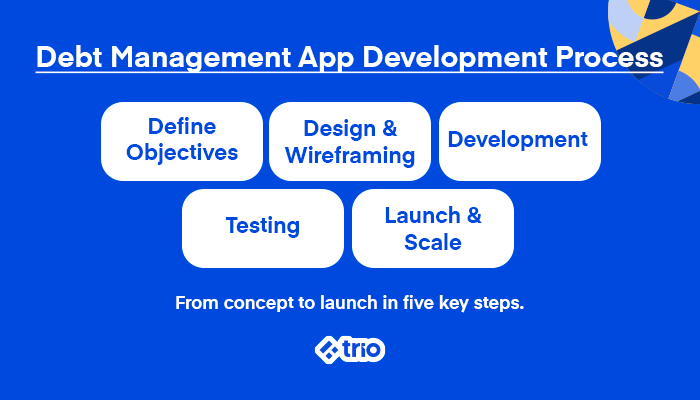
Clarify who the app serves and what their specific debt situation looks like.
As we have already mentioned, consumer credit card debt carries different mechanics than SME working capital loans.
Understanding the target user's actual pain shapes every feature decision. Also, research the competitive landscape to find out what existing apps do well, where users complain, and where there is a genuine unmet need.
Map the user journeys for the three or four core actions (adding a debt, viewing payoff options, making or recording a payment, and checking progress) and wireframe each.
Conduct usability testing on the wireframes before visual design begins.
In fintech specifically, clarity and trust signals (security badges, clear consent language, transparent data handling disclosures) belong in the UX design, not as afterthoughts.
For most debt management apps, a pragmatic stack will generally involve:
Development and testing happen in parallel. Automated testing should cover the financial calculation logic exhaustively, including interest calculations, payoff projections, and amortisation schedules. This is where precision errors are most damaging.
Penetration testing before launch is essential, since it's the mechanism by which you discover whether your authentication, session management, and API security actually hold under adversarial conditions.
Launch with the core features working reliably rather than with every planned feature working partially.
For a debt management app, the MVP should cover things like account connection or manual debt entry, the payoff calculator with both Snowball and Avalanche options, payment reminders, and progress tracking.
Everything else can follow once you have validated that users find the core product useful and trustworthy.
A debt management app at MVP stage typically needs a backend engineer, a mobile developer (or a full-stack engineer comfortable in React Native), a UX/UI designer, and a QA engineer.
Security and compliance expertise can come from a consultant at the architecture stage and a penetration tester before launch. Adding these as full-time hires from day one is rarely cost-effective at the pre-seed or seed stage.
This is the stage where staff augmentation with pre-vetted fintech engineers tends to be most efficient. You can add specific competencies without the overhead of full-time hiring for roles that may evolve significantly as the product matures.
For teams building fintech products, having access to fintech mobile app development expertise from engineers who have built production financial systems reduces the compliance and architecture learning curve that consumes early sprint cycles.
Trio places pre-vetted fintech engineers in 3–5 days at $40–$80/hr.