

 Read Client Stories





 Alex Kugell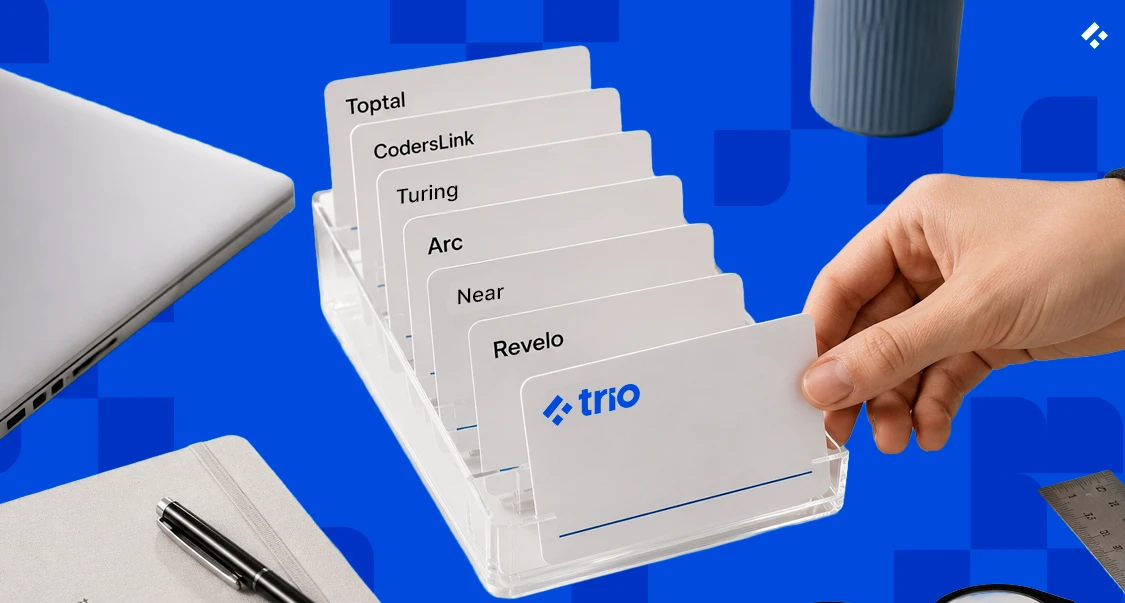
 Key Takeaways
- BairesDev is a genuinely large, well-reviewed vendor: 4,000+ engineers, roughly $800 million in 2024 revenue, and a strong Clutch track record.
- The three specific frictions are a $50,000 minimum project size, a 2-6 week sales process before you interview an engineer, and rates that independent analyses put at 1.5-2.5x leaner nearshore alternatives for comparable seniority.
- Arguably the most important factor is whether the engineer has actually shipped in a regulated environment, and whether the IP assignment chain and compliance posture would survive a real audit.
BairesDev is an incredibly popular option to hire nearshore developers. However, it’s not the best option for everyone.
Most buyers that we have worked with end up leaving or avoiding BairesDev because of their $50,000 project minimum, the 2-6 week sales cycle before meeting an engineer, and the senior rates that run well above leaner nearshore providers for comparable seniority.
Fortunately, there are plenty of alternatives available that may be the right fit if BairesDev is not.
Some of the best BairesDev alternatives in 2026 include Trio, Revelo, Near, CodersLink, Turing, Toptal, and Arc.dev.
If you decide Trio is the best option for you, or you want to find out more, compare options.
Why Teams Look for BairesDev Alternatives
In many ways, BairesDev provides an incredible service, and there is a lot that is done genuinely well.
Founded in 2009, it has built a genuinely large operation, with over 4,000 engineers, and roughly $800 million in reported 2024 revenue (up from about $550 million the year before).
Their Clutch profile has dozens of verified reviews sitting close to a perfect score.
For many companies, it is a genuinely good fit.
However, there are several different factors that completely remove BairesDev as an option for many firms:
- The $50,000 project minimum: If you need two or three junior engineers for a six-month sprint, you’re likely below that floor.
- Pricing sits behind a sales process: There’s no public rate card, although Clutch lists a blended $50-99/hr.
- The sales cycle: Client reports and aggregated reviews put the process at 2-6 weeks from first call to actually interviewing an engineer.
- Rate opacity below the headline number: The blended rate bundles compensation, benefits, payroll taxes, recruiting, and account management, but the split isn’t disclosed. Several engagements also carry a reported FX buffer of 2-4% per invoice, worth noting on a six-figure annual engagement.
None of this makes BairesDev a bad vendor. Instead, it makes it a vendor built for a specific buyer, namely, enterprise-scale organizations who need ten or more engineers, a multi-year commitment, and that have a procurement function that can absorb a multi-week sales process.
How We Evaluated These Alternatives
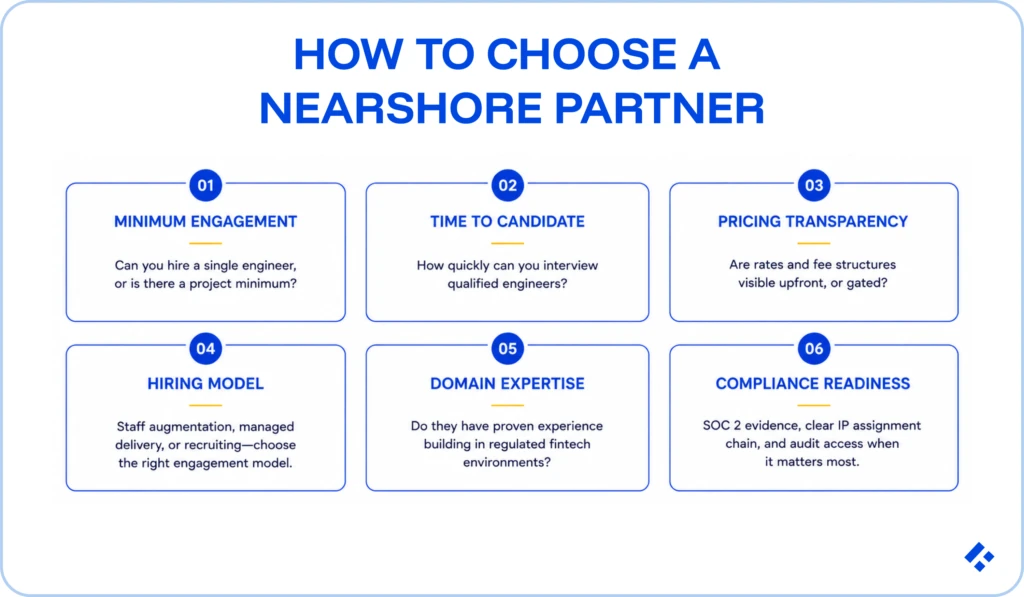
Here’s exactly how we judged all seven, including ourselves, against six questions:
- Minimum engagement: Can you hire a single engineer, or is there a project floor?
- Time to first candidate: Days, or weeks?
- Pricing transparency: Published, or gated behind a discovery call?
- Engagement model: Staff augmentation (you direct the work), managed delivery (the vendor owns the outcome), or recruiting (the hire lands on your own payroll)? These are three different products, and most comparison pages blur them together.
- Domain depth: A generalist bench, or engineers who’ve actually shipped inside a regulated environment?
- Compliance posture: SOC 2 evidence, a clear IP assignment chain, and audit access for anyone touching sensitive systems.
Build with Trio
Looking for a nearshore engineering partner?
Share your team’s requirements, delivery goals, and preferred engagement model. Discuss your options with Trio.
Meet engineers from the Trio network


 Back-End Developer


These profiles show our network. We’ll confirm skills, fit, and availability for your project.
Tell us what you’re building
Share your requirements. Our team will follow up to discuss a match.
Thanks for reaching out.
Your inquiry has been saved. Our team will review your project details and follow up using the email you provided.
Back to TrioThe 7 Best BairesDev Alternatives in 2026
| Provider | Model | Minimum | Time to candidates | Rates | Best for |
| Trio | Staff aug/dedicated teams | 1 engineer | 3-5 days | $40-80/hr ($7K-14K/mo) | Fintech and regulated engineering |
| Revelo | Staff aug | 1 engineer | ~72 hrs to shortlist | Published, nearshore rates | Long-term embedded LATAM teams |
| Near | Multi-function staffing | 1 hire | ~2-3 weeks | Varies by function | Hiring across eng + finance + ops |
| CodersLink | Staff aug/EOR/recruiting | Model-dependent | ~1-2 weeks | Quote-based | Mexico-focused mid-market |
| Turing | AI-matched talent network | 1 engineer | ~1 week | Quote-based | AI/ML and data-heavy builds |
| Toptal | Freelance network | 1 engineer | ~1-2 weeks | $60-150+/hr | Short-term specialist gaps |
| Arc.dev | Freelance marketplace | 1 engineer | ~72 hrs | $60-110/hr | Fast, self-directed hiring |
1. Trio: Best for Fintech and Regulated Engineering
Some of the hiring models available through Trio include staff augmentation and dedicated teams. Engineers join your standups, your repo, and your sprint, allowing you to direct the work and keep control
There’s no minimum or project floor, so you can hire. Since every developer is pre-vetted and just needs to be selected based on your requirements, placement runs 3 to 5 days.
Rates for senior fintech specialists from various nearshore and offshore regions range from $40 to 80/hr, or $7K to 14K/month, all-inclusive.
The real differentiator is Trio’s vertical fintech benches (payments, ledger, KYC/AML, core banking, fraud, RegTech) built as dedicated specialties. Developers understand industry requirements, and engagement structures are SOC 2-ready, with an IP assignment chain designed to hold up under audit.
Choose this over BairesDev when: you’re a fintech running under ten engineers of external headcount, you need someone who’s actually built a double-entry ledger or an EDD escalation path before, and a six-week procurement process isn’t realistic for your timeline.
Not for you if: you want a vendor to own end-to-end delivery of a project you’d rather not manage yourself, or you’re staffing a non-technical function.
2. Revelo: Best for Long-Term Embedded LATAM Teams
Revelo has a 400,000+ engineer network across Latin America, a roughly 72-hour shortlist turnaround, client-led interviews, and published nearshore staff augmentation pricing.
That last point is a primary reason why many people choose this option against BairesDev’s contrasting gated model.
Payroll, compliance, and benefits sit with Revelo across the countries it operates in, giving you the freedom to hire from locations that would not have been open to you otherwise, like many other options on this list.
Choose this over BairesDev when: you want a large network, transparent published pricing, and to run your own hiring loop end to end.
Not for you if: you need deep vertical specialization. The network is broad by design, not domain-curated the way a smaller, focused bench is.
3. Near: Best for Multi-Function Nearshore Hiring
Near places engineering roles alongside finance, operations, marketing, and admin roles across LATAM, all through a single staffing relationship rather than separate vendors per function.
This means you don’t need additional partnerships when you need staffing outside of development positions. However, it does come at the trade-off of true niche specialization.
Choose this over BairesDev when: you’re building a broader nearshore back office, not just an engineering pod.
Not for you if: you need engineering-specialist depth specifically. A generalist agency covering many functions at once, by its own positioning, runs a shallower engineering bench than a provider built around engineering alone.
4. CodersLink: Best for Mexico-Focused Mid-Market
CodersLink has three primary engagement models: staff augmentation, EOR, and recruiting.
Each has its own minimum commitment, and strong operational infrastructure specifically for Mexico (labor law compliance, statutory registration handled on your behalf), which matters more to most US buyers than they initially expect.
Choose this over BairesDev when: Mexico is your target market or your timezone anchor, and you want a choice between more than one engagement model.
Not for you if: you want sourcing breadth across all of LATAM rather than a Mexico-first focus.
5. Turing: Best for AI/ML and Data-Heavy Builds
Turing is an AI-matched talent network with a large global pool and fast matching turnaround.
The company itself tries to be at the forefront of AI development, offering products alongside their staffing models.
This indicates that they have the in-house skills available to thoroughly assess developers in this niche. However, this would only be utilized in the initial developer vetting, not necessarily in the placement.
Choose this over BairesDev when: the roles are ML, MLOps, or data engineering, and you’re optimizing for matching speed over white-glove account management.
Not for you if: you need compliance-grade domain vetting specifically. Matching quality here leans algorithmic; a dedicated fintech-specific screening process isn’t the product’s focus.
6. Toptal: Best for Short-Term Specialist Gaps
Toptal is a freelance network with a strong screening reputation and premium rates ($60-150+/hr depending on specialization).
Their exclusivity is what truly makes them stand out, with a hiring process that focuses on procuring top talent in a variety of fields.
It’s important to keep in mind that everyone you hire through Toptal is essentially a freelancer, which may not be the most suitable hiring model for your situation.
Choose this over BairesDev when: you need one senior specialist for a defined, bounded stretch of work, not an ongoing team.
Not for you if: you need retention as part of the value proposition. Freelancers move between engagements; that mobility is inherent to the model, not a flaw in execution.
7. Arc.dev: Best for Fast, Self-Directed Hiring
Arc is a marketplace model with roughly 72-hour matching and rates in the $60-110/hr range, built for speed and flexibility.
Their HireAI model does not allow clients to view initial portfolios in seconds, but it isn’t as personal as a hand-picked placement, and you only have a 90-day replacement guarantee.
Choose this over BairesDev when: you already have strong internal engineering leadership and just want fast access to candidates.
Not for you if: you want the vendor itself to carry meaningful vetting risk on your behalf. A marketplace model puts more of that evaluation burden back on you.
BairesDev vs. the Alternatives: The Pricing Reality
| BairesDev | Leaner nearshore (Trio included) | |
| Senior engineer | Roughly $70s-90s/hr per most analyses, up to $100-180/hr for specialists per some sources | $60-95/hr |
| Blended | $50-99/hr (Clutch) | $40-80/hr |
| Minimum | $50,000 project | 1 engineer |
| Time to first interview | 2-6 weeks | 3 days to 2 weeks |
| Pricing published | No | Varies (Revelo yes, Trio yes) |
| Extras | FX buffer of 2-4% per invoice reported | Typically bundled into the quoted rate |
A senior engineer around $90/hr full-time works out to roughly $15,000-16,000 a month.
The same seniority through a leaner nearshore provider often lands closer to $10,000-14,000 a month, which, across a four-person pod over twelve months, could add up to a six-figure difference, or enough for another hire or two.
What’s important to keep in mind is what BairesDev is offering. Their rate bundles delivery managers, QA coordinators, and account infrastructure, which not every competitor does.
If you don’t already have engineering management capacity of your own, that overhead may be worth considering.
Fintech Niche Capabilities
When working in industries like fintech, you need to know that your engineers know everything they need to for you to successfully move in a regulated region.
A capable generalist backend engineer assigned to a payments team without that specific background is a risk more than a cost saving.
Even within the fintech niche as a whole, there are subcategories that require genuine specialty, like reconciliation correctness.
Also ask about things like IP assignment chains: the engineer, to the nearshore entity, to the vendor, to you. Not every LATAM jurisdiction treats moral rights the same way a US-style assignment contract assumes.
Finally, consider if these engineers could actually survive a SOC 2 audit. You will need to know about access provisioning, offboarding evidence, background checks, and a documented change-management trail.
How to Choose: A Decision Path
Choosing the right nearshore software development partner can be daunting. Consider these questions to help you narrow down your decision:
- Need ten or more engineers, a multi-year commitment, and want the vendor to run delivery end to end? BairesDev is a genuinely strong fit here. Stay with it.
- Need one to five engineers and already have your own engineering manager? Staff augmentation, Trio, Revelo, or CodersLink.
- Building in payments, lending, banking, or anything a regulator will eventually read? A domain-benched provider specifically. Trio.
- Need one specialist for an eight-week stretch? Toptal or Arc.dev.
- Are roles ML or data-first? Turing.
- Hiring across engineering and non-technical functions at once? Near.
- Want the hire to eventually land on your own payroll? A recruiting or EOR model, CodersLink among them.
If you want to learn more about how we work and whether or not Trio is the right fit for you, book a decision call.