

 Read Client Stories





 Alex Kugell
 Key Takeaways
- The EOR fee itself, $199-699/month depending on provider tier, is the smallest layer of total cost. Employer contributions and statutory obligations usually add far more, and can vary a lot by country.
- Percentage-of-payroll pricing (commonly 8-20% of salary among EOR providers specifically, versus 2-12% for domestic PEO arrangements) is a poor fit for engineering roles, since it scales with salary.
- Country choice moves the loaded cost of a hire more than provider choice does.
- Recruitment, time-to-fill, and replacement costs are yours under an EOR. Under staff augmentation, they’re already built into the number you’re quoted.
- The entity-versus-EOR breakeven point is roughly 8-12 employees, but it could be as high as 15-25 depending on the specific country.
EOR fees run $199-$699 per employee per month. A good middle ground to help you estimate in sectors like fintech is $400-$600.
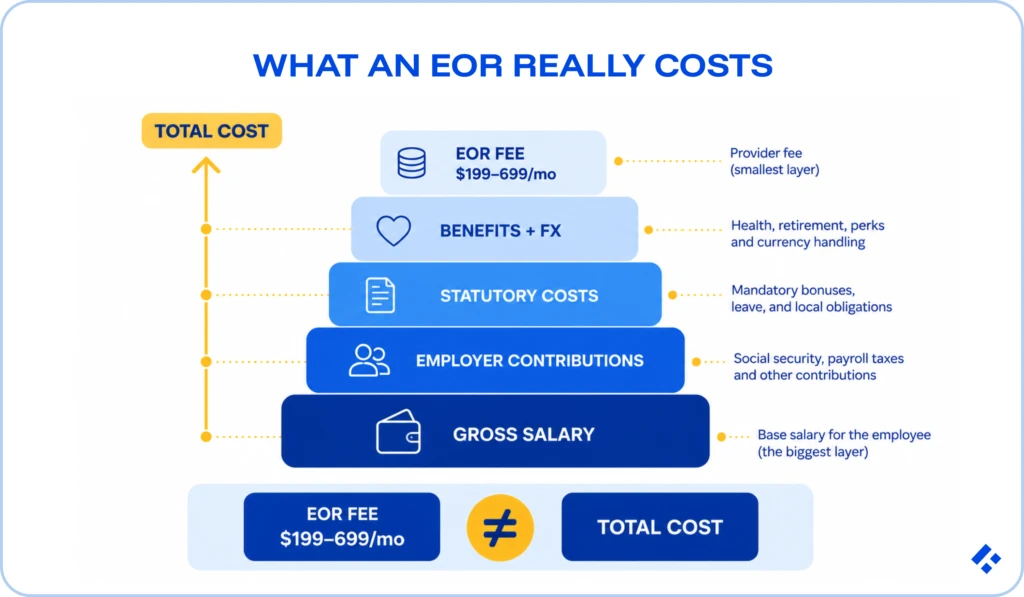
But the fee is not the only cost. In fact, it’s the smallest layer.
Employer contributions, statutory bonuses, and benefits markups sit underneath it, and for engineering salaries specifically, the total often lands 40% or more above gross pay.
Let’s go into how much an employer of record costs, where you could potentially minimize those costs, and a variety of factors that you need to consider.
At Trio, we offer a variety of different models to connect you with skilled software developers with production experience in regulated industries like fintech.
The Short Answer
| Provider tier | Fee per employee per month |
| Entry / smaller vendors | $199-349 |
| Market median | $400-599 |
| Major platforms (Deel, Remote, Oyster) | ~$599-699 |
| Enterprise / quote-based | $800-1,200+ |
| Commonly cited average | ~$399-400 |
This is what an EOR charges, but not what an employee actually costs.
Employer contributions, statutory bonuses, benefits markups, and FX handling are all additional costs that you need to be aware of.
It’s also worth knowing that discounts typically open up around 10 employees.
The Pricing Models: and the One That Punishes Engineering Hires
| Model | How it works | Predictable? | Fits |
| Flat per-employee-per-month | Fixed fee regardless of salary | Yes | Almost all engineering hiring |
| Percentage of payroll | Commonly 8-20% of gross compensation among EOR providers | No, scales with salary | Low-salary, high-volume roles |
| Hybrid enterprise | Blended, negotiated | Partly | Large multi-country programs |
| Pay-as-you-go | Per-event or per-cycle charges | No | Very small or irregular headcount |
As you can likely already tell, percentage-of-payroll pricing is a poor fit for engineering specifically, because engineering salaries are relatively high.
Also keep in mind that you need to watch out for country surcharges. A $199/month vendor that surcharges certain countries can end up costing more than a $299/month vendor that doesn’t.
Make sure that you compare providers against your actual country mix before deciding on one.
What Sits Under the Fee
| Layer | What it adds | Notes |
| Gross salary | Baseline | The number people quote and compare |
| Employer social contributions | Varies enormously by country | The largest and most variable layer |
| Statutory bonus (where mandated) | Commonly 8%+ of annual salary | Mandatory across most of LATAM specifically |
| EOR platform fee | $199-699+/employee/month | The visible line |
| Benefits markup | Varies | Provider-dependent, often a margin on premiums |
| FX handling | Commonly 1-3% | On cross-currency invoices specifically |
| Onboarding/conversion fees | One-time, $0-500 typically | Higher when converting an existing contractor |
| Termination/offboarding | One-time, $250-1,000 typically | Severance itself is separate and statutory |
Employer contribution rates are worth knowing, since they can greatly affect your final costs.
Chile and similar low-burden markets commonly run in the low single digits, the US around 7.65-12%, the UK around 13.8%, Colombia and Argentina in the low-to-mid 20s percent range, Mexico around 30%.
Brazil is among the highest in the region once every mandatory component, social contributions, the 13th-month salary, vacation accrual, and FGTS, is bundled together rather than counted as separate line items.
You also need to keep LATAM’s currency volatility in mind.
For example, the Argentine peso lost over 100% against the dollar in 2024. This means an EOR contract for Argentine hires needs a clearly stated FX policy.
The Costs That Never Reach the Invoice
- Recruitment: Sourcing a senior LATAM engineer independently means job posts, screening, and interview loops. Agency placement fees run 15-25% of first-year salary.
- Time to fill: Senior engineering searches commonly run weeks to months. A slipped roadmap item can cost a lot in and of itself.
- Vacancy and replacement: If the engineer leaves, the whole cycle repeats, and under an EOR, finding the replacement is entirely your problem.
- Ramp-up: New engineers reach full productivity over weeks to months regardless of which model brought them on.
EOR vs Staff Augmentation vs Contractor vs Entity
People compare an EOR salary to a staff augmentation hourly rate, but this is not accurate. To compare properly, convert both to annual all-in cost per engineer.
| Contractor | EOR | Staff Augmentation | Local Entity | |
| Visible annual cost, senior LATAM engineer | ~$70,000 invoiced | ~$95,000-105,000 loaded | ~$120,000-150,000 (at $60-75/hr, 2,000 hrs) | ~$95,000 + entity overhead |
| Recruitment cost | Yours | Yours | Included | Yours |
| Replacement cost | Yours | Yours | Included | Yours |
| Misclassification exposure | High | Removed | Provider’s | None |
| Entity setup | None | None | None | $20,000-100,000+ and months |
| Breakeven vs entity | N/A | Country-dependent | N/A | Above that |
On visible cost alone, staff augmentation looks like the most expensive option, but you need to keep in mind that recruitment, vacancy, and replacement are already built into the number.
Contractor is the cheapest visible option but carries real misclassification exposure, which could cost you as much as $50,000-500,000+ per worker, with retroactive liability, back benefits, contributions, profit-sharing, and interest.
Entity setup cost varies enormously by country, but is usually around $20,000 at the low end.
How to Get a Comparable Quote
An itemized on-cost list naming every employer contribution, statutory bonus, and premium is absolutely essential.
Ask for confirmation of the actual pricing model, flat per-employee-per-month, in writing.
One of the best ways to get this done is to ask for a sample invoice at your actual salary level, in your actual country, before signing anything.
At Trio, we provide all of this and more. We understand that fintech talent specifically can be incredibly expensive. Our models not only provide cost savings, but also transparency.