

 Read Client Stories




 Alex Kugell
 Key Takeaways
- Argentina has grown into one of the three largest fintech ecosystems in Latin America alongside Brazil and Mexico, with 939 fintech companies as of 2026, according to Chambers and Partners.
- Senior fintech developers in Argentina cost $46,000 to $82,500 per year for US-facing remote roles in 2026, averaging $58,392. Developers with fintech, payments, or compliance backgrounds cost 20% to 30% more than general developers.
- Argentina ranked 15th globally and 2nd in Latin America in the Chainalysis 2024 Global Crypto Adoption Index, producing a pool of engineers with genuine production crypto and stablecoin experience driven by real consumer demand.
- Individual vetting is still required, but Argentina’s active ecosystem means a targeted search surfaces more fintech-experienced candidates than most markets.
Argentina is widely known as one of Latin America’s strongest general software engineering markets, thanks to its deep STEM education, the best English proficiency in the region, and large talent pool.
However, we have found that Argentina is specifically strong for fintech engineering. This can be attributed to the country’s fintech ecosystem itself.
Argentina’s persistent high-inflation environment drove a digital banking and payments wave, followed by a crypto and stablecoin wave.
The result is an engineering talent pool with genuine, hands-on experience building payment systems, digital banking infrastructure, card issuing platforms, and crypto applications at scale.
However, hiring from Argentina is not the right choice for every company, and not all developers in the country are guaranteed to have the right skills for your fintech firm.
Let’s look at everything you need to know about finding and hiring fintech developers in Argentina, including the skills that the ecosystem produces, what these developers cost, how to vet them for fintech-specific competency, and the practical considerations for hiring them.
At Trio, we take care of all of the vetting and sourcing on your behalf. We simply need to select developers from our talent pool based on your requirements, so you can access the right talent in as little as 3-5 days.
Why Argentina Produces Strong Fintech Engineers
While Argentina’s tech talent is incredibly educated, English-proficient, and cost-effective, the most beneficial consideration for fintech specifically is that the ecosystem has trained a generation of Argentine engineers in financial systems.
The Digital Banking and Payments Wave
Argentina now ranks among the three largest fintech ecosystems in Latin America with 939 companies, a figure that reflects steady compounding growth over several years.
The fintech market is valued at $4 billion in 2025 and projected to reach $9.7 billion by 2033, per DataCube Research.
Mercado Pago, the financial arm of MercadoLibre, has played a massive role in this, along with Ualá, founded in 2017, which has grown into a digital bank with millions of users across Argentina, Mexico, and Colombia, offering cards, payments, loans, and investment products.
Naranja X serves millions of users across Argentina’s interior. Pomelo, founded by veterans of Naranja X, Mastercard, and Mercado Pago, built modern payment infrastructure (card issuing, payment gateway, BaaS) that is now used by fintechs across the region.
These companies have produced many experienced engineers by providing experience in systems that US and EU fintechs build, such as payment processing, digital wallets, card issuing, lending workflows, and KYC onboarding at scale.
Related Reading: Guide to Outsourcing Software Development to Argentina.
The Crypto and Stablecoin Wave
Argentina’s inflation environment, which exceeded 100 percent annually in recent years, has massively encouraged crypto adoption.
Cryptocurrency and dollar-pegged stablecoins can be used as stores of value and inflation hedges.
Companies like Lemon Cash, Bitex, and Belo built crypto wallets, exchanges, and remittance products serving real consumer demand at significant scale.
The result has been a pool of engineers with genuine production crypto and blockchain experience.
From what we have observed, these developers are ideal for working on systems handling real money for real users in a financially demanding environment.
The Argentine Fintech Talent Pool and Hubs
Argentina has an estimated 115,000+ active software developers, with approximately 27,000 new IT graduates entering the market annually.
As with most other cases, the fintech-experienced subset of this pool concentrates in the cities where the ecosystem is anchored.
- Buenos Aires is home to most of Argentina’s tech talent and the headquarters of MercadoLibre/Mercado Pago, Ualá, and Brubank. It holds the deepest pool of senior fintech engineers in the country and the largest concentration of engineers with production fintech experience.
- Córdoba is Argentina’s second-largest tech hub and the headquarters of Naranja X. It carries strong fintech engineering depth, particularly in consumer financial products and digital banking.
- Rosario and Mendoza are growing secondary hubs. Mendoza has attracted senior remote-first developers who prefer working outside Buenos Aires, making it a relevant pool for fully remote engagements.
Common Fintech Skill Sets Among Argentine Developers
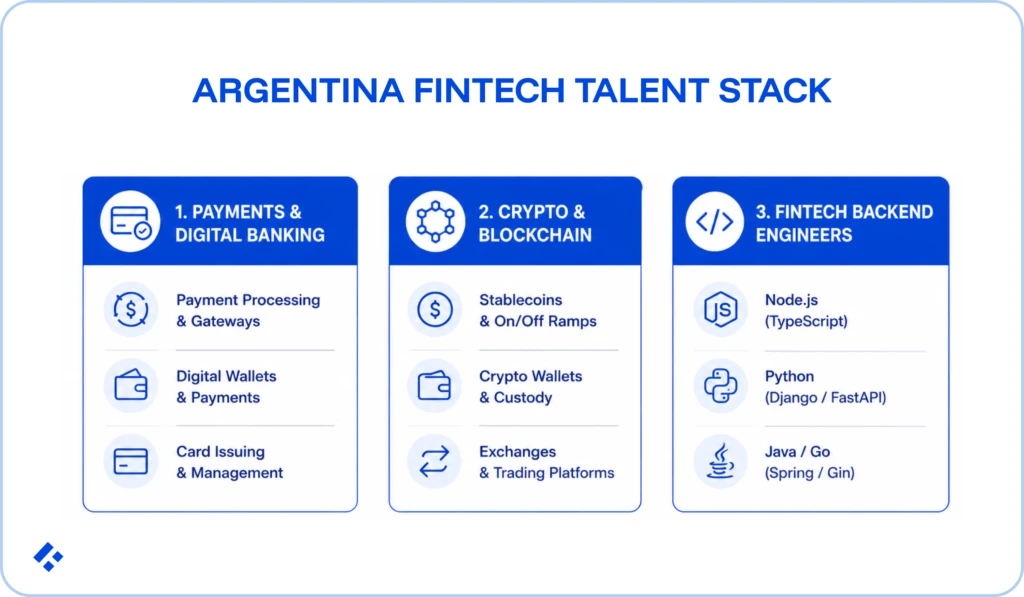
Argentina’s fintech engineering talent pool clusters around three skill profiles, each shaped by a different part of the local ecosystem.
Profile 1: Payments and digital banking engineers: Engineers from the Mercado Pago, Ualá, Naranja X, and Pomelo ecosystems with production experience in payment gateway integration, digital wallet architecture, card issuing and management, transaction processing at scale, and the ledger and reconciliation systems that underpin digital banking.
Profile 2: Crypto and blockchain engineers: Engineers from Lemon Cash, Bitex, Belo, and the broader crypto ecosystem with production experience in crypto wallet architecture, exchange systems, stablecoin integration, blockchain transaction handling, and the compliance considerations specific to crypto.
Profile 3: General fintech backend engineers: Engineers with strong general backend skills and fintech domain exposure through working at financial products companies. They understand financial data conventions and compliance basics.
Common technical stack across the pool:
- Backend: Node.js, Python, Java, Go, .NET (strong .NET presence reflects enterprise and banking sector history)
- Frontend/Mobile: React, React Native (high cross-platform mobile demand from consumer fintech)
- Cloud: AWS (dominant), GCP
- Data: PostgreSQL, Redis, Kafka for event streaming
- Strong mobile-first development reflecting the consumer-fintech-heavy local market
Fintech Developer Rates in Argentina
Argentine fintech developer rates are competitive within LATAM and substantially below US domestic benchmarks.
However, fintech expansion across Latin America has also driven 20 to 30 percent premiums for developers with financial services experience over general developers at comparable seniority.
Annual salary ranges for US-facing remote roles (2026):
| Seniority | Annual (USD) | Hourly equivalent |
| Junior (0–2 years) | $21,000–$28,000 | ~$18–$25/hr |
| Mid-level (2–5 years) | $35,000–$55,000 | ~$25–$45/hr |
| Senior (5+ years) | $46,000–$82,500 | ~$45–$75/hr |
| Senior AI/ML or specialised fintech | $85,000–$100,000 | ~$70–$90/hr |
The average remote developer working with US companies earns approximately $58,000 per year.
Buenos Aires, with its higher cost of living and the greater competition for developers there, is typically 10 to 15 percent more expensive than other regions. As we discussed above, it is also where most of the country’s fintech talent congregates.
The most important thing is for you to hire developers with the specific payments, digital banking, or compliance backgrounds that you need.
They may be more expensive, but this premium is well worth paying when compared to the 4 to 8-week fintech domain ramp that a general developer requires before contributing safely in a regulated financial environment.
It is also important to note that Argentina’s peso fluctuates significantly against the dollar. This is a non-issue for the hiring engagement when developers are paid in USD, which has become standard practice for Argentine developers working with international companies.
This still provides massive savings compared to the $150,000 to $220,000 for equivalent US roles. On average, we see a 50 to 65 percent cost reduction while maintaining LATAM timezone alignment.
How to Vet Argentine Fintech Developers
A well-targeted search in Argentina is going to surface more candidates with genuine domain knowledge than in many other places.
But whether any individual engineer has the specific competencies your product needs should still be confirmed through vetting, not assumed from their country or employer history.
We do this vetting on your behalf here at Trio, but if you decide to hire on your own, then there are five fintech competencies to screen for:
- Monetary precision: Does the candidate know why monetary amounts must be stored as integer minor units or DECIMAL/NUMERIC types, never as FLOAT?
- Payment idempotency: Can they describe the client-generated idempotency key pattern and explain what happens in the write-ahead log gap in payment retries?
- KYC/AML state machine design: Would they design KYC as a stateful lifecycle with ongoing monitoring, or as a verified boolean?
- PCI DSS scope management: Do they understand SAQ A versus SAQ D and how hosted payment pages affect the cardholder data environment scope?
- Regulatory framework awareness: Do they understand which regulatory frameworks apply to the systems they build, at the engineering-implication level, not just as acronyms?
Practical Hiring Considerations
When hiring from another country, you need to consider timezone overlap and potential language barriers.
Argentina operates on ART (UTC-3), which is roughly one to two hours ahead of US Eastern time (depending on US daylight saving).
This means that most of the working day of an Argentinian and a US developer overlaps, allowing them to communicate in real time and take care of issues as soon as they emerge. This synchronous collaboration is critical for dealing with regulatory issues in fintech.
When it comes to language, Argentina ranks highest in LATAM for English proficiency in the technology sector.
This reduces the communication friction, but you will still need to vet each developer individually, as there will still be some variation.
Legal hiring models
Four options exist for hiring Argentine developers:
- Managed platform/staff augmentation (Trio’s model): A partner employs or contracts the developer and places them with you. You manage the work, while the partner handles employment, payroll, compliance, and currency.
- Employer of Record (EOR): A third party employs the developer on your behalf in Argentina, handling local compliance. This has a higher recurring cost than contractor engagement.
- Independent contractor: This is a direct engagement. Argentine developers typically operate under the Monotributo regime (a simplified tax category for independent contractors) or as Responsable Inscripto. You manage the relationship and USD payments directly.
- Local entity: You establish your own Argentine legal entity. This is only justified at a significant hiring scale.
Hiring Argentine Fintech Developers Through Trio
At Trio, we place pre-vetted senior fintech developers, sourced from all over LATAM. These developers have all had experience working with US and EU fintech companies.
This means you can rest easy, knowing that every developer you work with has the relevant domain context from the local ecosystem, rather than requiring extensive orientation before contributing safely in a regulated environment.
Placement can happen in as little as 3 to 5 days at $40 to $80 per hour ($7,000 to $14,000 per month), with US timezone overlap and the fintech domain depth that Argentina’s ecosystem produces.