

Hire by Technology
SERVICES



To ramp up augmented engineers on a regulated codebase, you essentially need to teach them to distrust their best instincts.
Especially if you are hiring general engineers without niche-specific experience, the reflex to refactor, delete dead code, and simplify may be strong. Usually, this is the mark of a strong engineer.
In fintech, this becomes a liability, since the weird code is often written that way on purpose because a regulator required it.
An easy way to minimize ramp-up time is to hire developers who have several years of production experience in codebases that face your specific regulations. At Trio, we specialize in fintech, pre-vetting developers so you can access them in 3-5 days.
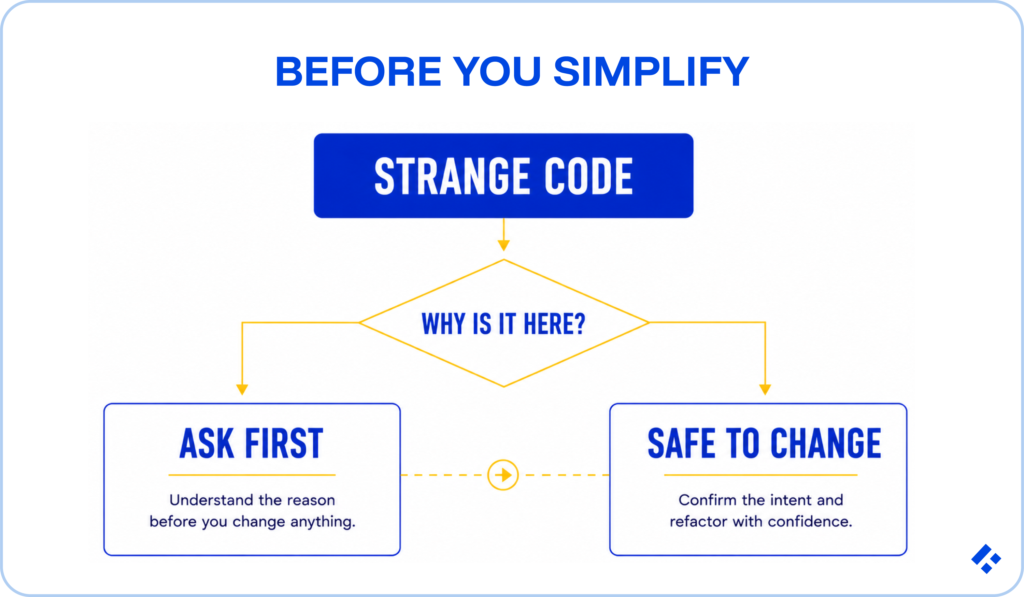
Chesterton's Fence is an idea from G.K. Chesterton's 1929 book "The Thing," which states that you shouldn't tear down a fence across a road until you understand why someone put it there in the first place.
In legacy code specifically, it’s become a standard best practice and for good reason.
Before deleting the strange-looking check or the redundant validation, you need to understand what it actually does.
In an ordinary legacy codebase, that fence is usually there for a technical reason, such as a race condition someone hit years ago, a downstream system that chokes on a null value, or something reconstructable from the code itself and its git history.
In a regulated codebase, a second category of fence shows up that developers hired through general IT staff augmentation might not be familiar with. These include a regulator, an auditor, or a sponsor bank requirement.
They're far harder to see, because the reasoning behind them usually lives in a compliance document, audit finding, or a settlement, rarely showing up in the repository at all. Your new engineer may never have read these documents or even know they exist.
Common examples we see include:
Provided you went with a reliable nearshore software development company, your augmented engineer is likely good. The ramp isn't really about making them competent.
Unless that hiring firm was specifically a fintech software development company, you need to ramp compliance awareness.
Let’s take the standard virtues of a strong engineer, and how these need to be shifted during ramp-up so they can work effectively in a regulated context.
It’s worth noting that none of these recalibrations make an engineer slower everywhere in the codebase. They only affect them in a specific, learnable set of places, and full speed everywhere else.
Even a generalist who's never seen a payments system can absolutely learn what to look for.
Everywhere else, dead code is debt, and removing it is basic hygiene.
When dealing with regulations, however, apparently-dead code may be retained deliberately for audit purposes, may feed a report on a schedule that isn't visible from the codebase, or may exist as a legally required fallback path.
Recalibration: dead code gets a ticket and a question attached to it, not a delete, until somebody with the context confirms it's genuinely dead.
Simpler is usually better. But a convoluted-looking calculation may encode a regulatory formula exactly as written, and simplifying it can change a number that has to match a filing somewhere.
Payment code in particular tends to accumulate entropy because engineers get scared to touch it. Instead of not refactoring it at all, developers need to refactor with a test that pins the regulated behavior first.
Recalibration: characterize existing behavior with tests before changing it, and treat any output that leaves the system as a nonnegotiable contract.
Deduplicating similar-looking logic is clean design in general software development. But two validations that look identical may serve two regulatory purposes that are legally allowed to diverge later.
In this specific instance, merging them couples two things regulation may eventually pull apart, creating more work later or even resulting in issues during audits.
Recalibration: confirm two things really are the same requirement before unifying them.
As we have already mentioned, engineering risk and regulatory risk are very different.
Something as simple as a one-line change to a log message, for example, can be low-risk from a pure engineering standpoint and high-risk if that specific log happens to be audit evidence.
Recalibration: learn which parts of the system count as regulated surface area, and apply a different speed there regardless of how small the change looks.
Usually automation, wherever possible, is the right call. But a required human approval sometimes exists purely because a human is the requirement.
In these cases, the inefficiency cannot be optimized.
Recalibration: before automating anything manual, ask directly whether the manual-ness itself is the actual point.
Laying out these rules is relatively simple, but actually communicating them to an engineer, within a reasonable amount of time, is significantly more difficult.
Write down which services, modules, and data flows are regulated, and by what specifically.
A new engineer can't develop caution about a boundary that nobody has ever drawn for them.
Even a rough annotation on an existing architecture diagram may be enough to change behavior almost immediately.
A comment reading something like "rounds half-up per [regulation], do not change without compliance sign-off" makes fences clear.
Similarly, tests named for what they protect can be incredibly valuable.
With that said, nobody can annotate everything, but every fence made visible this way is one an engineer won't walk through by accident later.
From what we have seen in massive production codebases, this is probably the single most valuable practice because it scales. You just need to annotate something once, and every future engineer, augmented or permanent, benefits from the same note.
Don’t pair developers for everything, just the important stuff.
The senior engineer's primary job in these pairings is narrating the invisible context. They can direct with comments like "this looks removable, but it's what feeds the quarterly report."
Think of it more like a transfer of judgment than an actual code review.
The first step is to provide the domain reading (how the money actually moves, and what the business has to prove), but after that you need to actually sit with the engineer and read a regulated module directly against the regulation it implements.
This is one of the best ways we have found to convey how a compliance requirement becomes a specific code pattern.
Once someone has seen that mapping happen, it’s easier for them to recognize the pattern unprompted.
Engineers don’t want to look junior by asking, so they don't ask, and inevitably end up refactoring straight through a fence.
You need to build a company culture where "why is this here?" is a normal, respected question with a fast answer, a channel, a named person, and a documented decision log somewhere findable.
This is genuinely learnable, and quickly, by the right engineer. A few signals that someone is ramping well on regulated code specifically:
From what we have observed, the engineers who ramp onto regulated codebases fastest tend to be the ones who've worked somewhere the code genuinely mattered before, like payments, healthcare, aviation, or anywhere else where a mistake carried consequences.
That prior experience instills the instinct before they ever touch your codebase, making it critical to screen for it, whether you are hiring directly, through IT staff augmentation, or even outsourcing the software development of entire features.
Make sure that you confirm each point before an augmented engineer touches anything on the regulated surface:
Since many of these, like annotations, are one-time investments, you end up making everyone faster, freeing up knowledgeable senior engineers for better uses than constantly answering questions.
Trio's engineers are bench-tested by different verticals in the fintech domain: payments, lending, banking, etc. This allows you to onboard and ramp up augmented engineers in as little as 3-5 days.
For more information, book a staff augmentation consultation.