


 Read Client Stories




 Alex Kugell
 Key Takeaways
- Neobank apps run on core banking systems, third-party integrations, Banking-as-a-Service (BaaS), and embedded finance.
- BaaS providers carry genuine business continuity risk. Railsr, for example, nearly collapsed in 2023 before surviving and merging with Equals Money.
- Custom neobank development typically runs $100,000-$500,000 for a full MVP, while white-label solutions are significantly cheaper and can launch in weeks rather than months.
- Regulatory compliance isn’t a one-time licensing step. Ongoing audits, reporting, and evolving regional rules apply for the life of the product.
- The most successful neobanks (Nubank, Chime, Revolut) grew by serving underserved populations or addressing clear pain points well.
Neobanks, or digital-only banks with no physical branches, keep growing on the strength of lower overhead and a better user experience.
Traditional banking can’t match the swift decision-making and rapid response to user demands. The traditional infrastructure they need to maintain also pushes prices up.
For these, and many other reasons, the global neobanking market was valued at over $143 billion in 2024 and continues climbing toward a projected $3 trillion-plus by 2032.
Let’s look at everything you need to know for your own neobank app development. We will cover all the steps from planning to launch, and beyond.
One of the best ways to ensure your application is a success is to get experienced developers on your team who have previously built similar, online-only banks that comply with regional regulations.
What Is a Neobank?
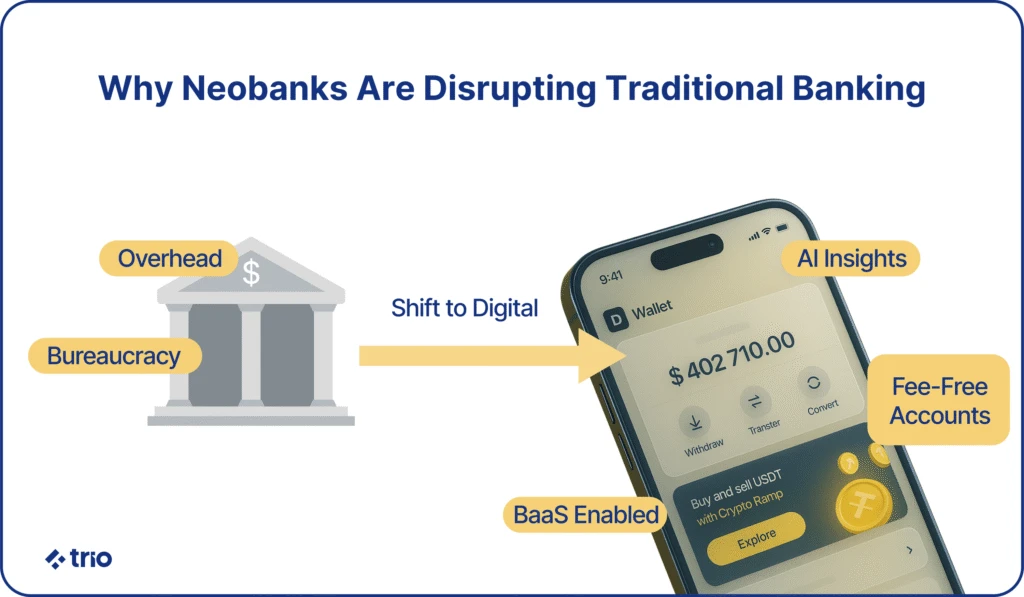
A neobank is essentially a digital-only bank with no physical branches and none of the overhead that comes with them.
Most neobanks operate through mobile and web apps exclusively, which makes the app itself the entire product.
While being strictly online has its drawbacks, it lets neobanks offer fee-free or reduced-fee accounts and adopt new technology, AI-driven personalization, and blockchain-based payment optimization faster than institutions carrying legacy infrastructure.
Some neobanks operate independently once they’ve secured a banking license.
Others partner with an already-licensed institution through a Banking-as-a-Service arrangement. From what we have seen, the latter option is incredibly popular as it lets the neobank focus on product and experience while the BaaS partner handles the regulated infrastructure underneath.
How a Neobank App Actually Works
The technology underneath a neobank splits into four layers:
- Core banking systems are the foundation, handling deposits, withdrawals, interest, and the basic mechanics of an account. Mambu, Thought Machine, and 10x Banking remain popular choices here, specifically for their cloud-native, scalable architecture.
- Third-party integrations, connected through APIs, add specialized capability like KYC/AML identity verification, payment gateways, credit bureau access, and utility aggregators, letting you focus development effort on the actual user experience.
- Banking-as-a-Service (BaaS) providers like Solaris or Synapse handle licensing, account creation, card issuing, and compliance as a package, which is genuinely attractive for a startup that wants to focus on building an MVP.
- Embedded finance capability rounds this out, letting a neobank integrate with non-financial apps to extend its offering beyond core banking.
The Vendor Risk Most Guides Don’t Mention
Before choosing a BaaS partner specifically, you need to consider how it creates a genuine business continuity risk.
Railsr is a real cautionary example. Valued at $1 billion in 2021, it almost collapsed in early 2023, before it was sold in a prepackaged bankruptcy for just $500,000 after regulatory issues at a subsidiary blocked its planned sale to a strategic buyer.
All of that happened mid-dependency, with real customer accounts running on the platform.
Fortunately, Railsr still exists, but its story is a good example that even a well-established BaaS provider can go through an existential business crisis with very little warning to the companies depending on it.
To minimize your risk, we recommend avoiding tight coupling to a single provider, and having a genuine contingency plan for a partner failure.
Neobank vs. Digital Bank
Neobank and digital banks often get used interchangeably, but they are different enough that you need to understand which one you are actually referring to.
A digital bank frequently refers to the digital arm of a traditional bank, still bound by that institution’s existing compliance structure and legacy constraints.
On the other hand, a neobank is fully independent, typically a startup or scaleup, that secures its own banking license or partners through BaaS, trading some infrastructure convenience for considerably more flexibility in how the product actually works.
Successful Neobanks Worth Knowing
Nubank (Brazil), Chime (US), Revolut (UK/EU), Monzo (UK), N26 (EU), and Starling Bank (UK) are some of the most successful neobanks out there.
These firms all follow a very specific pattern that likely contributed to their success: they served an underserved population or a clear pain point exceptionally well rather than launching with feature parity against every traditional bank offering.
Nubank specifically has become one of the largest neobanks globally by customer count, and it was initially built around a straightforward, transparent credit card product in a market where that transparency itself was the differentiator.
5 Business Models for Neobank Apps
Five broad models cover most of how neobanks actually make money, each with a real example worth knowing.
- Interchange-led models earn a fee every time a customer uses their card (Chime built its business largely this way).
- Credit-led models lead with a credit product before a full bank account, earning interest and fees on what customers borrow (Nubank’s growth followed this path).
- Ecosystem-led models treat the account itself as a loss leader and monetize value-added services, budgeting tools, savings goals, and subscriptions layered on top (this is closer to how Monzo operates).
- Asset-led models focus on high-yield savings and earn interest on deposits, sometimes with an ethical or sustainability angle (Aspiration is a good example).
- Product extension models use an existing customer base and platform to sell an expanding range of financial products like insurance, loans, and investing (Robinhood).
The option, or mix of options that you should go with, usually depends on your target audience.
For example, a neobank serving freelancers and SMEs might lean into subscription and multi-currency features, while one targeting first-time account holders typically needs to stay close to free for the core product to earn trust first.
Neobank App Development: Step by Step
You should always start with market and competitor research, including a clear read on the regulatory environment you’ll operate in.
It’s critical to define a specific value proposition tied to a real target audience; then you can choose a business model that actually fits that audience rather than defaulting to whatever a competitor does.
Design the interface with real care, since a clunky experience is a competitive disadvantage in a category built entirely around convenience.
Once your designs are ready, choose your tech stack and architecture (React Native, Flutter, or Swift for frontend; Node.js, Django, or Golang for backend are all common choices), then choose a development partner with genuine fintech and regulatory experience.
These experienced developers can help you build an MVP with the essential features.
Make sure to cover things like KYC/AML integration, digital wallet and card issuance, cross-border transfers, and real-time notifications. Then you can validate your product before expanding.
The reason you need fintech experts on your team is not just because of the build itself, but because of the regulatory compliance, which needs attention throughout.
Ongoing audits, reporting, and data protection standards apply for the life of the product.
Once live, continuous testing, scaling, and monitoring keep the app both secure and responsive to real usage patterns as the user base grows.
What Neobank App Development Costs
A fully custom neobank MVP typically runs $100,000 to $500,000, with the exact figure depending on feature complexity, security requirements, and integration depth.
On top of the build itself, you’ll need to prepare for other costs, like licensing and compliance, which can run from $50,000 in smaller, less-regulated markets to well into seven figures in heavily regulated markets.
In the US or EU, security setup and ongoing monitoring commonly run another $100,000-$500,000, and initial marketing typically adds $200,000 or more depending on channels and reach.
White-label and modular solutions cost less upfront and launch faster, commonly weeks rather than months, but come with real limitations such as less flexibility to differentiate and a longer-term dependency on the vendor’s own roadmap and stability.
Budget for real ongoing costs too. Continuous cloud infrastructure and DevOps, regular security audits and penetration testing, and customer support need to be solid from day one.
Common Challenges in Neobank Development
Standing out in an increasingly crowded market can be difficult, especially if you have no existing user base and no reputation for trustworthiness.
Outside of your technical offering, a clear brand and a genuinely differentiated niche matter as much as the product itself now.
Vendor dependency, as we have discussed above, is a real and ongoing risk that deserves contingency planning.
Regulatory requirements vary meaningfully by region and change over time within a single region too, making compliance an ongoing function rather than a project with an end date.
And scaling infrastructure without a microservices and containerized approach from early on tends to produce serious technical debt right as transaction volume starts climbing.
For experienced fintech developers who can help you with all of this and more, request a consult.