

If you are looking into ways to increase engineering capacity for a fintech product, Arc has probably come up as an option.
Arc.dev gets mentioned frequently in conversations about hiring remote developers. The platform built recognition around an AI-powered matching system called HireAI, with access to 190 countries, and real human support.
But global reach doesn’t automatically translate to the right fit when you’re building in payments, lending, banking, or any regulated financial environment.
That’s where a company like Trio comes in.
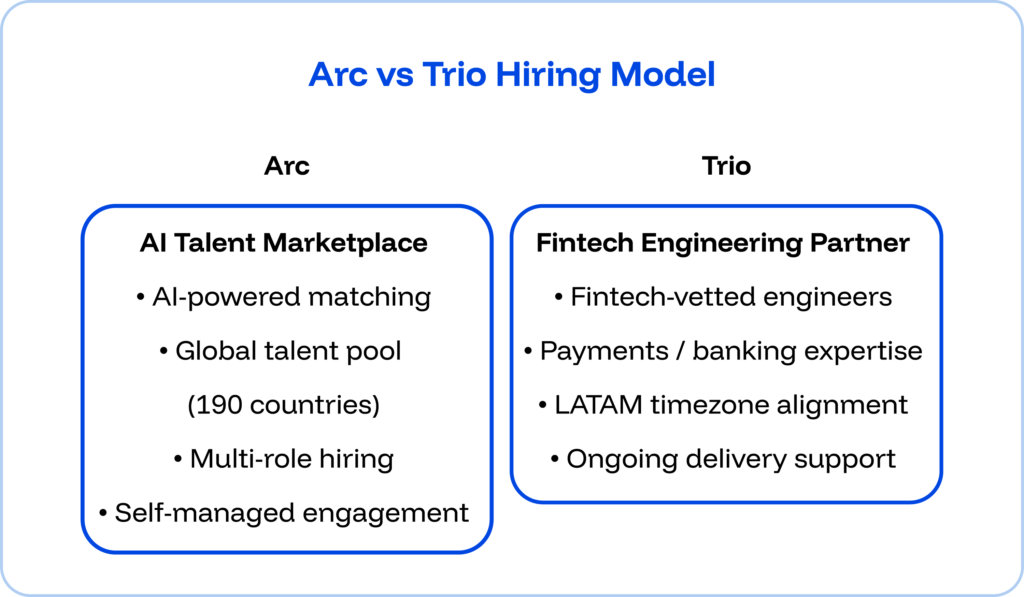
Arc and Trio serve different types of companies, with different priorities around domain expertise, support structures, and what happens after a developer joins your team.
Let’s take a look at Trio vs Arc for fintech teams, dive into the differences when it comes to fintech specifically, and all the intricacies that come with the regulated environment, to help you make the best choice for your business.
For help figuring out which option fits your situation, book a discovery call.
Key Takeaways
- Arc operates as a global talent marketplace with AI-powered matching across all tech roles. Trio functions as a fintech-specific staffing partner with domain-vetted engineers.
- Finding fintech-experienced developers on Arc requires filtering a broader talent pool, and you have no guarantee that their fintech skills are properly assessed. Trio screens every engineer specifically for payments, lending, banking, or compliance experience.
- Arc’s rates typically range from $15 to $110+ per hour for freelancers, with 20% of the annual salary platform fee for full-time hires. Trio’s transparent pricing sits between $40 and $90 per hour with no markup.
- Both platforms provide trial periods. Arc has a two-week window. Trio’s has an ongoing replacement guarantee.
- For teams needing designers, marketers, or product managers alongside developers, Arc’s multi-role coverage may justify the broader approach.
Quick Comparison
| Arc | Trio | |
| Model | AI-powered talent marketplace | Dedicated fintech staffing partner |
| Talent Focus | Multi-role (developers, designers, PMs) | Fintech engineering only |
| Geography | Global (190 countries) | LATAM / Brazil-forward |
| Time to First Candidate | 72 hours (freelance), 14 days (full-time) | 3 to 5 days |
| Pricing Range | $15 to $110+/hr + a 20% platform fee on annual salary for full-time hires. | $40 to $90/hr, no markup |
| Vetting Process | Technical + communication assessment | Fintech domain + technical fluency |
| Replacement Support | 2-week trial (freelance), 3-month (full-time) | Ongoing replacement policy |
| Onboarding Help | Payment processing, basic support | Structured onboarding assistance |
| Stack Coverage | Very broad | Fintech-focused |
| Domain Expertise | General technical seniority | Payments, lending, banking, compliance |
Arc Overview: What the Platform Provides
Founded as a subsidiary of Codementor, Arc built its model around connecting companies with pre-vetted remote developers through an AI-powered matching system.
The platform has hundreds of thousands of developers across 190 countries, covering everything from software engineering to design, marketing, and product management.
The vetting process runs through four stages:
- Profile screening that reviews work history and technical background
- An English and communication assessment (either live interview or recorded video)
- A technical interview or pair programming session
- Ongoing quality monitoring through client ratings
Arc’s biggest positioner in the hiring market is its HireAI system.
The algorithm analyzes job requirements and surfaces candidate matches based on technical skills, experience level, availability, rate expectations, and past performance, far faster than a person would be able to.
The system also learns from placement outcomes, which means repeated use theoretically improves match accuracy over time.
Trio Overview: How the Platform Approaches Fintech
Trio focuses exclusively on fintech engineering, which allows for a niche edge.
Every developer you’ll find at Trio is guaranteed to have experience in financial systems, whether that shows up as work on payment infrastructure, lending platforms, banking APIs, digital wallets, or compliance-adjacent products.
Vetting goes beyond basic coding ability.
Instead, Trio screens for domain fluency, which means candidates arrive already familiar with KYC workflows, AML requirements, SOC 2 controls, PCI DSS scoping, and the practical constraints of building in regulated environments.
Developers are also hand-picked and placed based on the work done on previous projects, so that you can rest easy knowing the developer doesn’t have to learn anything, and onboarding can be cut down to a couple of days.
Related Reading: Trio vs Toptal for Fintech Developers
Vetting Process Comparison
Both platforms vet their developers, but as we have already mentioned, this happens very differently.
Arc’s process filters for general technical competence and communication ability.
A developer who can write clean code, knows the technologies you are using, can solve algorithmic problems, and communicate in English.
What the vetting doesn’t assess is whether they understand how financial transaction reconciliation works under production load, or what compliance auditors actually look for during SOC 2 reviews.
The AI matching layer adds another dimension. HireAI surfaces candidates based on keyword alignment and historical performance patterns.
That works well for matching React experience to React requirements or identifying developers who’ve worked remotely before. It works less well for very nuanced domain knowledge, like the kind that you might need in fintech environments.
Trio’s screening adds a domain layer on top of technical vetting.
Candidates have all demonstrated not just coding ability but practical fintech experience with real products under regulatory oversight. This distinction is incredibly important when mistakes can lead to fines and losses in user trust.
That distinction shows up most clearly in ramp time.
A strong generalist developer can absolutely learn fintech domain knowledge, but the timeline for that learning doesn’t always align with your roadmap and requirements.
Speed to Hire and Geographic Considerations
Arc targets 72 hours for freelance developer matches and 14 days for full-time placements.
Those timelines assume you’re ready to interview candidates immediately and can move through selection quickly.
The reason they are able to get this process to fast is largely due to the AI matching, which accelerates the initial shortlist. Everything after that still falls on you.
Trio aims for three to five days from intake to first candidate, with domain matching built in. That timeline accounts for fintech-specific requirements, not just technical skill alignment.
This is made possible by the fact that developers are hand-picked based on your requirements, so you only get a handful of portfolios to choose from, all guaranteed to have the required skill and fintech experience.
Geography adds complexity to your hiring considerations.
Arc’s 190-country reach sounds impressive, but a developer in Southeast Asia operates 12 hours ahead of a team in San Francisco. Daily standups require someone to join at 5 AM or 11 PM.
Arc does provide geographic filtering, so you can narrow searches to specific regions or time zones. But that filtering reduces the effective talent pool, making it even less likely that you will find someone with niche fintech expertise.
Trio’s LATAM focus provides 0 to 3-hour time zone differences from most US teams. That overlap keeps collaboration synchronous when it needs to be, which tends to accelerate velocity on fintech projects where regulatory questions and technical tradeoffs need quick resolution.
For companies in European timezones, or who want someone to take the night shift, Trio also has a sizeable pool of African developers.
Pricing Breakdown
Arc’s pricing model has incredible variance, largely due to the global locations of their developers.
Developer rates range from $15 to $110+ per hour for freelancers. For full-time hires, the platform takes a fee of 20% of the first-year salary placement fee, which can add up quickly when you’re building a team.
There is also a $300 deposit to start hiring. While it isn’t much, the cost does represent an increased risk since there is no guarantee you can get it back if the developer doesn’t work out.
Trio’s range sits between $40 and $90 per hour, with no hiring fee and no subscription. That transparency makes budgeting cleaner, particularly when you’re scaling multiple engineers simultaneously or planning capacity across quarters.
The ROI comparison only holds if quality stays comparable, though.
If Arc surfaces a genuinely better fit for a specific technical problem, paying more may make sense.
But for fintech work where domain fluency drives time-to-contribution, the cost difference compounds when you account for onboarding friction and ramp periods.
Related Reading: Trio vs Upwork: Finding Vetted Fintech Developers
Fintech Domain Fluency
As we have already mentioned, this is the biggest differentiating factor between Trio and Arc.
Regulated financial products carry constraints that shape engineering work in specific ways. Users in fintech also have unique expectations that do not necessarily align with more generic trends.
Arc’s developers come from every industry background. The platform offers a fintech developer category, but filtering by that tag doesn’t guarantee actual fintech experience.
The probability of finding a fintech-ready match depends on how many profiles you review and how effectively you screen during interviews if you have limited location requirements, that decreases your chances of finding the right person.
Trio’s fintech focus eliminates those concerns. Every candidate gets screened for domain exposure before placement, and the specific product area and the candidate’s background are carefully considered before portfolios are presented.
The intentionality behind the vetting process can greatly reduce ramp time for compliance-heavy work.
Support and Relationship Management
Arc facilitates the match and processes payments through its platform. Beyond that, the relationship transfers to you.
If you have the resources, like experienced engineering leadership and established remote management processes, that works fine.
For lean teams or founders who need to focus on product and fundraising rather than contractor administration, the self-managed model adds overhead.
Arc does provide customer support and has engagement managers for larger accounts, but the level of ongoing involvement appears to vary based on contract size, and differs depending on whether you’re working with freelancers or full-time placements.
Trio stays involved throughout as your long-term tech partner.
Clients get documented onboarding steps, defined communication expectations, sprint integration guidance, and an escalation path when issues arise.
Risk, Guarantees, and Trial Periods
Arc provides trial periods: two weeks for freelance developers, three months for full-time hires.
If you’re not satisfied during that window, Arc supports finding a replacement, but the specific terms and ease of replacement can vary a lot.
After the trial period expires, relationship management becomes yours entirely. If performance issues emerge three months into a freelance contract, you’re managing that situation without platform support.
Trio’s replacement guarantee extends beyond the initial trial.
If a placed engineer isn’t working out at any point during the engagement, you can reach out to Trio and start the process of finding another developer without losing project context or starting sourcing from scratch.
When Arc Makes More Sense
There are definitely times when Arc is going to be a better fit than Trio.
If you need multiple role types outside of fintech engineering, Arc’s coverage across designers, marketers, product managers, and project managers provides one-stop access.
Building a cross-functional remote team through a single platform is one of the many perks of Arc’s broader, marketplace nature.
For tech stacks involving niche frameworks, legacy systems, or technologies outside mainstream fintech work, Arc’s massive global pool will also give you more options and make it more likely that you’ll find someone with the required skills.
The same applies if you need specialists in emerging technologies like specific AI frameworks or blockchain implementations outside financial services.
If you already have refined processes for vetting technical candidates and managing remote contractors across time zones, Arc is also a great option.
When Trio Works Better
If you are trying to put together a fintech team with experience in payments, lending, banking, or identity, the combination of domain-vetted talent, time zone alignment, transparent pricing, and ongoing support that Trio offers has incredible value.
An engineer who already knows payment rail behavior, reconciliation workflows, and regulatory reporting requirements doesn’t need three weeks of onboarding before contributing to sprints.
They arrive understanding what questions to ask and which architectural patterns to avoid.
If you have previously used remote contractors and struggled with time zone gaps that turn simple questions into day-long delays or similar issues, then Trio’s time-zone overlap is the solution.
Trio’s structured onboarding and ongoing relationship support also free up limited internal resources.
Related Reading: Fintech Recruiting Agency Alternatives
Conclusion
Arc and Trio operate with fundamentally different models and serve different buyer profiles.
Arc functions as a global, AI-powered talent marketplace with broad coverage across roles, technologies, and geographies.
Trio works as a fintech-focused development partner with a narrower scope but deeper domain alignment.
For most fintech teams building regulated products, dealing with compliance requirements, and moving fast through product milestones, the combination of fintech-vetted engineers, time zone overlap, transparent pricing, and relationship continuity makes Trio a more practical fit.
For more information, book a decision call to compare options.
Frequently Asked Questions
Does Trio compete with Arc for all types of developers?
Trio competes with Arc specifically for fintech engineering talent. Trio screens developers exclusively for domain expertise in payments, lending, banking, and regulated environments rather than general technical ability.
How does Arc’s pricing compare to Trio for fintech developers?
Arc’s pricing is a lot more variable than Trio’s, and developers typically charge $15 to $110+ per hour plus a fee made up of 20% of the developer’s annual rate for full-time hires. Trio’s pricing ranges from $40 to $90 per hour with no platform markup or hidden fees.
Can I find fintech-specific developers on Arc?
You can search for fintech-specific developers on Arc by using category filters, but the platform doesn’t vet candidates specifically for domain fluency.
What happens if an Arc developer isn’t working out?
If an Arc developer isn’t working out during the trial period (two weeks for freelancers, three months for full-time), Arc supports finding a replacement, though specifics vary by contract type, and after the trial, management falls entirely to you.
How long does it take to hire through Arc versus Trio?
Through Arc, you can expect matches within 72 hours for freelancers or 14 days for full-time hires. Trio typically delivers first candidates within three to five days with fintech-specific vetting and structured onboarding.
Does Trio only work with Latin American developers?
Trio’s talent network centers on Latin America, with strong Brazil coverage for time zone alignment with US teams, though Trio also sources from regions like Africa when alternative working hours benefit the client.