


 Read Client Stories





 Alex Kugell

 Key Takeaways
- Treat KYC as a tiered decision rather than one gate. A risk-based flow lets most applicants pass with light checks and reserves enhanced due diligence for the minority that warrants it.
- Document capture is where most drop-off happens, so the order of your steps matters more than the number of them. Teams commonly report that moving the ID upload later in the flow is among the cheapest wins available, though the size of the gain varies by product.
- Five stages cover almost every fintech onboarding flow: identification, identity verification, due diligence and risk scoring, account linking, and ongoing monitoring.
- Rules move in both directions. FinCEN exempted US companies from beneficial ownership reporting in August 2026, so onboarding logic written against the Corporate Transparency Act may now be collecting data nobody needs.
- Onboarding across regions rarely means one flow with a country field. Verification sources, acceptable documents, and retention rules differ enough that most teams end up with per-market variants of the same spine.
- Automation reduces manual review volume but raises the cost of a bad decision, since an automated rejection still has to be explainable to a regulator and to the customer.
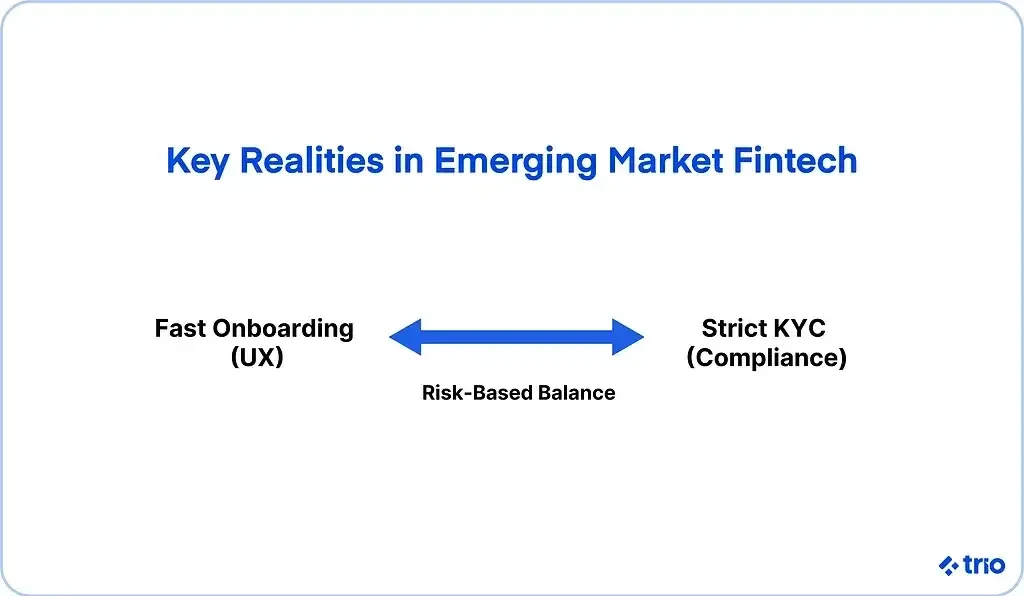
Fintech companies often feel stuck trying to create a fast onboarding process while also satisfying every KYC and AML rule that applies to them.
It sounds simple on paper, yet the moment your client onboarding flow slows down or asks for something unexpected, potential users start drifting away.
A small hiccup may be all it takes for someone to try a different financial service that feels easier.
This tension only gets worse as synthetic identities and deepfake attempts increase.
Some teams respond by tightening every control, which might look safe at first, but often frustrates new users. Others take the opposite path and strip the flow back to almost nothing, which works nicely until a regulator points out gaps in the onboarding process.
A more sustainable path usually appears when you combine a risk-based KYC process with thoughtful design and reliable tools.
That approach tends to reduce friction, support faster onboarding, and help you prevent fraud without slowing people down.
It also gives you a better chance of meeting global regulatory requirements without burning out your compliance team. At Trio, we have a host of fintech specialists who can advise your team and help implement these solutions.
What KYC Means For Modern Fintech Compliance
Before improving your client onboarding process, it helps to step back and look at what KYC means for financial institutions today. At its core, KYC involves verifying a customer’s identity, assessing their risk profile, and screening for global sanctions or red flags connected to financial crime.
For fintech companies, this usually includes document verification, identity verification checks, and ongoing monitoring. In many cases, the onboarding journey also triggers customer due diligence requirements that must meet both local and global standards.
The challenge is that fraud tactics keep evolving.
Deepfake video calls that look convincing at first glance, or synthetic identities stitched together from real and fabricated data, can slip through older verification systems. Regulators are very aware of this shift, and they expect companies to keep up rather than rely on outdated methods.
Strong KYC compliance builds trust and helps protect both your customers and your business. Weak controls often lead to chargebacks, surprise AML alerts, or regulatory audits that bring higher stress and remediation costs later on.
How the Customer Onboarding Process Works in Fintech
A typical digital onboarding process starts when a new customer enters a few basic details, then moves through identity verification and a set of automated checks.
By the time the onboarding experience ends, the company should have enough information to understand the customer’s identity and their intended financial activities.
The tricky part is that every step introduces a chance for friction.
A blurry photo, a liveness check that feels finicky, or a missing piece of customer information can disrupt the entire customer onboarding experience. Even if your compliance team knows why the step matters, users may not understand it.
A smoother onboarding journey often depends on clear instructions, predictable steps, and verification tools that behave consistently on different devices.
The Five Stages of KYC Onboarding
Almost every fintech onboarding flow decomposes into the same five stages, whatever the product. Naming them separately helps, because the friction and the compliance obligation sit in different places.
Customer identification: The applicant gives you their name, date of birth, address, email, and phone. This is the cheapest stage to get wrong, because asking for one field too many here costs you people who would have converted.
Identity verification: A government ID is captured and checked, usually with a liveness or selfie match, and ss-referenced against credit bureau data, public records, or a national ID database where one exists. Document capture tends to see the highest drop-off rates in most onboarding flows.
Due diligence and risk scoring: The applicant is screened against sanctions lists, politically exposed person lists, and adverse media, then assigned a risk rating based on jurisdiction, expected transaction behavior, and background. High-risk profiles move into enhanced due diligence, which means more documents and a human reviewer.
Account linking and funding: The customer connects a bank account through an aggregator or adds a card. Fraud signals show up here that the earlier stages miss, such as a funding source whose name does not match the verified identity.
Ongoing monitoring: Compliance does not stop at signup. Transaction patterns get watched, risk ratings get refreshed, and suspicious activity gets reported under the Bank Secrecy Act or its local equivalent.
Common Challenges That Disrupt the Onboarding Experience
Fintech companies face several recurring issues during onboarding.
Some challenges are obvious, like customer drop-off when document capture keeps failing. Others are subtle, such as identity theft attempts that look harmless at first or data collection requirements that vary from country to country.
Jurisdiction-based rules can be especially tough. The United States may ask for owner information during business onboarding, while the EU uses eIDAS guidelines, and the Financial Action Task Force publishes updated expectations on digital identity.
Even when global and local rules overlap, they rarely align perfectly.
User experience is also a major pressure point.
If the onboarding solution treats every applicant as high risk, the process becomes slow and heavy. On the other hand, if verification requirements drop too low, you may accidentally approve someone who triggers AML (anti-money laundering) regulations later.
Onboarding Users Across Regions With Different Verification Rules
Teams often plan for one onboarding flow with a country dropdown, then find that the dropdown changes almost everything behind it.
The documents differ first. A national ID card is the default across much of the EU and Latin America, a US flow leans on driver’s licenses and SSN-based checks, and a few markets have no photo ID that vendors read reliably.
The data sources differ more. Where a national identity database or an eID scheme exists, verification can be a lookup that returns in seconds. Where it does not, you are back to document capture and a selfie, with the drop-off that comes with it.
Retention and residency rules differ again. How long you must keep a copy of an identity document, and where that copy may physically sit, is decided locally, so one global storage bucket is rarely compliant in every market you serve.
What tends to work is a single shared spine, the five stages above, with per-market variants of the steps inside it. Keep the orchestration and the audit trail common, and treat the verification method, the accepted document list, and the retention policy as configuration rather than code.
Balancing KYC Compliance With a Low-Friction Onboarding Experience
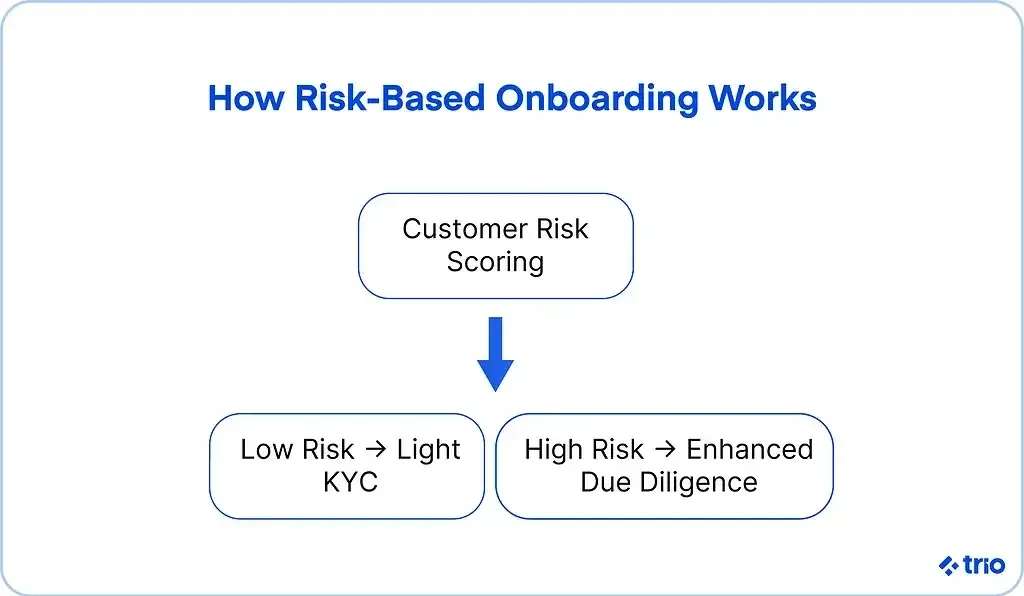
A risk-based approach tends to work well because it adjusts the onboarding process based on real signals rather than treating everyone the same.
Customers with a low-risk assessment can move through a more lightweight onboarding journey. People who appear higher risk move through enhanced due diligence instead.
Small design choices play a big role here.
Clear prompts during document verification, shorter copy, and guidance when something fails can reduce frustration. You may also find that personalizing the onboarding process to match common document types or connection speeds in specific countries helps customers finish without confusion.
We have seen fintech teams reduce friction simply by reordering steps or by giving users a tiny bit of explanation about why identity verification matters. It sounds minor, but it can change the customer experience drastically.
Four Patterns That Cut Friction Without Cutting Checks
Progressive profiling asks for the minimum at signup and collects the rest when the customer has a reason to care, usually at first funding or first withdrawal. The compliance obligation does not change; the point at which you ask does.
Save and resume keeps a partially completed application alive for days rather than minutes. A surprising share of abandonment is someone who did not have their passport to hand, and those people come back if the flow lets them.
Risk-based verification runs the heavy checks on the applicants who score high and lets the rest through on lighter evidence. In most flows we have seen, this moves conversion and manual review cost further than anything else on this list, though how far depends on how skewed your applicant mix is.
Step-up verification holds a check until the customer does something that justifies it, such as raising a transfer limit. It keeps the signup short while still gating the risky action.
When this balance works, you get faster onboarding times, improved customer satisfaction, and fewer false positives that would otherwise hold people back.
KYC Solutions and Identity Verification Software
KYC software can automate large parts of the onboarding process and reduce manual review.
Most fintech teams rely on some combination of biometric checks, OCR for document verification, and real-time identity verification to validate a customer’s identity.
API based KYC solutions give you the flexibility to change the journey depending on risk or region.
Some providers also include behavioral analytics to detect suspicious movements or unusual typing patterns, which helps prevent fraud without adding visible steps.
One interesting shift is the rise of low-document and zero-document onboarding in certain regions.
These approaches rely on trusted data sources rather than forcing customers to upload documents. When done correctly, it leads to faster onboarding with less frustration.
It is also important to choose tools that reduce false positives rather than create piles of unnecessary alerts. That is partly why companies often work with partners like Trio, who help engineering teams select the right KYC provider, integrate APIs cleanly, and ensure compliance without slowing product development.
Compliance Requirements Fintech Companies Must Meet
The rules keep shifting, and in a few places they have shifted in the opposite direction to what teams expected.
In the EU, the AMLA authority and eIDAS 2.0 identity wallets are shaping digital onboarding expectations.
The US went the other way. FinCEN finalized a rule in August 2026 that exempts US companies from beneficial ownership reporting entirely, and reporting companies no longer report beneficial ownership information for US-person beneficial owners or company applicants.
Foreign companies registered to do business in the US still report, on new deadlines. If your onboarding flow or your KYC vendor still collects BOI from domestic entities as a Corporate Transparency Act obligation, that logic is now out of date.
The UK updates JMLSG guidance frequently, and countries across the GCC push toward unified digital KYC.
These changes affect not only KYC onboarding but also ongoing monitoring, recordkeeping, and customer identification requirements. Your compliance team must stay familiar with both global sanctions lists and local AML regulations.
Companies must also pay attention to audit trails, data residency, and how automated decisions are reviewed by real people.
Teams that prioritize compliance early tend to encounter fewer issues if they seek to expand into new markets later. Partnering with fintech developers experienced in regulated builds, such as those at Trio, can help engineering and compliance teams coordinate required onboarding flows.
Future Trends in Digital Onboarding and KYC
Several trends appear to be shaping client onboarding.
AI-driven verification is becoming more common, although regulators encourage companies to maintain human oversight. Predictive risk scoring is gaining traction, but it works best when paired with clear policies.
Reusable digital identity is gaining ground through verifiable credentials and eIDAS 2.0 wallets, though real adoption is still thin outside a few markets. This may cut down on document verification requests, which could eventually help reduce friction for both new and returning customers.
Zero-knowledge proofs are getting attention, too.
They allow people to prove certain facts without exposing unnecessary customer data. While not mainstream yet, they hint at a privacy-conscious future for financial services.
How to Build a High-Performing Client Onboarding Process
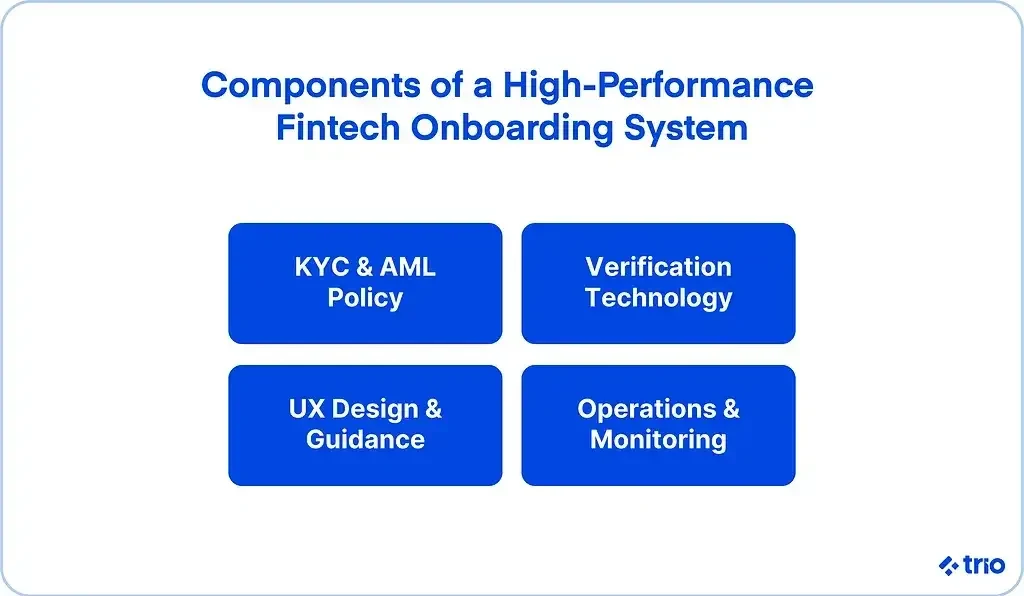
A strong onboarding solution relies on clear policies, good tooling, and a team that understands the regulatory requirements behind each step.
This includes customer due diligence, enhanced due diligence, and ongoing monitoring once the customer begins financial activities.
Vendor selection matters as well.
Some KYC providers offer reliable uptime and clear documentation, while others introduce complexity that slows product teams down. Many fintech companies use a mix of third-party tools for verification, authentication, and AML screening.
It also helps to train your operations and support teams so they can spot red flags, recognize suspicious behavior, and understand how different decisions affect compliance and customer experience.
Sometimes these teams catch problems long before automated systems do.
Working with engineering partners such as Trio can shorten the time it takes to build a secure onboarding experience that scales as your customer base grows.
Strategies for Improved Onboarding
Teams that succeed with digital onboarding often share a few habits.
They test their onboarding journey regularly with real users; they refine their KYC process instead of leaving it static; and they use data to understand where friction occurs.
Some companies noticed that asking for a document too early caused drop-offs, so they shifted it to a later point. Others realized their identity verification provider generated too many false alerts, and switching to a different KYC software cut their operational workload significantly.
Changes like these may sound small, but they often improve customer retention and reduce the number of people who stall during onboarding.
Conclusion
A thoughtful onboarding process can help you prevent fraud, keep regulators happy, and give new customers a smoother start. It takes creativity, strong systems, and a clear approach to KYC compliance, but the payoff is worth it.
When fintech companies balance UX with regulatory expectations, they tend to grow faster and avoid costly surprises.
If you refine your onboarding journey, select KYC solutions carefully, and keep your compliance team involved early, you can create a client onboarding experience that feels straightforward for users and dependable for your business.
You need developers who are not only great at coding but also understand the unique challenges of the industry. To hire fintech developers, request a consult.