
Hire by Technology
SERVICES


C is a general-purpose, procedural programming language developed by Dennis Ritchie at Bell Laboratories in 1972.
Originally created to write the UNIX operating system, C has remained one of the most widely used programming languages in the world for over five decades. Even though the language is quite old, the problems it solves well haven't gone away.
However, choosing C for your application if it isn’t the right choice could be incredibly detrimental. The last thing you want is to build a new application with immediate tech debt.
In fintech and financial services, C and its close relative C++ power some of the most performance-critical infrastructure in the industry, like the firmware inside HSMs, the embedded software running ATMs and POS payment terminals, and more.
Let’s take a more detailed look at what C is, why it still matters in financial infrastructure, and when and how to hire C developers with the right domain experience for your fintech environment.
At Trio, we pre-vet C and C++ developers with production experience in financial systems and compliance-sensitive environments, so you can avoid any compliance ramp-up.
Before going further, a few technical concepts are worth defining, since they come up in C developer job descriptions and technical interviews.
Structured programming, or modular programming, is a programming paradigm that favors a single, unified flow per program, with code executing instruction by instruction.
It produces readable, reusable components.
Lexical variable scope determines whether a variable has meaning outside the function in which it was defined.
In C, variable scope is determined by the surrounding code structure. This design produces predictable, auditable behaviour, which is important in financial systems where data handling must be traceable.
Recursion allows functions to call themselves, either directly or indirectly, breaking a problem into smaller sub-problems using a previously established value to compute a new one.
C supports this kind of recursion natively and uses it in parsing, traversal, and certain cryptographic algorithms.
A static type system means the language checks types before code compiles rather than at runtime. C's static typing catches errors before they reach production. This is another reason we continue to see C in financial systems where runtime errors carry serious consequences.
Finally, manual memory management means developers explicitly allocate and free memory using functions like malloc() and free(). This gives C programs precise control over resource usage, which matters in memory-constrained embedded systems like payment terminals and HSMs.
It also means bugs like memory leaks and buffer overflows are the developer's responsibility to prevent, making experience and code review practices critical hiring criteria.
C is a general-purpose, procedural programming language. Dennis Ritchie developed it in 1972 at Bell Labs as the vehicle through which the UNIX operating system was rewritten from assembly language.
Its design priorities of low-level memory access, clean syntax, and minimal runtime overhead still make it ideal for systems programming in 2026.
C has also served as the foundation for much of modern computing. C++, C#, Java, and Python all trace architectural lineage back to C.
At its core, C sits in a category called middle-level languages.
Low-level languages like assembly talk to hardware directly but are difficult for humans to read and maintain. High-level languages like Python or JavaScript abstract hardware entirely, making them productive for application development but unsuitable for performance-critical or resource-constrained environments.
Instead of sitting at either of these extremes, C occupies the middle ground. It provides high-level abstractions like functions, loops, and structs, while still allowing direct memory access and hardware interfacing that high-level languages cannot offer.
The language uses a static type system, meaning type errors surface at compile time rather than in production, and supports structured programming, lexical scoping, and recursion.
One thing to note, if you are coming from more modern languages, is that its standard library is intentionally lean (only 32 keywords). This simplifies learning and deployment while keeping the runtime footprint small.
C and C++ do not power fintech products in the same way that Node.js or Python do. Instead, they operate closer to hardware, which handles some of the most sensitive and performance-critical operations in the entire financial system.
The first and foremost justification for using C would be if you wanted to build an operating system, but there are various other elements that make it a fitting language for a wide array of needs, many of which we have already touched on.
C spans both low-level and high-level programming, making it suitable for systems programming (kernels, firmware, cryptographic modules) and application development within the same language. Very few languages offer this range.
C programs compiled for one platform can be adapted to run on others with minimal changes.
The ANSI C standard, established when the language was gaining widespread adoption, contributes to this consistency.
In a financial infrastructure where systems may run across diverse hardware environments, portability reduces maintenance overhead.
C's structured programming model, which includes task-oriented functions, if-else statements, and for-loops, produces compartmentalised, readable code.
For financial systems that must be auditable and maintainable over long timescales, structured code is not just a preference; it is a requirement.
The C compiler catches type mismatches before the code runs.
As we have already mentioned, in financial systems where a type error in a calculation can produce a materially wrong result, compile-time detection is meaningfully safer than runtime discovery.
C's malloc(), calloc(), and free() functions let developers control memory precisely.
This matters in embedded payment hardware, where RAM is measured in kilobytes and every allocation decision has a performance consequence.
Thirty-two keywords means a smaller surface area to learn and a simpler mental model to maintain.
Developers who know C well tend to have a cleaner understanding of what the computer is actually doing, too, which translates into more predictable, debuggable code.
Despite its small keyword set, C's standard library covers input/output, string handling, math, memory allocation, and more.
The library's dynamic memory allocation functions, combined with manual control, give developers the flexibility to build complex structures without unnecessary overhead.
C's combination of hardware access and high-level abstraction makes it the go-to language for embedded systems.
Some common examples of this include digital cameras, industrial controllers, payment terminals, and anything else where software runs directly on constrained hardware.
C++ was developed by Bjarne Stroustrup starting in 1979 as an extension of C.
Instead of thinking of it separately, it is nearly a superset of C. In other words, most valid C code compiles as C++.
It adds object-oriented programming, templates, operator overloading, the Standard Template Library, and more sophisticated memory management tools.
| Feature | C | C++ |
| Paradigm | Procedural | Procedural, object-oriented, generic |
| OOP support | Not supported | Full support (classes, inheritance, polymorphism) |
| Memory management | Manual (malloc/free) | Manual and automatic (new/delete, smart pointers) |
| Function overloading | Not supported | Supported |
| Standard library | Lean standard library | Extensive STL (vectors, maps, algorithms) |
| Primary fintech use | HSM firmware, embedded payment hardware, legacy core systems | HFT execution engines, trading infrastructure, quantitative systems |
For fintech hiring, a developer building HSM firmware or POS terminal software typically works in C, while a developer building a low-latency trading engine or extending a bank's legacy C++ core system needs C++ proficiency.
In our experience, many experienced candidates know both, but the depth of their C++ OOP experience versus their embedded C experience often differs.
C and C++ appear in the infrastructure of organisations, including:
C developers working in fintech environments typically focus on one of several layers.
At the systems programming level, these developers build and maintain embedded software for payment hardware, cryptographic modules, and financial infrastructure components. Then at the integration level, they will write interfaces between C-based legacy systems and higher-level application code.
At the performance engineering level, they optimize execution-critical paths in trading or processing systems.
Day-to-day tasks in a fintech C role may include:
Proficiency in C, and ideally, C++ as well: The fintech use cases for the two languages overlap significantly, so a developer who can work fluently in both adds meaningful flexibility for a financial infrastructure team.
Understanding of memory management: Manual allocation and deallocation using malloc(), calloc(), and free() is a core C skill with direct consequences in financial systems. Errors here produce buffer overflows, memory leaks, and use-after-free vulnerabilities.
Systems programming fundamentals: Experience with operating system concepts, hardware interfaces, and embedded systems is important for fintech C roles, but especially those involving payment hardware or HSM integration.
Knowledge of adjacent languages and frameworks: C codebases in financial organisations rarely exist in isolation, so familiarity with Python, Java, or Node.js is required for integration work, and with tools like CMake, GDB, and Valgrind needed for build and debugging.
Cryptographic awareness: Fintech C developers working near HSMs, TLS implementations, or payment security infrastructure should at least understand basic cryptographic concepts. This includes symmetric versus asymmetric encryption, key management, hash functions, and why certain implementations are vulnerable.
Abstract critical thinking and strong problem-solving: Low-level debugging in C, systematic, hypothesis-driven thinking. This skill tends to distinguish strong systems developers from those who struggle without a high-level framework to lean on.
Security-first coding practices: Any C code that handles payment data, cryptographic keys, or authentication tokens must be written with security as a primary constraint.
Glassdoor data reports the average yearly salary of a C developer in the United States at approximately $116,000. Senior C developers can earn up to $152,000 annually. Junior or entry-level C developers start around $90,000.

Developers with fintech domain experience, such as HSM programming, embedded payment systems, or trading infrastructure, typically charge a 10–15% premium above these figures.
Senior C developers in LATAM average around $100,000, with mid-level developers at approximately $76,000.
The cost differential here can largely be attributed to the lower cost of living, not in technical quality, and for C roles in particular, where the skill set is rare globally, LATAM engineers working nearshore at US timezone overlap deliver strong value.
Eastern Europe C developer salaries run at approximately $100,000, which is comparable to LATAM. Both regions represent meaningful savings against US domestic rates.
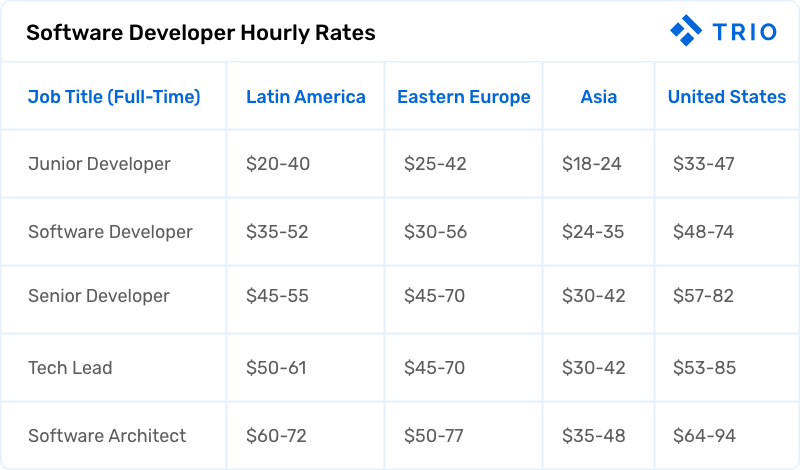
For shorter engagements or project-based work, hourly rates vary by region and seniority:
Hiring C developers is harder than hiring for most languages.
This is simply because the developer population is smaller, the skill set skews toward systems programming backgrounds that general job boards surface poorly, and the subset with genuine fintech domain experience (HSM programming, embedded payment systems, trading infrastructure) is smaller still.
Here are the steps you can take to ensure a successful hiring process:
The sourcing and domain assessment steps for C developers with fintech experience typically take longer than for more common languages.
Trio's pre-vetted pool of C and C++ developers with production financial systems experience eliminates the longest parts of that process.
Placements can happen in as little as 3–5 days, at rates of $40–$80/hr for LATAM nearshore engineers, with a replacement guarantee.
Developers working in C typically use the following tools: