
Hire by Technology
SERVICES


Smartphones have become so pervasive that it's likely even you are doing the tasks that you once did with a console or a computer with a pocket-sized flatscreen. That’s why a mobile app business plan is the most lucrative way of capitalizing on emerging markets.
For startups and businesses centered around technology, this means creating business plans that can cater to a new horizon of innovation. Where smartphones are concerned, the most efficient way to cater to this need is through mobile apps.
Developing a mobile app starts with a good app idea that you think will interest your target demographic. But to truly see your app thrive, or if you plan to raise funding of any sort, you need a mobile app business plan.
Let’s look at why a mobile app business plan is beneficial for your organization, what steps you should take to write a business plan for your mobile app, and how you can put that plan into practice with our expert app developers.
Our developers have many years of experience in mobile app development, including in heavily regulated niches like financial applications.
They have assisted many companies with everything they need to translate their technical business plan into something investors can understand, and can make recommendations based on your specific product and their first-hand experience.
The app market for mobile applications is continuing to grow. More and more businesses and entrepreneurs are trying to get into the game before the market gets too saturated.
The market is expected to grow to $1,230 billion by 2035.
However, creating a valuable and profitable app is not as easy as some people might think, and business plans are an essential first step to a successful launch.
A comprehensive mobile app business plan serves as a guide for everyone involved in the project. It also gives insight into how the app should be introduced to the market in the most lucrative way.
If you need to raise any outside capital, a professional business plan signals to investors that you understand the market and have thought through the risks. Without it, most serious investors that we have interacted with won't take the conversation further.
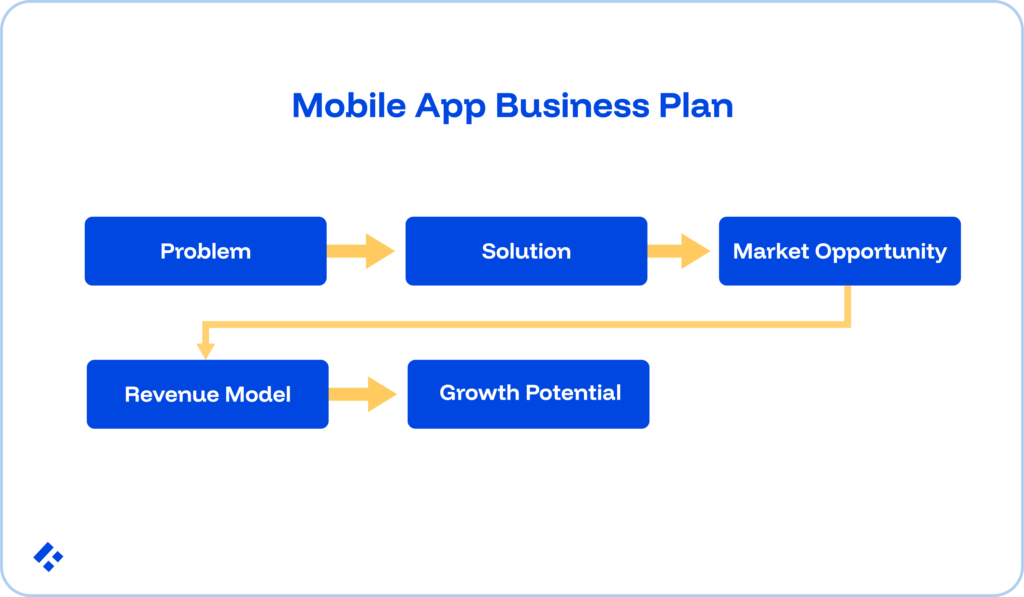
Coming up with a good business plan is fairly straightforward and usually contains the following:
If you are struggling with where to start, you can always use a template. This doesn’t restrict what you write; it just makes sure that you cover everything that your development partners will expect to see.
Here is a practical mobile app business plan template outline:
Let’s take a more detailed look at each of these sections and exactly what you will want to write in your business plan.
This is an opportunity for you to summarize your business plan in a concise manner. Readers should be drawn to your app and want to learn more about your goals at this point.
Leaving this part for last, after you're done writing the rest of your business plan, might help you better formulate your words for this section.
For investors, this is often the only section that gets read before they decide whether to look further, so it carries significant weight.
A company description is exactly what it sounds like. It is a good opportunity to be detailed about various elements of your app company.
For example, your company name, legal structure, financial highlights, and suppliers should be part of this description, as well as a brief history and overview of your app company's objectives and consumers.
In short, what are you selling?
Write a detailed description of the mobile app product or service you're providing, with a focus on how customers benefit. Describe the core app features that make your product work, and explain specifically what problem they solve.
Again, be descriptive here. Include copyrights, patents, research and development proposals, and how the mobile app fares in the app market.
At this step, you should start drawing conclusions based on market analysis, which should be composed of details such as a sketch of your target market and target audience, an overview of your industry, historical and current market projections, and an analysis of your competitors.
We always recommend that our clients look at similar apps in their category on the App Store and Google Play Store to understand pricing, positioning, and what users are asking for in reviews.
All this should be backed up by quantitative and qualitative data.
Combining all the information you have gathered, illustrate a strategic means of reaching your goals from promotion to development costs to labor to operational management and lifecycles.
Your marketing strategy should include how you plan to acquire users, what channels you'll prioritize, and what your expected marketing budget looks like at each stage.
This is where you explain the roles and responsibilities of the people in your app company.
Even advisors and non-technical staff, like accountants and attorneys, should be listed.
In our experience, investors pay particular attention to this section.
They want to know who is building the app, who is running the business, and whether the team has done this kind of thing before. Stakeholders should be included, too, with a description of their percentage of ownership.
Use an organizational chart that categorizes different departments with the names of each employee and company associate.
For this section, you'll need to come up with some projections of how much your mobile app will make.
You can make some statements about your financial history for the past few years.
If you are working with a brand-new app startup with no history, replace this with your assumptions and the data behind them. This could include expected monthly active users, projected conversion rates, and estimated development costs through launch.
Most mobile app startups eventually need outside funding to reach scale.
Whether you're approaching angel investors, venture capital firms, or applying for an accelerator, investors will want to see two things: a pitch deck and a full business plan.
These are often used interchangeably, but there are a couple of differences you need to keep in mind.
A standard pitch deck for an app startup covers:
The primary difference between a business plan and a pitch deck is that the pitch deck presents this information visually.
No matter how awesome your app is, you need to know how to introduce it to the app market. This means making sure that it reaches the right audience and starts generating revenue within the first few days.
Building a mobile app that's user-friendly and well-optimized is crucial for the project's success. But without knowing how to market it, it will take you much longer to reach your business goals.
A marketing strategy shows that you know your product well and understand the needs of your audience and the market. Here’s how you do that:
Knowing what differentiates your product will help create the proper positioning and brand messaging you need to market mobile apps effectively.
Study similar apps in your category across the App Store and Google Play to understand where the gaps are and what users consistently ask for.
Who are you targeting? What are their interests?
This answer can contain one or more types of people, but you must outline them as detailed as you can.
Creating a user persona often puts together the following demographic information:
Psychographic data is also important. This allows you to understand the mindset of your target audience. Here are some examples:
In the beginning, you will define your user personas based on your own perception. But you need to know that your perspective is subjective.
As you gather more research, you will need to adjust the persona.
Depending on your target, you should tailor the channels you use to reach out to them.
If your potential user base is on Instagram, then you should market on Instagram. Don't waste your time on LinkedIn.
A common pitfall people make when marketing is to do everything. In theory, that sounds great. Except it's a no stone unturned approach that will spread you thin.
Get to know your target audience and find where they congregate.
Growth hacking is one of many popular techniques we are seeing. This is where you rapidly try out new methods to increase brand awareness.
It's particularly great for app startups with very little funding that are looking for creative ways to use mobile marketing.
Here is a list of marketing channels for you to consider:
As we have already mentioned, a good way to get ideas is to study mobile apps that have already become successful. Find out what they did in their early stages to move the needle.
Related Reading: Salesforce Developers Hiring Guide
The classic growth model mobile apps use is to develop a user base and then monetize it later. But that is not the only path to success.
Your choice of business model affects not just revenue, but how investors evaluate your projections and how users perceive your app from day one.
The most common monetization models we see used for mobile apps include:
Once you've decided how to monetize your app, you need metrics to know you're doing it right.
Before you build an app, these metrics will be speculative. However, they can still help you understand how your mobile app and business will perform in the long term.
In the context of mobile, this metric would be called cost per app install (CPI). If possible, you can go further to find out the cost per activation (CPA).
Your acquisition cost needs to be significantly lower than your lifetime value for the business model to work.
If this type of information doesn't exist yet for you, you will have to rely on industry benchmarks. Companies like Fiksu can give you information on cost per thousand (CPM) from month to month.
Ideally, you will want to know how much money you can make on average from a single user.
This projection drives most of your key financial assumptions and is the figure investors will probe most carefully.
A low LTV will be considered a yellow flag, and if your acquisition costs are high, then you're going to have a hard time breaking even.
Your burn rate is essentially the rate at which a startup burns its liquid cash. This can be measured in monthly increments. Another way to think of this is as negative cash flow.
Cash is spent through fees, hosting charges, mobile app development costs, and other variable and fixed overheads. Like any good business, you will want to keep cash flow down.
Runway refers to how much time you have before your business runs out of cash. To calculate the runway, use this formula:
Runway = (Total funds) / (Burn Rate)
Naturally, your cash flow will be determined by your monetization strategy and how well it is executed.
Finally, you should project your profits and losses over a period of a year.
When estimating your possible earnings, it makes sense to look at the situation from different angles: a best-case scenario, a worst-case scenario, and, well, realistic conditions.
Analyzing these three different outcomes will give you an idea of where you might want to cut costs and potentially help you avoid going bankrupt during the first few months in business.
If you are able to recapture the expenses during your first year in a worst-case scenario, that gives a lot of promise for your mobile app in the app market.
Early idea validation will ensure that you are investing in the right project.
Start by researching the market and getting feedback from industry experts and potential final users to get an idea of how viable your app idea is.
You should also think about what you might want to change to create a mobile app that's more viable.
There are multiple ways to validate your app. Here are a few:
If you already have a landing page set up, you can get straight to work.
You just need a small marketing budget, and then you can test a target audience and evaluate the response.
Google Trends allows you to compare keywords for relevancy. If you are entering a growing market, then you can validate the market potential based on search volume.
This tool won't work for mobile apps built around novelty ideas, though.
In the App Store and Google Play Store, be sure to check out the category that aligns with your mobile app. You will see similar apps that are competing.
Download a few of them and learn their strengths and weaknesses. This will help you come up with your unique selling proposition.
More importantly, read the reviews to see what users like and dislike about the app.
It would help if you asked yourself the following questions:
Companies like data.ai (previously App Annie) and Sensor Tower provide app market data and analytics to help drive growth for mobile apps.
Surveys and questionnaires can be very insightful if done correctly. This method will give you the best insights about customer behavior, which can make or break your plan.
All for the better, of course.
How you choose to go about it is up to you. Some people are comfortable asking strangers on the street. Others tap into their social networks and ask their friends and acquaintances.
Finally, there are polls, which you can leverage to package your questionnaire in a presentable format.
A lot of the companies that we work with learn that mobile apps are lucrative, hire developers with experience in Java or Swift, and try to dive headfirst into something they know nothing about.
This sets them up to fail before they even start.
Fortunately, the steps outlined here should help you write a business plan and build a more effective strategy around mobile app development.
Monetization, financial metrics, investor preparation, and figuring out what makes your product unique are a few principal points to take away from this.
We have experienced developers who can draw from everything they have seen to advise you, help you put together a mobile app business plan that draws investors, and then help you implement those plans with code that allows you to scale in the future.
They are also familiar with financial applications and all the data handling and security regulations that need to be accounted for.