

Hire by Technology
SERVICES


If you are shipping features slower than you would like, every sprint can start to feel like a small anxiety attack.
Work spills over, priorities change mid-sprint, and you keep asking the same uncomfortable question in retro: why are we still not getting more done? It is draining for engineering leaders, and it is not exactly fun for developers either.
As that pattern repeats, frustration tends to spread. Stakeholders lose trust in estimates. The team feels like they are always behind.
Sometimes leadership responds by pushing harder: more scope, tighter deadlines, more meetings. That usually makes things worse, not better, because the real constraints are hiding inside the workflow, not in how many hours people sit at a desk.
The hopeful part is that sprint delivery speed is surprisingly fixable when you treat it as a system problem instead of a people problem.
You probably need cleaner backlog items, smaller slices of work, fewer hidden dependencies, and better sprint mechanics.
In this guide, we will walk through how to speed up sprint delivery in a way that respects your team, improves predictability, and actually scales.
This is the kind of work our experienced developers at Trio do with our clients, and the patterns are remarkably consistent across teams and tech stacks.
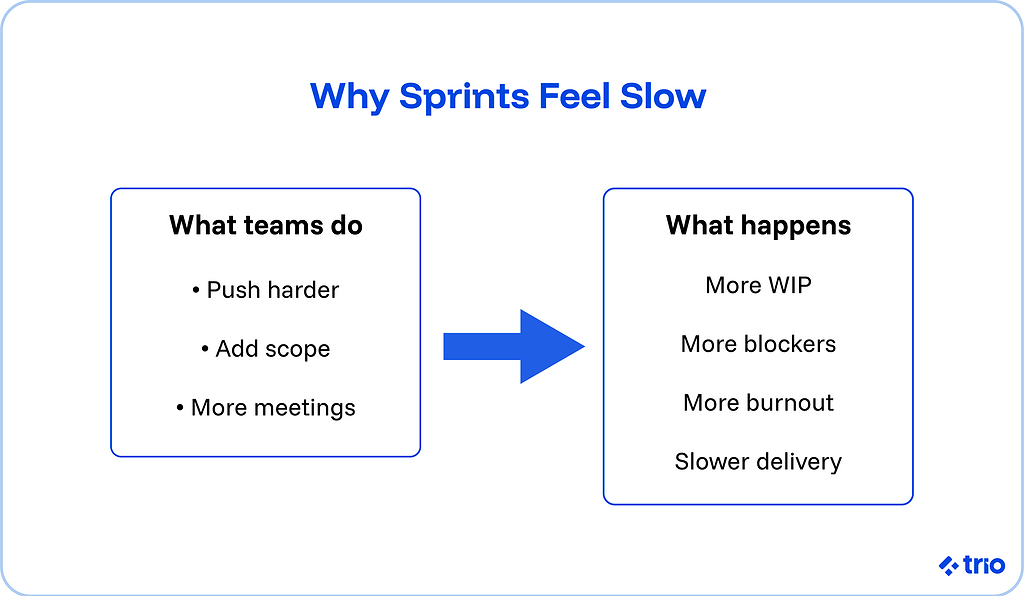
Before you try to sprint faster, it helps to understand what is actually slowing you down.
Most teams are not lazy or unmotivated. They are stuck in a system that almost guarantees delays.
There are a few recurring issues that quietly drag down sprint throughput.
Many teams only plan the visible tasks and ignore the invisible work that rides along with them.
Unplanned bug fixes, integration problems, context switching, and last-minute "quick asks" from stakeholders all steal time away from planned work.
On a board, it looks like the sprint was well planned. In reality, your developers are doing a completely different workload than what you thought you committed to.
When tickets are huge or fuzzy, you cannot predict them.
Large, ambiguous stories are one of the fastest ways to guarantee rollover at the end of each sprint.
Developers spend the first half of the sprint just trying to understand what to build, then the second half battling complexity that could have been prevented with earlier conversation and better slicing.
Slow review cycles, waiting for another team, unclear ownership on shared components, and "please ask X, they are the only one who knows that part of the system" all add latency.
Your sprint might look full of work, but the actual bottleneck is often one or two key people or functions. Until you fix that, asking the team to go faster just creates friction.
Speed in the sprint starts well before the sprint. If your backlog is messy, your sprints will be too. A sprint cannot move faster than the quality of the work that flows into it.
A clean, sprint-ready backlog is usually the lowest-hanging fruit.
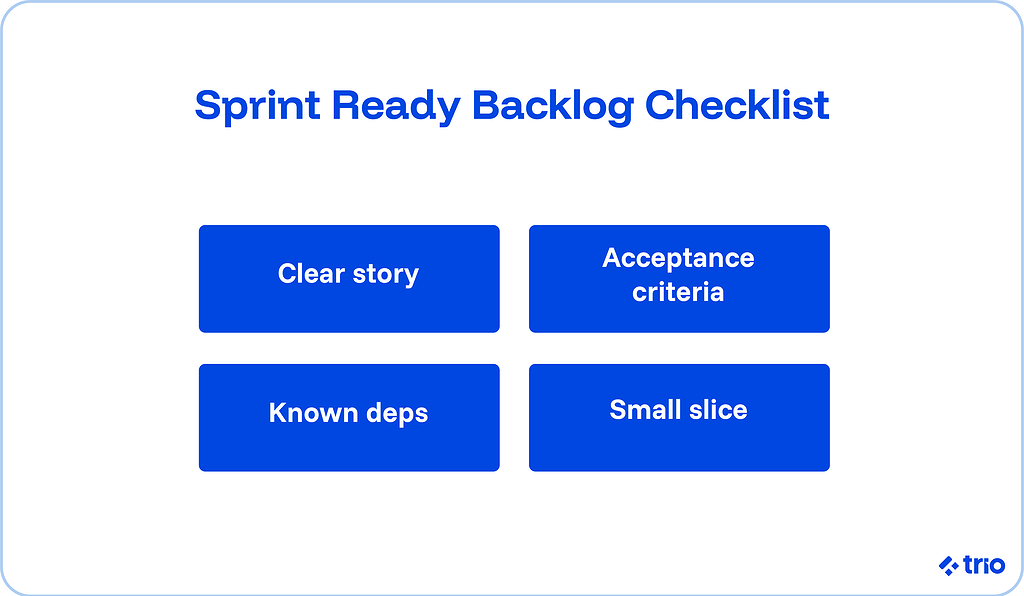
A simple definition of ready acts like a quality gate for backlog items. It might include things like: a clear user story, acceptance criteria, rough design decisions, known dependencies, and an agreed impact or priority.
The point is not to over-process every ticket. The point is to avoid pulling half-baked ideas into a sprint and hoping developers can sort it out mid-flight.
Most teams underestimate how small a ticket needs to be to move predictably.
If a single story regularly spans the whole sprint, it is probably too big.
Smaller stories make it easier to spot problems early, reduce context switching, and turn the board into a real flow tool rather than a graveyard of "in progress" cards.
As a rule of thumb, if a story cannot be finished in a few days by one developer, it is worth asking if it can be sliced further.
Product and engineering sometimes operate like separate worlds.
When engineers are pulled into backlog refinement earlier, they can flag technical risks, suggest simpler approaches, and expose hidden dependencies before planning.
That small change tends to improve estimates and reduce the number of "oh no, we did not realize this" moments mid-sprint.
Ironically, one of the fastest ways to speed up sprint delivery is to stop overfilling sprints.
It may feel counterintuitive at first. Leaders often want to maximize capacity so nothing is wasted. In reality, overstuffed sprints slow teams down.
A leaner plan creates the space your team needs to actually finish work.
Instead of asking how much you could do in theory, look at how much you actually finished in the last few sprints.
Use that as your baseline. If the team typically completes 25 story points (a unit of measure in Agile methodologies), planning 24 is usually smarter than planning 35.
Over time, that discipline tends to increase throughput because the team builds confidence and spends less time thrashing.
Most teams have a certain amount of unavoidable unplanned work: production issues, small requests, support, and data questions.
If you pretend that work does not exist, your sprint plan will always be wrong.
Reserve a slice of capacity for it. Even a small buffer can make the planned work much more predictable.
Once a sprint begins, new scope should be the exception, not the norm. If everything is urgent, nothing is. It helps to agree upfront with stakeholders on what counts as genuinely urgent.
When Trio works with clients, we often help them adopt a simple rule: if it will not affect production or a critical launch, it can wait for the next sprint.
This allows all the developers, existing ones and new ones you augment your team with, to work as effectively as possible.
If you want sprints to finish faster, focus on how work moves from "in progress" to "done", not on how quickly you start new tasks.
A board full of half-done work looks busy. It does not deliver value.
Better flow usually comes from fewer things in progress and more collaboration.
When everyone has three or four tickets in progress, nothing moves. People bounce between tasks, reviews pile up, and you get stuck in the middle of the board.
Setting a work-in-progress limit, even a gentle one, encourages the team to finish what they started. It also forces conversations that result in developers assisting one another and preventing bottlenecks.
Huge pull requests are a hidden sprint killer.
They are hard to review, risky to merge, and tempting to postpone until your developers have more time.
Smaller PRs with a single clear concern move through the system faster.
They are easier to test, easier to review, and easier to roll back if something goes wrong. That directly shortens cycle time.
For tricky stories or high-risk changes, it often pays to have two or more developers swarm on the same ticket for a short period.
It may look less efficient on a spreadsheet.
In reality, it often leads to faster and safer delivery because knowledge spreads and fewer surprises show up at the end of the sprint.
Even if development moves quickly, your sprint will feel slow if everything piles up in testing during the last two days.
The classic mini waterfall inside the sprint pattern is one of the most common delivery problems we see.
Shifting quality earlier tends to speed up both feedback and delivery.
Instead of building everything first and testing at the end, encourage developers and testers to collaborate as soon as a small slice of functionality is ready.
Many teams set a soft goal like "nothing sits in dev done for more than a day". That small constraint nudges work to flow instead of pooling.
You do not need full-blown test automation from day one, but even a modest suite of automated checks can help.
Things like smoke tests, basic regression tests, or API contract tests can catch obvious issues quickly.
That frees human testers to focus on exploratory testing where their judgment actually matters.
If bugs constantly pop up right after the sprint, your definition of done is probably too loose.
It may help to explicitly include criteria like "merged to main", "deployed to staging", and "basic monitoring in place".
When done really means done, your next sprint is not dragged down by clean up from the last one.
Metrics are a bit of a double-edged sword. Used well, they shine a light on bottlenecks.
Used poorly, they push teams to game numbers instead of delivering value. Speeding up sprint delivery is easier when you track the right signals.
Lightweight metrics are usually enough.
Velocity can be useful, but it is easy to misinterpret. Story points are subjective, and teams can inflate them without actually going faster.
Cycle time, on the other hand, shows how long a ticket takes from "in progress" to "done". Throughput tells you how many items you finish over a period.
Those two numbers tend to reveal whether process changes are really helping.
It is tempting to react to every bad sprint. That kind of knee-jerk response can create chaos. It is usually better to look at trends over several sprints.
If cycle time is slowly shrinking, you are probably on the right track, even if one sprint goes sideways. If it keeps growing, something in your system likely needs attention.
When engineers understand the numbers, they can help solve the problems. Metrics should feel like a shared tool, not a report card.
Some of the best improvements I have seen came from developers who noticed a pattern in the data and suggested a change that leadership had not considered.
There is a limit to how much process can do. At some point, speed depends on the skills, alignment, and stability of the team.
Trio spends a lot of time here with clients because the fastest teams are usually those with strong engineers who stay long enough to really own the system.
A few people-related choices can have a big impact on sprint delivery.
Constant churn kills delivery speed. New developers need onboarding, context, and review.
If your core team is always busy bringing others up to speed, it is hard to ship quickly.
Investing in a stable core team and only adding headcount when necessary often leads to better long-term velocity than constant growth.
Every engineer has strengths. Some are great at backend architecture, others shine in frontend polish, and others in debugging gnarly issues.
When you align work with strengths, sprint delivery tends to feel smoother. It does not mean pigeonholing people forever, but it does mean being thoughtful when assigning critical tasks.
Sometimes sprints are slow because the system is a mess: tangled architecture, no tests, unclear boundaries.
In that situation, you can work on the process all you want, but senior engineering experience is often the real unlock. This is one area where Trio teams come in.
A senior engineer or fractional tech lead can help design a sturdier foundation, so each sprint is not a firefight.
Every now and then, you run into a more uncomfortable reality: the pressure to speed up sprint delivery might be masking broader product or organizational issues.
It can feel risky to admit this, but it is usually better than pretending everything is fine.
Sometimes the right move is to step back and change the game slightly.
If priorities change every sprint, you will never feel fast. It is worth checking whether your product roadmap is clear enough and whether stakeholders are aligned.
Shipping the wrong features very quickly is not helpful. Slowing down briefly to clarify strategy can actually make future sprints much more effective.
If developers keep working late to hit sprint goals, you might see a short bump in output followed by a crash in quality and morale.
When people are tired, they make more mistakes, and those mistakes slow you down. Sustainable speed is a better goal than a single impressive sprint.
Scrum is a good option, but it doesn't fit everyone. Some teams eventually find that Kanban, or a hybrid approach, matches their work better.
If your environment is highly interrupt-driven, forcing everything into rigid sprints may actually reduce speed.
It is okay to adjust the framework as long as you do it thoughtfully.
Speeding up sprint delivery is not about pushing your team harder. It is mostly about reducing the friction that prevents work from flowing.
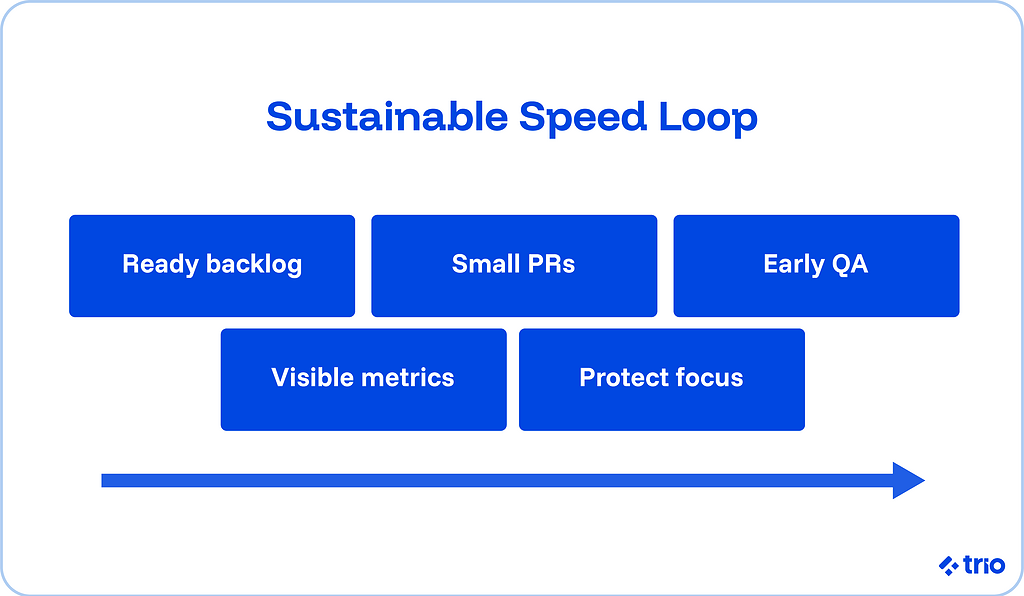
When your backlog is clear, your stories are small, your dependencies are visible, and your sprint mechanics make sense, speed begins to rise on its own.
You may still hit the occasional messy sprint, but the overall pattern becomes steadier and easier to trust.
If you stay patient, keep the system clean, and support your engineers with the right structure and experience, your team can deliver faster in a way that actually feels sustainable.
Having experts who have worked on countless projects before can be a great addition to your team. That is where Trio can assist. We connect companies with skilled developers, our custom placement making sure you get everything you need.
To find out if we have the right developers for you, get in touch.
Speeding up sprint delivery without burning people out means improving the workflow rather than demanding more hours. A mix of smaller stories and better flow usually gets you there.
Your sprints end with unfinished work because the plan does not match the real workload. Smaller scope and clearer slicing tend to make the final days far less chaotic.
Whether you shorten or lengthen sprints depends on how your team works, although shorter cycles often improve focus and make the team adjust scope earlier.
A user story should be small enough for one person to complete in a few days, which reduces uncertainty and keeps work moving through the board.
Testing piles up at the end of the sprint because work enters QA too late. Earlier handoffs and smaller pull requests keep testing more balanced.
Sprint velocity is a rough measure of how fast you are moving, although cycle time and throughput tend to give clearer signals about true delivery speed.
Stopping emergencies from derailing sprints means reserving space for unplanned work and deciding upfront which requests can wait.
Changing the sprint scope when new priorities appear should be a last resort, and if it happens often, it usually means refinement or strategy needs attention.
Developers say stories feel vague because they are missing details or decisions that make the work predictable. Bringing engineers into refinement earlier usually helps.
The fastest way to reduce rollover is to plan fewer items, slice them smaller, and finish them before pulling anything new into progress.