


 Read Client Stories




 Alex Kugell
 Key Takeaways
- Hiring remote fintech developers saves 40 to 60 percent on development costs compared to in-house US hiring, while still accessing senior engineers with production financial services experience.
- The most common remote hiring mistakes in fintech are underweighting domain knowledge (payment systems, KYC/AML, PCI DSS awareness) in favour of general technical skills.
- LATAM nearshore development is often the best model for US fintech companies. With Trio, you are looking at $40 to $80 per hour, with 4 to 8 hours of working-day overlap.
If you’re trying to hire remote developers, it can be incredibly difficult to find people who communicate well, deliver reliably, and integrate into your existing team without friction.
That challenge intensifies in fintech, since a developer who builds clean e-commerce code may still lack the compliance awareness, security instinct, and financial domain knowledge that regulated financial products require.
Finding the right developer directly, even when the talent pool is so limited, affects your product’s success, your team’s velocity, and, in fintech, your regulatory standing.
Let’s walk through the practical process of how to hire remote software developers, what to look for, where to find candidates, how to evaluate them, and how to manage a distributed engineering team once you have one.
Why Companies Hire Remote Software Developers
There are many reasons why companies might decide to hire remote software developers instead of finding someone in-house.
Cost
A tight budget is the most common reason why we see businesses look at remote hiring.
Remote software developers reduce costs related to taxes, legal fees, pension contributions, infrastructure, and office equipment.
If your project doesn’t need full-time commitment, you don’t have to pay someone for their full-time availability. Some businesses save 40 to 60 percent on development costs.
It also gives you the ability to hire developers from regions where there is a lower cost of living, resulting in lower salaries in general.
In fintech specifically, senior fintech engineers in US tech hubs go for around $140,000 to $200,000 in base salary. LATAM nearshore engineers with equivalent production fintech experience bill at $40 to $80 per hour, meaning a monthly rate of $7,000 to $14,000.
If you are a relatively small, Series A fintech building or scaling a payment product with limited funding, that difference determines what’s buildable within a given runway.
Speed
Selecting, interviewing, hiring, and onboarding take weeks at minimum, often months.
In fintech, slow hiring can get incredibly expensive because things like compliance deadlines don’t adjust if you can’t find the right person.
Banking partner integrations, PCI DSS certification timelines, and regulatory examination schedules all have fixed dates, too.
If you expand the region in which you are looking, you expand the talent pool available to you.
With access to pre-vetted global talent networks, your company is likely to reduce the time it takes to find the right person.
Access to Fintech Domain Expertise
Finding the right match in fintech means confirming the developer has seen idempotency failures in payment systems, understands why float arithmetic corrupts financial data, knows how a KYC state machine differs from a simple boolean flag, and has worked in codebases where compliance documentation matters as much as the code itself.
That combination is relatively rare and doesn’t concentrate in any single local market.
Again, remote hiring is how fintech companies increase their ability to access it.
Challenges of Hiring Remote Fintech Developers
Unfortunately, there are some unique challenges that emerge when hiring remote developers that you would not have to deal with in more conventional contracts.
Time Zone Differences
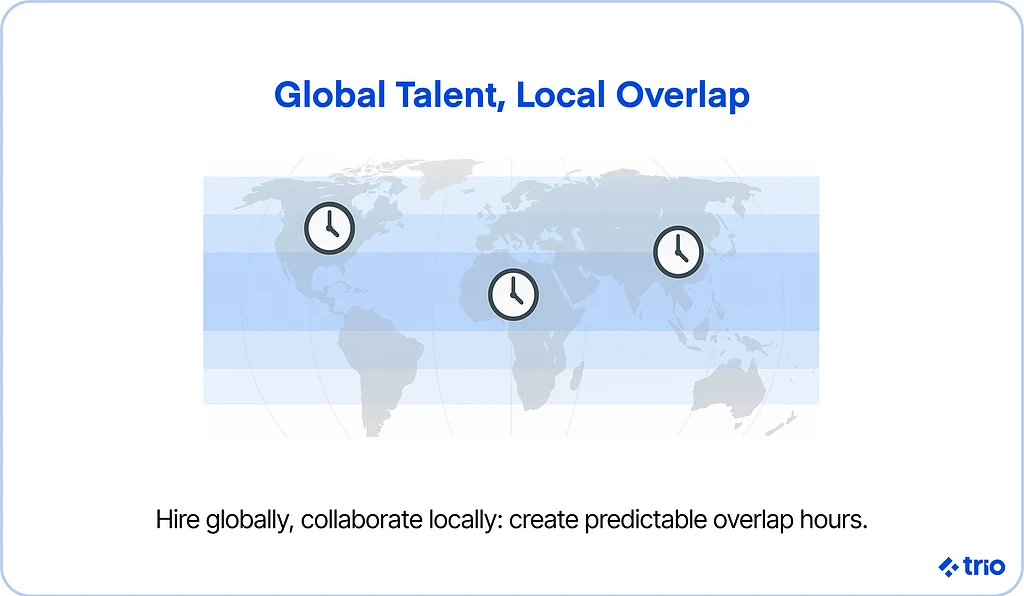
Timezone gaps affect fintech teams more than general software teams because compliance decisions often require real-time input, and needing to wait 24 hours before a decision can be finalized and actioned is not an option.
LATAM nearshore reduces this to same-day responses with four to eight hours of US working-day overlap.
Designing workflows around the actual overlap window and relying on async tools (Slack, Loom, documented decision records) for everything else tends to produce better outcomes than fighting the timezone reality.
Security and Compliance for Remote Access
Remote fintech developers access systems that handle financial data, payment credentials, and sometimes customer PII.
Developers should work through company-managed VPNs, and access to production systems should follow the principle of least privilege, with role-based access controls that limit exposure beyond what each engineer needs.
PCI DSS environments in particular require that access to cardholder data environments is logged, monitored, and restricted.
These controls need to be established as part of the hiring and onboarding process.
Cultural Fit and Communication
Bringing people together from different countries and backgrounds can be a massive strength for many remote teams.
However, it also requires a more intentional communication structure.
Direct feedback that feels efficient to one engineer can land as dismissive to another.
To get around this, make sure that you establish clear written communication norms early.
Onboarding and Compliance Ramp
Onboarding remotely requires a lot of structure.
In fintech specifically, developers without prior financial services experience typically need 4 to 8 weeks before they reach compliance-aware productive velocity.
During that period, they produce code at 50 to 70 percent of normal output as they learn the compliance reasoning behind architectural decisions, and they should not touch any compliance-critical work.
A documented onboarding process, scheduled check-ins, and an assigned team buddy during the first few weeks can all help reduce isolation and accelerate productive contribution.
Legal and Compliance
Employment laws, tax obligations, and data privacy rules vary by jurisdiction.
If you are hiring someone across borders, you need to keep in mind that DORA (the EU’s Digital Operational Resilience Act) includes third-party vendor due diligence requirements for financial services companies operating in EU markets.
On top of that, SOC 2 auditors may scrutinise how remote developers access financial systems.
Working with an Employer of Record (EoR), like Trio, handles the employment law complexity.
We have a thorough understanding of the compliance obligations around remote access to regulated systems.
Where to Find Remote Fintech Developers
Conventional job boards are an option for finding remote fintech developers, but there are also other options available that are specifically tailored to remote work.
Related Reading: Fintech Recruitment Reshape: Strategies to Win Talent in 2026
Freelance Marketplaces
Freelance marketplaces like Upwork and Fiverr allow you to move quickly. You can post a role and receive applications within hours.
The downside is signal quality, since many freelance marketplaces carry thousands of developers who present well on paper but lack the production fintech experience that compliance-critical work requires.
Sorting through applications from a pool of thousands is time-consuming, and the review and rating systems don’t capture domain-specific competence well.
For short-term, clearly scoped tasks that don’t touch any heavily regulated aspects of your product, marketplaces can work.
For payment systems, KYC engineering, or anything with compliance consequences, the vetting overhead typically outweighs the speed advantage.
Specialized Talent Networks
Talent networks like Trio pre-vet developers before they reach the hiring stage, which removes a significant portion of the screening burden.
You can rest easy, knowing that any candidates who reach you have already passed technical and communication screening.
Trio’s vetting includes domain-specific assessment targeted at things like payment system architecture, compliance-aware development practices, and TypeScript proficiency in financial codebases.
LATAM Nearshore
Hiring from Latin America is not necessarily as cheap as hiring from somewhere like India, but it is one of the most cost-efficient hiring locations because of the practical timezone alignment for US-based fintech companies.
Argentina, Colombia, Mexico, and Brazil have developed strong fintech engineering talent pools, partly because the region hosts significant financial services operations and partly because several major fintech companies have built engineering centres there.
At $40 to $80 per hour, LATAM nearshore rates represent roughly 30 to 50 percent of the cost of equivalent US talent.
On top of that, their work day largely overlaps with the United States, so you remove the decision latency that you would experience in other offshore engagements.
What to Look for When Hiring Fintech Developers
As we have already discussed, hiring in fintech is considerably more difficult than hiring developers for more general software development.
A big reason for this is that there are a host of additional skills that are required for fintech, which take time to build and maintain on the developer’s side.
Fintech Domain Knowledge
Before a technical screen, establish whether the candidate has worked on payment systems, KYC/AML flows, ledger engineering, or compliance-regulated codebases.
A developer who has built a payment retry mechanism understands idempotency from production experience; however, a developer who is very talented and hard-working may be doing their very best, but still make critical mistakes, leading to critical bugs.
TypeScript and Modern JavaScript
TypeScript has become the default in professional fintech front-end and back-end codebases.
Type safety in payment amount fields, account identifiers, and financial data structures prevents a class of runtime errors that are unacceptable in regulated financial code.
For fintech back-end work, Node.js and Python are the most common languages, while Java appears in core banking integrations, and Go is used in high-throughput financial systems.
Related Reading: Fintech Career Paths in 2026: Compliance, Jobs, and Roles
Security Awareness
In just one minute, approximately $2.9 million is lost to cybercrime globally. Fintech products are disproportionately targeted because the payoff is direct.
This means that every developer on a fintech team should understand secure coding practices, like input validation, injection prevention, credential management, and the specific PCI DSS-aware development practices that prevent cardholder data from appearing in debug logs or being stored incorrectly.
Developers who build security awareness into their daily work lower the risk profile of every feature they ship.
Data Structures and Algorithms
Strong fundamentals in data structures and algorithms allow developers to solve problems efficiently and adapt to unfamiliar technical challenges.
For example, a developer who understands data structures well enough to choose the right one for a transaction reconciliation query writes faster, more maintainable code than one who doesn’t.
Communication and Async Skills
As we mentioned above, communication matters more in remote fintech teams than in co-located ones because the cost of ambiguity compounds.
A misunderstood compliance requirement, an unclear API contract, or an undocumented architectural decision can produce defects that surface in a regulatory examination rather than a code review.
Strong written communication, comfort with async-first collaboration, and the habit of documenting decisions rather than relying on verbal alignment are the communication skills that separate effective remote fintech engineers from frustrating ones.
The 7-Step Hiring Process
While the hiring process can be complex at a glance, it can be broken down into seven simple steps that can help you guarantee your hiring success.
Step 1: Define Your Fintech-Specific Project Needs
The first thing is to clarify what the engagement actually requires.
Is this a one-off payment integration or a long-term product engineering role? Does the product touch card data (PCI DSS scope)? Does it involve KYC or AML flows? What is the expected regulatory environment, and does the developer need prior experience navigating it?
Being as specific as possible at this stage prevents interviewing candidates whose general technical skills are strong but whose domain background is misaligned.
A developer hired to build a KYC state machine who has never built one before will have a compliance ramp that costs real time and money.
Step 2: Write a Job Description
Once you understand what you need, your next goal should be to write a comprehensive job description.
A good job description sets accurate expectations on both sides. For fintech roles specifically, this means going beyond the tech stack into whether PCI DSS experience is required or a preference, whether the developer will work on payment infrastructure, compliance tooling, or customer-facing financial interfaces, and what compliance frameworks the product operates under.
If the stack runs on React, Node.js, and PostgreSQL, say so. If TypeScript is mandatory, make sure that this information is included.
Step 3: Source Through the Right Channels
Where you look shapes what you find. Freelance marketplaces produce volume, which is fine if you have the resources to sift through thousands of applicants.
Vetted talent networks, on the other hand, produce a smaller talent pool of more qualified developers. The right choice depends on the role.
For production-critical fintech engineering, payment systems, compliance tooling, or anything that will be reviewed in a SOC 2 audit, a vetted network that has already assessed fintech domain knowledge saves the screening effort and reduces the risk of a compliance ramp surprise.
Step 4: Screen Applications and Portfolios
A portfolio shows what someone has actually built and acts as a useful tool to identify work that resembles your product’s scope and regulatory context.
A developer who has built payment APIs, KYC onboarding flows, or financial data dashboards in a production environment has seen the failure modes that theory misses.
GitHub history can supplement the portfolio review process.
Look for evidence of test coverage on payment flows, use of DECIMAL or fixed-precision arithmetic for monetary values, and security-aware coding practices.
These signals appear in the code and distinguish engineers with fintech production experience from those who have primarily built general web applications.
Step 5: Test with Fintech-Specific Technical Scenarios
Coding challenges and pair-programming sessions reveal whether skills match claims.
For fintech roles, we recommend that you extend the standard technical assessment with domain-specific scenarios.
A payment idempotency challenge (how would you prevent a double charge when a network timeout occurs mid-payment?) reveals payment systems’ understanding.
Similarly, a decimal precision question (why is 0.1 + 0.2 !== 0.3 in JavaScript and why does this matter in financial calculations?) reveals awareness of a specific, expensive fintech failure mode. A KYC state machine design question reveals compliance engineering instinct.
Just remember to keep paid test projects short and clearly scoped.
Lengthy unpaid assessments drive away experienced engineers who are already in demand and don’t need to prove themselves through hours of uncompensated work.
Step 6: Interview for Technical Depth and Domain Alignment
Technical ability and domain alignment are the two dimensions that matter most for fintech remote hiring.
A developer with strong TypeScript and React skills but no financial services context will produce technically correct code that misses compliance requirements, but at the same time, a developer with fintech domain knowledge but outdated technical skills will slow the team down.
For remote roles specifically, also assess communication under realistic conditions. The hiring process itself should give you an idea of this, but ask additional questions if required.
Step 7: Onboard with Compliance Awareness
Hiring ends with the signed contract, but developers still need to be onboarded. The best way to get them contributing productively is to structure this process, providing technical context (codebase walkthrough, architecture documentation, local dev setup) as well as compliance context.
When developers understand why the KYC state machine has these specific states, how the PCI DSS scope boundary was drawn, where the audit trail infrastructure lives, and which decisions have regulatory reasoning behind them, they can avoid costly mistakes.
You should also establish access controls before day one. Set up VPN access, configure role-based system access, and confirm that the developer’s working environment meets the security standards your compliance framework requires.
At Trio, we support clients through this process when the intake volume is high, allowing them to reallocate their resources.
Best Practices for Managing Remote Fintech Developers
- Use the right communication tools: Slack or Microsoft Teams handles quick updates well. Complex architectural or compliance decisions benefit from a synchronous call rather than an asynchronous thread that gets misread. Jira, Linear, or Asana keeps work visible across time zones.
- Set clear milestones and deliverables: Break projects into milestones with defined deliverables, agree on realistic timelines together, and document decisions so they don’t have to be relitigated. For fintech specifically, milestones tied to compliance gates (sandbox certification, penetration test scheduling, banking partner review) should be identified early.
- Design workflows around timezone reality: Schedule synchronous meetings only during overlapping hours and rely on asynchronous updates, shared documentation, and recorded demos for everything else. LATAM nearshore teams facilitate this.
- Run regular check-ins: Without office visibility, problems can compound. Short, predictable check-ins (a daily standup or a weekly project review) give everyone an opportunity to surface blockers before they become missed deadlines.
- Build culture with intention: Remote team culture requires deliberate effort. Celebrating milestones, acknowledging individual contributions, and creating space for non-work interaction all help.
Freelancers vs. Staff Augmentation vs. Full Remote Teams
| Option | Best For | Time to Hire | Cost | Pros | Cons |
| Freelancers | Short tasks, clearly scoped prototypes | 1 to 5 days | Low | Fast, flexible | Inconsistent quality, poor long-term continuity, no compliance domain depth |
| Staff Augmentation (Trio) | Long-term team scaling, fintech production roles | 3 to 5 days | Medium ($40 to $80/hr) | Pre-vetted fintech domain knowledge, seamless integration, 95% retention | Slightly higher cost than unvetted marketplaces |
| Outsourced Remote Team (Trio) | Full product builds, end-to-end development | 2 to 4 weeks | Higher | Turnkey development, managed delivery | Less direct control over day-to-day engineering |
Final Thoughts
Hiring the right remote fintech developer gives you incredible leverage.
However, a mis-hire in a compliance-critical role costs not just the re-hiring time but the compliance ramp, the technical debt from production decisions made without domain context, and potentially the regulatory exposure.
The biggest problem our clients encounter is that they need the time and the skill on their team to be able to assess developers correctly.
Trio’s staff augmentation model addresses this directly.
At Trio, we place pre-vetted fintech engineers with production financial services experience in as little as 3 to 5 days. The LATAM-based experts range from $40 to $80 per hour, depending on your requirements.