

Hire by Technology
SERVICES

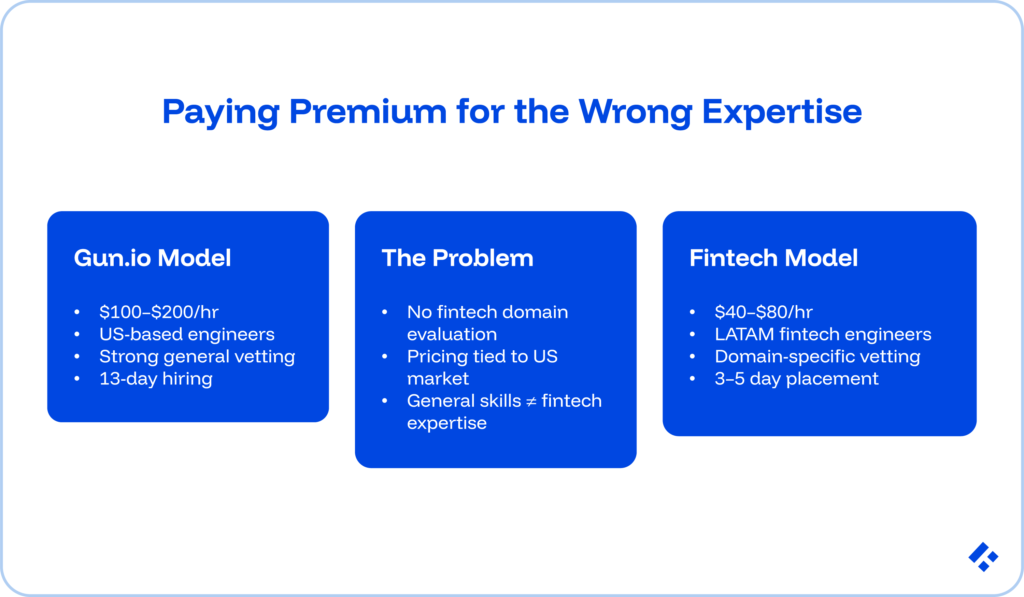
Gun.io charges $100–$200/hr for freelance engineers and a 20% first-year salary fee for full-time placements. From what we have been able to see, these are some of the highest rates in the vetted staffing market.
There are a couple of factors that drive this pricing, including that its vetting is rigorous for general engineering quality. But, it does not systematically evaluate fintech domain competencies such as payment rail protocols, KYC/AML state machine design, double-entry ledger integrity, or fraud ML training-serving skew.
This means that, for fintech engineering roles, that combination produces the worst value equation of any major staffing platform.
You end up paying a premium for quality measured on the wrong axis.
Let’s take a deeper look at where Gun.io is a good fit, where it isn’t, what it costs in practice, and the best Gun.io alternatives for hiring senior fintech developers in 2026; namely, Trio.
If you need a senior fintech talent, placed and onboarded in 3-5 days, compare options.
Some things Gun.io genuinely makes it a good option for a variety of different situations.
The ~10% acceptance rate and three-stage vetting process produce engineers who actually have the abilities that you would expect from senior developers.
Unlike platforms that classify seniority by years of experience alone, Gun.io's coding test and senior engineer interview create a quality bar that most commodity staffing platforms don't reach.
The result has been that developers in the community tend to carry real track records and have worked on some very meaningful projects.
Human judgment, not algorithmic matching, is also what drives Gun.io's placement decisions.
Compared to Turing's AI-dominant model, which client reviews flag for mismatches between automated profile analysis and actual role fit, the human-first approach reduces a specific and frustrating placement failure category for roles where communication style and collaborative instinct are all critical.
Contracting, billing, and onboarding all get handled by Gun.io, too. In the process, team members are present on calls, especially during initial interviews.
If your company doesn’t have an existing, strong internal technical recruiting capacity, you might want to consider how Gun.io’s end-to-end management reduces hiring friction.
Related Reading: Recruiting Agency vs Staff Augmentation
Gun.io's senior freelance developers typically run $110–$145/hr, putting a full month of engagement at $11,000–$12,000 at the conservative end.
Full-time placements carry a 20% first-year salary fee on top. This means that at a $160,000 annual salary, the placement fee reaches as much as $32,000.
One thing to note is that rates don't appear anywhere on Gun.io's website. You need a direct consultation in order to get any sort of quote. Fintech teams enter that conversation without a published benchmark to anchor against.
That cost does come with a bunch of services, namely Gun.io's vetting infrastructure, human-first matching, boutique support model, and the economics of sourcing primarily from the US and Canada talent market.
What you don’t get with that cost is a guarantee that the placed engineer understands why monetary amounts require DECIMAL rather than FLOAT in financial pipelines, how idempotency keys prevent double charges in payment retry flows, what a KYC identity verification lifecycle looks like across its full 14 states, or how training-serving skew silently degrades fraud detection models after deployment.
Gun.io's vetting process wasn't built to evaluate them.
For KYC/AML developers specifically, the stakes run higher due to increased compliance exposure.
Gun.io's talent pool skews heavily toward US-based engineers, which means you end up paying domestic market rates, where US salary floors and cost of living end up drastically increasing costs compared to LATAM nearshore markets, for example.
For general engineering quality, the US pool may carry a small advantage.
Senior engineers who have worked on large-scale US product teams bring patterns of collaborative engineering culture that some hiring managers value.
But you can hire similar engineers, who have also worked on large-scale product teams, from nearshore and offshore locations. It is important to evaluate what they have done previously, especially in an industry as diverse as FinTech.
LATAM fintech developers at Trio sit at around $40–$80/hr.
The premium for US-based engineers doesn't automatically translate to deeper fintech domain credentials. In many regulated domains, the LATAM production track record in particular competes directly with the US general engineering pool.
Gun.io averages 13 days from initial contact to signed contract. That beats traditional recruiting (often 4–8 weeks or more than six months for niche fintech positions) and stays competitive with other boutique staffing platforms.
This makes it a good option for steady-state product development hiring.
Fintech engineering capacity sometimes needs to be expanded even faster than that.
DORA implementation dates, PCI DSS audit remediation schedules, and Section 1033 API deadlines are some of the biggest drivers for rapid hiring that we have seen.
Gun.io's vetting runs on human judgment. The three-stage evaluation carries real depth.
A senior engineer conducting a technical interview can assess contextual engineering judgment, collaborative communication, and architectural reasoning in ways automated systems genuinely struggle with.
The problem for fintech teams is that the senior engineers running Gun.io's technical interview evaluate for general backend competency. This could include things like system design, code quality, debugging, and architectural thinking.
The platform's process doesn’t require that they evaluate fintech competency. The particular frustration here: Gun.io's human-first model would accommodate fintech domain evaluation without structural changes.
A senior engineer running a technical interview can ask domain-specific questions when the platform's process requires them, but if they don’t have fintech expertise themselves, they can’t thoroughly determine where they would be a good fit.
A genuine alternative for fintech teams retains what Gun.io does well while adding the domain pre-vetting Gun.io omits and pricing that reflects nearshore and offshore market rates rather than the US domestic floor.
Here are some things to think about:
Trio is one of the best alternatives to Gun.io due to a variety of different factors.
| Dimension | Gun.io | Trio |
| Primary talent pool geography | US-centric | LATAM nearshore |
| Freelance pricing | $100–$200/hr ($11K–$14K/month senior) | $40–$80/hr ($7K–$14K/month) |
| Full-time placement fee | 20% of first-year salary | No placement fee |
| Pricing transparency | No published rates; quote required | Published: $40–$80/hr |
| Average time to shortlist | ~13 days | 3–5 days |
| Vetting approach | Human-conducted: coding test, senior engineer interview, soft skills | Human-conducted: fintech domain evaluation per discipline |
| Fintech domain evaluation | Not systematically assessed | KYC/AML, payments, ledger, fraud ML, RegTech, open banking, data |
| Engagement model | Freelance or full-time; minimum hours apply | Full-time, part-time, project-based; flexible |
| Client geography served | US and Canada focus | Global (US, UK, EU, LATAM, APAC) |
| Retention rate | Not published | 95% |
| Trial period | Not offered | Replacement available if placement doesn't meet the brief |
| Best fit | Senior general engineers for US companies with budget flexibility | Senior fintech domain engineers globally, with domain pre-vetting built in |
As we have already mentioned, there are certain instances where there is a serious mismatch between what you pay for and what you end up getting.
This gap concentrates where fintech domain knowledge carries the most direct production consequence, and where general engineering seniority, however genuine, doesn't substitute for it.
Gun.io's premium buys general quality, but not the kind of domain depth that you need for roles like:
While there is a lot for which specific domain vetting is needed, Gun.io's general seniority likely justifies the premium for US companies with budget flexibility and limited domain exposure in these roles:
For that second group, Gun.io's boutique quality and human judgment in matching deliver real value.
There are many instances when Gun.io’s generally thorough vetting process and senior-heavy talent pool might make it a great option for you.
However, when it comes to FinTech development, you need someone with domain experience, which the platform does not assess for.
At Trio, we specialize in FinTech development. Our developers are all placed based on production experience in projects similar to your own, so you are guaranteed to have the right fit.
Book a decision call.
Gun.io works well for fintech companies hiring senior general software engineers. In other words, it might be a good option if you need React, Node.js, Python backend, or DevOps engineers that don’t particularly need fintech experience, and where you justify the top-of-market rates.
Gun.io prices at $100–$200/hr for freelance engagements, typically landing at $11,000–$14,000/month for senior roles, with a 20% first-year salary fee for full-time placements. Trio prices at $40–$80/hr ($7,000–$14,000/month) with published rates and fintech domain pre-vetting included. Turing runs $100–$200/hr for general engineers. Toptal typically runs $150–$250/hr at the premium end.
Gun.io's US-centric sourcing drives pricing toward domestic market rates by structural market dynamics. For fintech domain roles, the LATAM talent pool, particularly engineers with production experience in international projects, offers directly applicable fintech domain credentials at $40–$80/hr through a company like Trio.
Andela evaluates general engineering quality without fintech domain competencies as a structural design choice. Turing serves US/Canada clients only, full-time only, and has turned to AI-first matching without domain evaluation. Gun.io represents a cost-quality mismatch.
Gun.io averages 13 days from initial contact to hire, which is faster than traditional recruiting but slower than pre-vetted bench platforms. For fintech teams with compliance-deadline-driven engineering capacity needs, a 13-day staffing timeline may not be feasible, especially if you factor in the potential need to rehire if the person is not a good fit.