

Hire by Technology
SERVICES



In general cases, you can sort custom software development companies by cost, control, and speed.
However, the moment your software is regulated, none of those are sufficient deciding factors.
Instead, the question that matters the most is who carries the compliance obligation, the audit evidence, the IP chain, and the scope determination, because it stays yours no matter who writes the code.
Let’s look at everything you need to know about choosing a custom software development company when your software is regulated.
Cost, control, and speed are real considerations for standard development projects.
They tend to work well in most cases, since a team weighing a boutique agency against a large consultancy genuinely should think about how much day-to-day control they want to retain, how fast the engagement needs to start, and what the total cost actually looks like after overhead.
However, when a regulator, a sponsor bank, an auditor, or an enterprise customer's security team needs to examine the product, a different set of questions needs to be involved when deciding on an engagement.
The reality is that you cannot outsource the obligation. Whoever writes the code, the audit finding lands on you, the scope determination is yours to make, and the examiner asks you, not your vendor.
If you hire the wrong person, everything could look fine at first, but you may run into issues several years down the line when you fail a diligence review.
This applies to any regulated software, but fintech is where it shows up most often and most expensively: payment flows, KYC systems, and anything touching transaction data.
| Category | Who directs the work | Who owns the outcome | Typical fit |
| Global consultancy | Them | Them | Multi-year transformation, enterprise procurement, one throat to choke |
| Full-cycle agency | Them | Them | Defined build, limited internal engineering leadership |
| Boutique/niche specialist | Shared | Shared | Deep expertise in one domain or stack, senior attention, limited surge capacity |
| Staff augmentation | You | You | You have engineering leadership and a roadmap, need capacity or a specific skill |
| Marketplace/freelance | You | You | Discrete, short, low-continuity work |
A global consultancy directs the engagement and owns delivery end to end, which suits large, multi-year transformation work if you want a single accountable party and have the budget.
A full-cycle agency works similarly at a smaller scale, a good fit when internal engineering leadership is limited but the build is still substantial enough to need real delivery ownership.
Boutique or niche specialists split direction and ownership more evenly, bringing deep expertise in one stack or domain.
Finally, staff augmentation and freelance marketplaces both put direction and ownership on your side of the table, useful when you already have engineering leadership and a roadmap and need capacity or a specific skill.
From what we have observed, outside of industry experience, the most important question to help you decide between partners is whether you have engineering leadership capable of directing external work day to day.
Staff augmentation without an internal engineering team creates issues like scope drift.
On the other hand, managed delivery without any internal technical oversight produces a system nobody on your side actually understands.
Let’s look at all the specific questions you need to ask a potential software development company in order to ensure that your engagement survives contact with an auditor.
An auditor samples changes from the observation period and asks for the full chain: ticket, branch, review, approval, deploy, and a named human at each step.
If that evidence lives entirely inside the vendor's own systems, you create a dependency.
A good answer here is for the vendor to work inside your repo, your tracker, your CI, authenticating against your own identity provider rather than theirs.
When you do this, evidence becomes a byproduct of how the work happens.
Scope gets determined by system connectivity and data flows.
This means that, even if the contract tries to claim otherwise, a vendor engineer with a network path to a cardholder data environment is in PCI scope.
A shared CI pipeline or a shared builder server can quietly pull a whole team into scope without anyone deciding that on purpose.
Look out for whether or not the vendor can discuss specifically which scope tier their engineers will occupy, and what architectural changes would move them out of it.
The chain runs from engineer to local entity to vendor to you, and every link in it has to hold.
In some jurisdictions, moral rights complicate the assignment further. Weak links here tend to surface during diligence or an acquisition.
A good answer: the vendor can describe the full chain without hesitation and is willing to put it in writing.
Undisclosed subcontracting puts an unaudited fourth party directly into your commit history. It’s particularly common where capacity gets filled through informal partner networks.
You should ensure there are named individuals on the engagement, real notice if someone gets substituted, and a contractual bar on subcontracting without written consent.
An NDA is a contract between two parties. While it is necessary, it doesn't discharge obligations under frameworks like PCI DSS, GLBA, or GDPR.
Many people confuse it with a data processing agreement, which it is not.
Make sure the vendor distinguishes between these instruments without being prompted to.
In a regulated codebase, unusual-looking code often encodes a regulatory requirement whose actual reason lives in a compliance document somewhere.
A strong, competent generalist engineer may change that code the first chance they get, without truly grasping the negative effect they are having on your compliance.
You need engineers with real production experience in regulated environments specifically, and a vendor who asks about your regulated surface area upfront.
A boutique agency can have an airtight IP chain while a global consultancy runs an opaque subcontracting model underneath a polished proposal.
Category tells you how the work gets managed day to day, not if you’ll survive an audit.
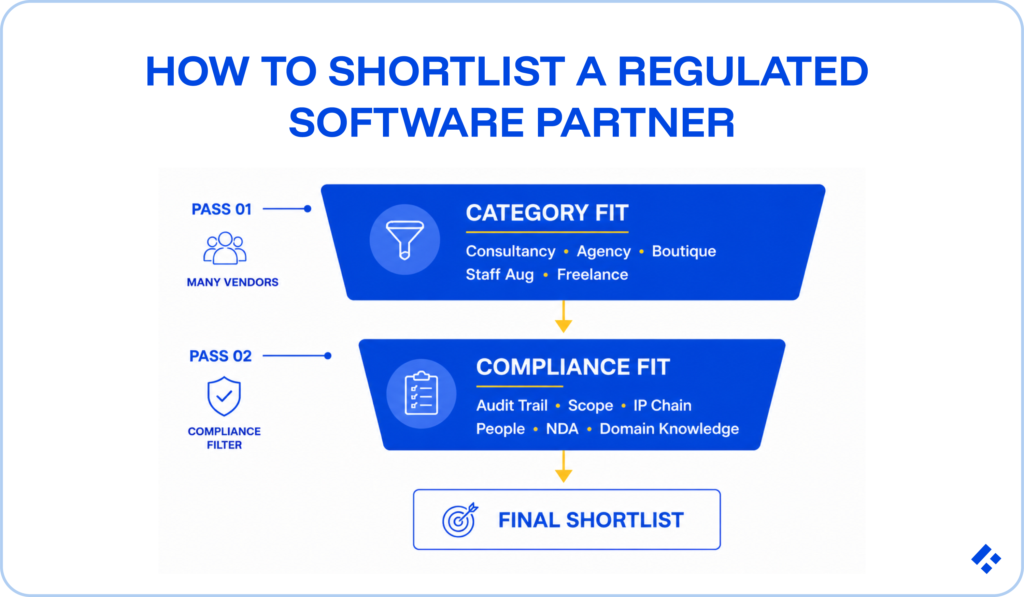
We recommend that you screen on category first, since it's fast and narrows the field quickly to something manageable. Then screen on these six questions, since they're what actually fails when something goes wrong.
Once a shortlist is genuinely narrowed using both passes, the diligence that follows gets more specific.
Figure out if there are references worth actually calling, ask about failure stories, test escalation paths, and find out whether a pilot engagement makes sense before committing to something larger.
Category drives price shape more than it drives quality. Consultancies usually bundle delivery management into a blended rate, so the number quoted already includes someone managing the engineering on your behalf.
Staff augmentation, on the other hand, prices the engineer specifically and assumes you're managing the work yourself, at your own cost.
To get a better idea of what you’ll really end up paying, we recommend that you look at loaded costs, including things like ramp-up time, management overhead, and attrition.
Keep in mind that, in fintech specifically, real domain experience carries a genuine premium, and paying it upfront is usually cheaper than discovering the gap mid-engagement.
In short, if you already have that capacity, you're paying for management you don't need, and staff augmentation or a boutique specialist is very likely the better use of the same budget.
If you need access to senior fintech expertise, in a hiring model that suits your project, book a decision call.


