

Hire by Technology
SERVICES


Ask a payments team how reconciliation is going, and you will usually hear a number. "We are matching 98% automatically."
While this match rate is a popular way to measure the success of reconciliation, it doesn’t really tell you anything, since it just talks about the easy transactions that were always going to line up.
It says nothing about the 2% that did not, and that 2% is where the money, the risk, and the engineering hours actually live.
Everything that matters (cost, customer trust, audit readiness, and how many people you need to hire) is decided by how quickly and cleanly you clear exceptions, not by how many transactions sailed through untouched.
Let’s take a look at how fintechs automate matching, why exceptions deserve your attention, how automated matching works in practice, what instant payment rails change, and the staffing question underneath all of it.
To get experienced developers who can help you understand which metrics to look at, as well as carry out solutions practically, we can help.
At its simplest, reconciliation is the process of confirming that two or more records of the same money agree.
In other words, if your internal ledger says a customer paid $500, but the processor's settlement report says $485 landed in your account, and the bank statement just shows a deposit, reconciliation is the process that helps you tie all those together and explain the difference.
In this specific instance, that difference was probably caused by a processor fee.
When your business is quite small, you can get away with making reconciliation a monthly task that someone does in a spreadsheet.
In fintech, however, it is continuous, high-volume, and multi-party.
You are probably going to be matching across your own system of record, one or more payment processors, card networks, banking partners, and increasingly real-time payment rails.
Each one of these adds complexity, since they have their own timing, format, and quirks. A single customer transaction can generate half a dozen records that arrive at different moments and look quite different.
You need to do it right, though, since clean reconciliation is what lets you pay out merchants accurately, report to regulators with confidence, detect fraud and leakage early, and close your financial month without a scramble.
When reconciliation is weak, you’ll probably start dealing with issues like delayed payouts, surprise write-offs, audit findings, and a finance team that can’t trust its own numbers.
Auto-match rate is the percentage of transactions your system pairs up without human involvement.
We’ve found that it can be very easy to measure and report, so teams are tempted to use it as a KPI that they can feel good about. But in reality, the number can be quite misleading.
A high match rate is actually measuring the transactions that behaved. The problem is that those matches were never at risk to begin with.
Automating them is definitely valuable, but it is not where the difficulty is.
Instead, the transactions that fail to match are the ones carrying important information.
A break means something happened: a fee you did not model, a partial refund, a duplicate charge, a currency conversion, a chargeback working its way through the system, or a timing mismatch between when you recorded the payment and when it settled.
Each unmatched item requires a small investigation, and if you are relying only on match rate, you end up avoiding them entirely.
Two fintechs can both report a 98% auto-match rate, but one may clear its 2% exceptions within hours, with clear ownership and a shrinking queue, while the other lets exceptions pile up for weeks, resolving them in frantic month-end batches.
That’s why many of our experienced payments leaders stop treating match rate as a north star and focus on optimizing the queue instead.
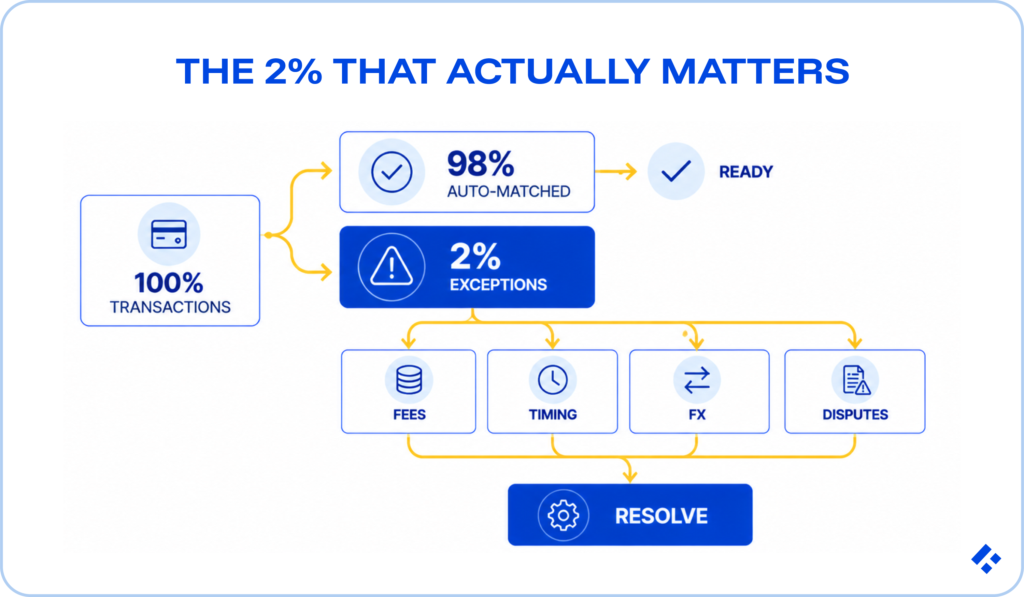
Breaks are usually not random. We find that they cluster into a handful of recurring types, and naming them is the first step to automating against them.
Taxonomy here helps with traceability.
"40% of our exceptions are fee gaps, 30% are timing, and 15% are partial captures" tells you exactly where automation will pay off and which breaks still need a human.
Automated reconciliation allows you to take advantage of a matching engine that applies rules and, increasingly, machine learning to pair records across sources, which means you can free up your people to deal with more complex cases.
You do not need to know how to build one to understand what separates good automation from bad.
The first layer is deterministic matching. These are exact and near-exact rules. In other words, you’ll match on transaction ID, on amount plus date, or something like a reference number.
We recommend this first since it lets you get rid of the bulk of volume quickly.
The second layer is fuzzy and tolerance-based matching. The system accounts for the exceptions above, and then matches net amounts after modeled fees.
The result is that it allows a settlement window for timing, tolerates FX spread, and links one-to-many relationships for partial captures, clearing items that would otherwise land in front of a person.
The third layer, where many teams are investing now, applies machine learning to the residual.
In other words, instead of hand-writing every rule, models learn matching patterns from historical resolutions and suggest pairings for ambiguous cases, with a human confirming.
Machine learning doesn’t manage to get everything, though. Instead, it augments the exception process rather than eliminating it, shrinking the last of the queue, and speeding up the humans. It does not remove the need for judgment.
For most of reconciliation's history, payments settled in batches, often overnight or over several days, which gave teams a comfortable window to gather records, run matching, and work exceptions. Instant payment rails have quietly removed that cushion.
With rails like FedNow and RTP in the United States, funds move and settle in seconds, around the clock, including weekends and holidays.
While customers love this, offering instant payments can give you a market edge; it also breaks the assumptions that batch reconciliation was built on. Transactions are final almost immediately, which means an unreconciled break is urgent.
Since settlement is immediate and irrevocable, errors have to be caught and resolved in near real time.
Volume arrives in a steady stream rather than predictable batch drops, so reconciliation has to run continuously rather than on a schedule. And because these rails operate every hour of every day, so must your monitoring, which has staffing implications.
There is a helpful tailwind here.
The move to the ISO 20022 messaging standard means you get richer, more structured data with each transaction, so you have more fields to match on and cleaner automation, which is exactly what continuous reconciliation needs.
Matching your ledger to a single processor is the most basic version of reconciliation you will ever see.
Real fintechs usually sit in the middle of a bunch of multiple processors, acquiring banks, card networks, payout partners, and sometimes several payment orchestration layers routing transactions between them. All of those need to agree, even though there may be no shared reference number to work off of.
When you route across providers for cost or reliability, as many teams do, that routing has to be reflected in reconciliation too, or funds appear to go missing simply because you are looking at the wrong provider's report.
Practically, we have found that reconciliation complexity is largely a function of decisions made upstream. Every processor you add, every rail you support, every orchestration layer you insert makes reconciliation harder, but multi-provider setups exist for good reasons.
When the exception queue grows, you either need to throw people at it, or invest in automation.
Most companies we work with default to people, because hiring a reconciliation analyst feels faster and less risky than building or buying tooling. It is an incredibly valid solution short-term, but doesn’t hold up as you continue to scale.
The problem with staffing your way out is that manual reconciliation effort scales roughly linearly with volume. Double your transactions, and you’ll eventually need close to double the people working breaks.
Automation flips the curve. The upfront investment is higher, but well-built matching means volume can climb without a matching climb in headcount, because the software absorbs the routine breaks and people focus only on the genuinely ambiguous ones.
You need to remember that the goal is not a reconciliation team of zero. It is a team whose size stays flat while the business grows, working the exceptions that actually need human judgment rather than the ones a rule should have caught.
There is a third path you can consider as well, which is a question of who builds the automation rather than whether to build it.
Pulling your core engineers onto a reconciliation build stalls the roadmap, but at the same time hiring full-time reconciliation specialists is slow and hard in a competitive market.
IT staff augmentation lets you bring in engineers who have built these systems before, so they can ship the capability and transfer the knowledge to your team, without permanently expanding headcount for a project with a finish line.
From what we have observed, there are a few principles that separate the teams that have reconciliation under control from teams that just have a good match rate:
None of this requires a bigger team, which is a common misconception. Instead, it requires treating the exception queue as the product.
Payment reconciliation is one of those functions that you never see until it fails. The issue is that when things go wrong, it can be very expensive and attract public attention.
Late payouts, blown month-end closes, audit findings, and customers who no longer trust that their money is where it should be are all just the tip of the iceberg.
Since the consequences are so severe, avoiding downtime is essential, and the teams that get this right understand early that they need to automate the trivial so people are actually free to deal with the issues
If you are at the point where reconciliation is starting to strain, whether you need to build the system properly or add experienced payments engineers to your team, Trio can help. Talk to us about fintech developers who have done this before.