

 Read Client Stories





 Alex Kugell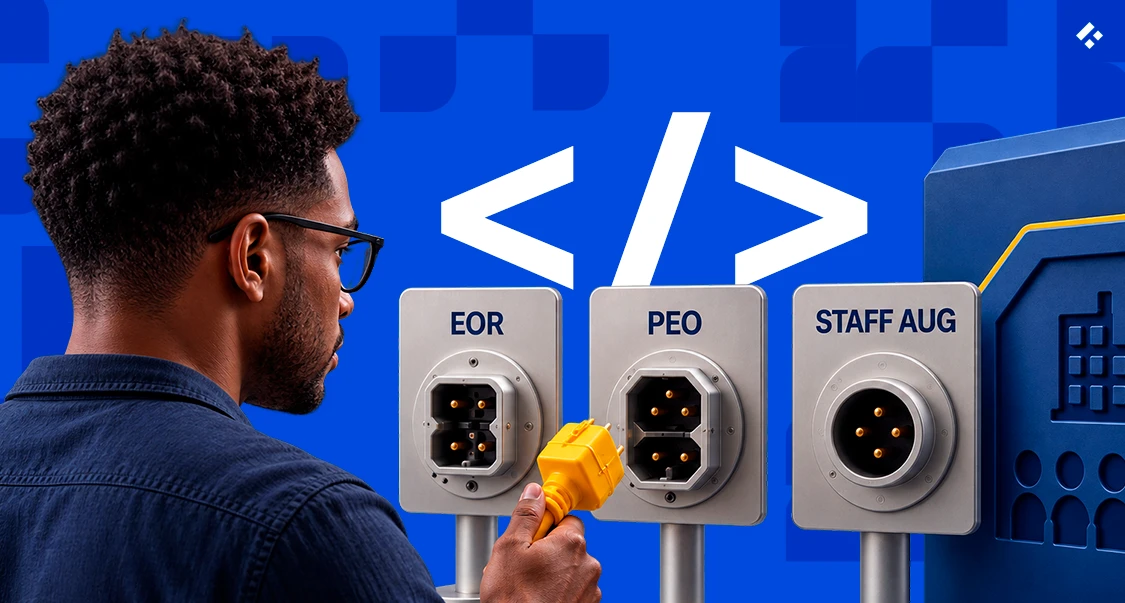
 Key Takeaways
- PEO, EOR, and staff augmentation rest on different assumptions about who the legal employer is.
- “International PEO” and “global PEO” are marketing labels. In nearly every case, the service being sold is functionally an Employer of Record.
- PEO and EOR are both employment-administration purchases. Staff augmentation is a capability purchase.
- IP assignment runs cleaner through a single-employer model (EOR or staff augmentation) than through PEO’s co-employment structure.
EOR, PEO, and staff augmentation aren’t three equivalent options, even though they are all popular for international hiring.
Knowing the difference and choosing the right one for your situation can help you reduce costs and prevent legal mistakes that result in fines and halted work.
Essentially, a PEO co-employs alongside a legal entity you already have. An EOR replaces the need for that entity. Staff augmentation means you aren’t the employer at all.
Let’s dive into all of the differences and which model might actually be a good fit for your company.
At Trio, we provide a variety of different hiring models, so you can access expert fintech talent without worrying about making a legal mistake in an already heavily regulated industry.
They Aren’t Three Versions of the Same Thing
Each option rests on a different assumption about who the legal employer is, and two of the three carry preconditions you may not meet.
The one-line version of each:
- A PEO means co-employment, so you remain a legal employer while the PEO shares specific employment functions alongside you, which means that you already need to have a legal entity in that jurisdiction.
- An EOR means substitution, so the provider becomes the sole legal employer, your company never appears on the employment contract, and the entity requirement disappears entirely.
- Staff augmentation means no employment relationship at all, because the provider employs the engineer and supplies their services to you. You’re just buying a service.
If you’re a US company hiring engineers in Colombia and you have no Colombian entity, the PEO option is already gone.
“International PEO” Is a Label
Services marketed as “international PEO” or “global PEO” are, in nearly every case that we have encountered, functionally an Employer of Record.
The provider’s own entity becomes the sole legal employer.
Co-employment requires your company to have a legal entity in the country where the employee works, and the jurisdiction needs to actually recognize co-employment as a legal framework.
The only time we really see this is as a US construct, a single model applied fairly consistently across fifty states, with a real regulatory apparatus behind it, ESAC accreditation and IRS CPEO certification among the more established pieces.
The concept doesn’t translate cleanly into most LATAM labor frameworks.
Instead, the term has just stuck around because some providers built their go-to-market around “PEO” before the industry settled on “EOR” as the clearer term.
If you believe you have PEO-style shared liability and you have an EOR arrangement, your understanding of who carries what risk is simply wrong.
The question to ask any provider using PEO language, and it resolves the category in one exchange: “Will our entity appear on the employment contract, and do we have an entity in this country?”
The Three Models Compared
| PEO | EOR | Staff Augmentation | |
| Who is the legal employer | You (co-employed) | The provider | The provider |
| Whose name is on the employment contract | Yours and the PEO’s | The EOR’s | The provider’s |
| Requires you to have a local entity | Yes | No | No |
| Available outside the US | Rarely, as genuine co-employment | Yes | Yes |
| Who sources the person | You | You | The provider |
| Who manages day-to-day work | You | You | You |
| Who replaces them if they leave | You | You | The provider |
| Where liability sits | Shared | Provider (primary) | Provider |
| Typical cost | 2-12% of payroll | $400-699/employee/month flat, commonly | Hourly or monthly rate for the role |
| What you’re buying | HR administration | Employment infrastructure | Engineering capability |
These models aren’t always an either-or choice.
Instead, a common setup that we see is a US entity with a PEO handling domestic HR, while a separate EOR covers a handful of international hires in LATAM to cut costs, and staff augmentation is used for flexibility.
The Elimination Sequence
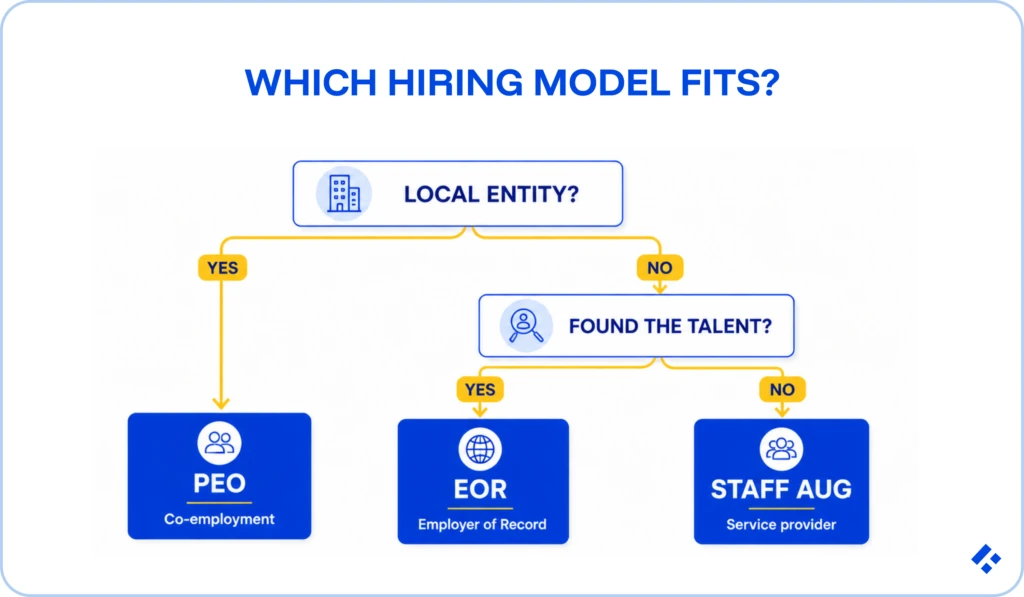
1. Do you have a legal entity in the country where this person will work? No means PEO is out, and anything sold to you as international PEO should be evaluated as an EOR. Yes means PEO remains available.
2. Have you identified the specific person you want to employ? Yes means EOR (or your own entity, if you have one), since you need employment infrastructure, not sourcing. No means continue to the next question.
3. Do you have the recruiting capability and the time to run the search? Yes means EOR still works if you have the budget for the search. For senior engineering searches in niches like fintech, that could run weeks to months. No means staff augmentation, since the sourcing and bench risk is the actual thing you’d be buying. This is our most popular hiring option at Trio.
4. Is this a permanent role you want on your own equity and career ladder? Yes means EOR or entity, even if it’s slower. No, or unclear, means staff augmentation preserves the option without forcing a termination event later.
5. How many people in this country? Under roughly 8-12, EOR is the best option. Well above that, a local entity becomes the cheaper structure, and PEO becomes genuinely available for the first time.
Two Cases Where the Model Choice Has Real Consequences
- IP assignment: The chain that has to hold is engineer, to their legal employer, to you. Each model produces a different version of that chain.
- Converting a contractor: A long-running contractor who’s become a de facto employee is a common trigger for this whole decision. The models that actually resolve this are EOR (employ them properly, going forward) or staff augmentation (engage them through a provider who employs them instead).
What to Ask Before You Compare Vendors
If you aren’t sure what you are signing up for, there are some questions that can help you resolve the category before price ever enters the conversation.
“Will our company appear on the employment contract?” distinguishes co-employment from substitution immediately.
“Do we need an entity in this country for this arrangement?” tells you whether you’re really looking at a PEO or an EOR wearing PEO branding.
“Who is responsible for finding a replacement if this person leaves?” distinguishes an employment-administration purchase from a capability purchase.
“Show me the IP chain from the individual to us” applies to all three models and gets answered differently by each.
At Trio, we provide any required information from day one, starting every engagement with a complimentary consultation, so you can rest easy knowing that you have all the information you need before the engagement starts.
If you are ready to start hiring fintech developers with many years of production experience, book a consultation.