


 Read Client Stories




 Alex Kugell

 Key Takeaways
- BCG, McKinsey, and the BIS all estimate genuine real-economy stablecoin payments at $350 to $550 billion for 2025.
- Stripe bought Bridge for $1.1 billion, Mastercard acquired BVNK for up to $1.8 billion, and Visa launched its own stablecoin platform.
- Two issuers hold roughly 83% of supply. Tether at about 59%, and Circle’s USDC at around 23%, which concentrates a meaningful amount of risk.
- MiCA’s full enforcement in July 2026 pushed Tether off EU-regulated venues while Circle secured authorization.
- Emerging-market corridors are where the economics work hardest, which is why Africa and Latin America specialists keep attracting both funding and partnerships from the card networks.
- Picking a vendor does not finish the job. Reconciliation, sanctions screening, and off-ramp configuration still have to be built on your side.
Stablecoin transfers passed the US ACH network in monthly volume for the first time in February 2026.
The surprising thing to many is that the companies behind that shift are no longer crypto startups operating at the edge of finance.
Instead, they are increasingly the same payment networks that have run global money movement for decades, plus a layer of infrastructure firms they have been busy acquiring.
Let’s take a look at the 12 stablecoin payment companies building the new money rails in 2026, including:
Circle
Tether
Paxos
Bridge
BVNK
Zero Hash
Conduit
Orbital
Fireblocks
Visa
Mastercard
Yellow Card
We’ll group them by what they actually do, so that you understand who to watch based on what area of financial technology might be relevant to you.
For senior fintech developers who can help advise you and implement new money rails, we can assist.
What The Volume Numbers Actually Say
Stablecoins moved roughly $33 trillion in 2025, more than Visa and Mastercard combined, but that number actually tells you very little.
Blockchains record that value moved, not why that move happened.
An exchange rebalancing internal wallets, a bot arbitraging a price gap, and a supplier invoice all look identical on-chain. BCG’s analysis with Allium concluded that about 7% of transfer volume represented genuine economic activity.
When you look even deeper, isolating real-economy payments, three independent studies converge: BCG estimates $350 to $550 billion, McKinsey and Artemis land near $390 billion, and the BIS arrives in the same range.
The growth underneath is still striking.
Allium’s labeled payment data shows $374.5 billion in 2025, up 76% year on year across 1.1 billion transactions at an average ticket of $342. B2B payments grew 87% to $83.1 billion, and consumer-to-business payments grew 131% to $89.7 billion.
The issuers
1. Circle
Circle issues USDC, the second-largest stablecoin by supply at roughly 23% of the market and the largest by annual transaction volume, recording $18.3 trillion against Tether’s $13.3 trillion in 2025.
The company trades on the NYSE, which makes it the most transparent issuer by some distance.
We have quickly seen that regulatory position has become the real differentiator.
For example, Circle secured MiCA authorization in the EU, holds licenses in Singapore and the UK, and positioned itself early for the GENIUS Act regime.
That came at a cost, though, because MiCA requires significant issuers to hold roughly 60% of reserves as deposits at EU credit institutions, while the GENIUS Act permits Treasury bills without a deposit floor; Circle now runs separate reserve pools per jurisdiction.
One pool cannot satisfy both rulebooks.
For teams choosing a stablecoin, USDC tends to be the default where regulatory clarity matters more than liquidity depth.
2. Tether
Tether’s USDT is still one of the largest stablecoins by supply at around 59% of the market, with liquidity that no competitor matches in emerging-market corridors.
Anyone building payouts into parts of Africa, Latin America or Southeast Asia will find USDT depth better than USDC in a number of markets.
The regulatory picture, however, pulls the other way.
Tether declined to pursue MiCA authorization and was consequently delisted across EU-regulated venues when the transition period closed on 1 July 2026. Reserve transparency has also drawn a lot of sustained scrutiny.
3. Paxos
Paxos specializes in regulated issuance, including white-label stablecoins for other brands. It handles the regulatory and reserve machinery so a payment company can put its own name on a token without becoming an issuer itself.
That model has become more interesting since the GENIUS Act created a federal path for payment stablecoin issuers.
Companies that want a branded token without building a licensed issuing entity have a plausible route now, and Paxos sits at the center of it.
On top of all of that, Mastercard has partnered with Paxos alongside Circle for conversion and settlement in its stablecoin work.
The orchestration layer
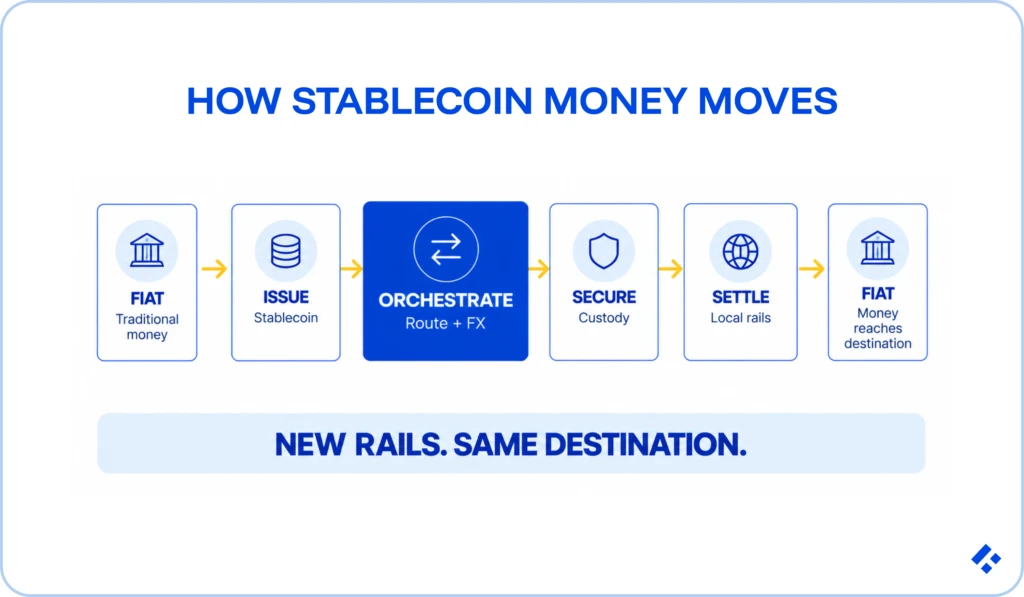
This is where most of the engineering value sits, and where the acquisitions happened.
4. Bridge (Stripe)
Stripe paid around $1.1 billion for Bridge, closing in February 2025. This was particularly notable since it was the largest acquisition in its history.
Bridge handles issuance, custody, FX between fiat and stablecoins, and cross-border payouts into local bank accounts, which covers most of what a payment company needs in one API.
Stripe has since built outward from it, acquiring Privy for wallet infrastructure and launching Tempo, a blockchain purpose-built for payments, with Paradigm.
Bridge also received preliminary conditional approval from the OCC for a national trust bank charter in February 2026.
If you are already on Stripe, enabling stablecoin acceptance has become closer to a feature toggle than an integration project, which is just another reason why Stripe is winning this category.
5. BVNK (Mastercard)
BVNK built enterprise stablecoin infrastructure connecting digital currencies to conventional banking rails, processing around $30 billion in annualized volume with EMI licensing across Europe and deep SEPA, Faster Payments and SWIFT coverage.
Mastercard announced a definitive agreement to acquire it in March 2026 for up to $1.8 billion, its largest digital-asset deal, with the transaction completing later in the year.
We’ve already seen BVNK power stablecoin payments for Visa Direct before the deal, which says something about how interconnected this layer has become.
It’s probably the strongest fit for European and UK fintechs too, given where its licensing sits.
6. Zero Hash
Zero Hash provides embedded stablecoin and digital asset infrastructure behind other people’s products, handling funding, payouts, remittances, and settlement through a single API.
It holds money transmitter licenses across more than 50 US states and operates in over 200 countries, with KYC, AML, monitoring, and Travel Rule screening built in.
The appeal for regulated businesses comes down to not having to acquire that licensing yourself.
Using something like Zero Hash can massively shorten your time to market, since they take all of the regulatory weight, while you can focus all of your energy on your actual services.
7. Conduit
Conduit focuses on cross-border business payments through stablecoin rails, specifically in corridors where correspondent banking chains run slowest. Latin America and Africa are its core markets.
The company has raised around $53 million, backed by Circle, Dragonfly, and Altos Ventures, and added multicurrency virtual accounts with IBANs in December 2025.
Just keep in mind that Conduit operates as a registered money services business working through licensed bank partners rather than holding a banking license itself, which is a reasonable model but changes your counterparty analysis.
8. Orbital
Orbital runs payment orchestration across stablecoins and more than 80 currencies, processing around $12 billion in annualized volume from a UK base. It holds FCA payment institution authorization along with SOC 2 Type 2 and ISO 27001:2022 certification.
That certification stack matters a great deal, especially when enterprise procurement and vendor risk teams ask for exactly those artifacts.
The custody and security layer
9. Fireblocks
Fireblocks provides institutional custody using MPC key management, and has become something close to the default standard for regulated banks and asset managers moving stablecoins at scale. Hundreds of financial institutions run on it.
A lot of people ignore custody, but it’s the thing that decides whether a security team approves the project.
Someone has to hold private keys, and the choice between self-custody with a multisig policy and a provider like Fireblocks is usually the first architectural decision a team makes and the hardest one to reverse.
The incumbents
10. Visa
Visa is a very well-known name by this point. It settles stablecoin transactions for merchant acquirers on Ethereum, Solana, and seven other chains after an April 2026 expansion, with the program running at roughly a $7 billion annualized rate.
The company also operates more than 130 stablecoin-linked card programs across over 50 countries, and launched the Visa Stablecoin Platform in beta in July 2026, which means that you get the infrastructure to mint, hold, and transfer digital money.
Then in June 2026, Open Standard, founded by Bridge co-founder Zach Abrams, launched Open USD, with more than 140 partners signed up, including Visa, Mastercard, Stripe, Coinbase, BlackRock, and BNY.
Minting and burning carry no fee, and partners share reserve revenue minus a management fee.
Visa’s framing throughout has been treasury modernization and settlement efficiency rather than a new consumer payment method, which, from what we’ve observed in the industry, is probably the correct read of where the value actually lands.
11. Mastercard
We’ve already mentioned the BVNK acquisition, but Mastercard also has run pilots enabling stablecoin payments and payouts with Circle and Paxos handling conversion and settlement.
It has been notably more cautious in public than Visa, with executives repeatedly telling analysts that most flows will begin and end in fiat.
That caution may be strategic positioning rather than genuine skepticism, given the $1.8 billion it then spent.
The regional specialists
12. Yellow Card
Yellow Card operates stablecoin payment infrastructure across more than 35 African countries, holding licenses in a region where most global providers have none.
Mastercard partnered with it in May 2026 to expand stablecoin payments across EEMEA, covering Ghana, Kenya, Nigeria, South Africa and the UAE, and it has validation from both card networks.
Africa is arguably where stablecoin rails make the strongest case, since correspondent banking is slow and expensive, local currency volatility is real, and the gap between theoretical and actual cost savings closes fastest in exactly these corridors.
Flutterwave, the continent’s largest payment network, has also deployed stablecoin settlement, and Bitso plays a comparable role across Latin America with more than nine million users.
What you still have to build
Choosing a provider from this list solves perhaps half the problem. The rest lands on your engineering team, and it consistently gets underestimated.
Reconciliation absorbs the most time.
On-chain transactions need matching to invoices, ledger entries, and ERP records, and the logic has to be idempotent, because a webhook firing twice must not credit an account twice.
Chain reorganizations only serve to add a complication that card rails never had.
Compliance screening means checking wallet addresses against OFAC lists before funds move rather than after, plus Travel Rule obligations above certain thresholds. Existing fraud detection tooling usually needs extending rather than reusing.
Chain routing and off-ramps round it out.
USDC exists on several chains with different fees and settlement characteristics, and recipients generally want local currency in a bank account, which means conversion partners per market with their own limits and spreads.
A focused production integration covering one or two corridors tends to run to a multi-week effort. The API call to send a transfer is the smallest part of it.
Working out which one fits
A rough process you can follow to help you make your decision, based on what fintech teams we already work with actually optimize for:
Already on Stripe and want stablecoin acceptance quickly: Bridge, since the integration cost is close to zero
European or UK fintech with enterprise volume: BVNK, for the licensing and SEPA depth
Need someone else to carry US regulatory weight: Zero Hash
Paying into Africa or Latin America: Conduit, Yellow Card, or a regional specialist with actual licenses in-market
Bank or asset manager with a security team to satisfy: Fireblocks for custody, paired with an orchestration layer
Want your own branded stablecoin without becoming an issuer: Paxos
Just keep in mind that corridor coverage usually decides it more than feature lists do. A provider with an excellent API and no liquidity in your destination market is not useful.
Building on stablecoin rails
Stablecoin integrations need an unusual combination: payments domain knowledge, ledger and reconciliation experience, on-chain familiarity, and enough regulatory literacy to ask the right questions before the architecture gets fixed.
The big issue here is that engineers with all four are genuinely scarce, which also tends to push up their price.
At Trio, we build fintech engineering teams for this kind of work, placing senior engineers who have shipped payment and ledger systems inside regulated environments, available through staff augmentation or as a dedicated team.
If you are scoping a stablecoin integration or working out whether one fits your corridors, request a consult.