
You might sense a shift in the fintech world.
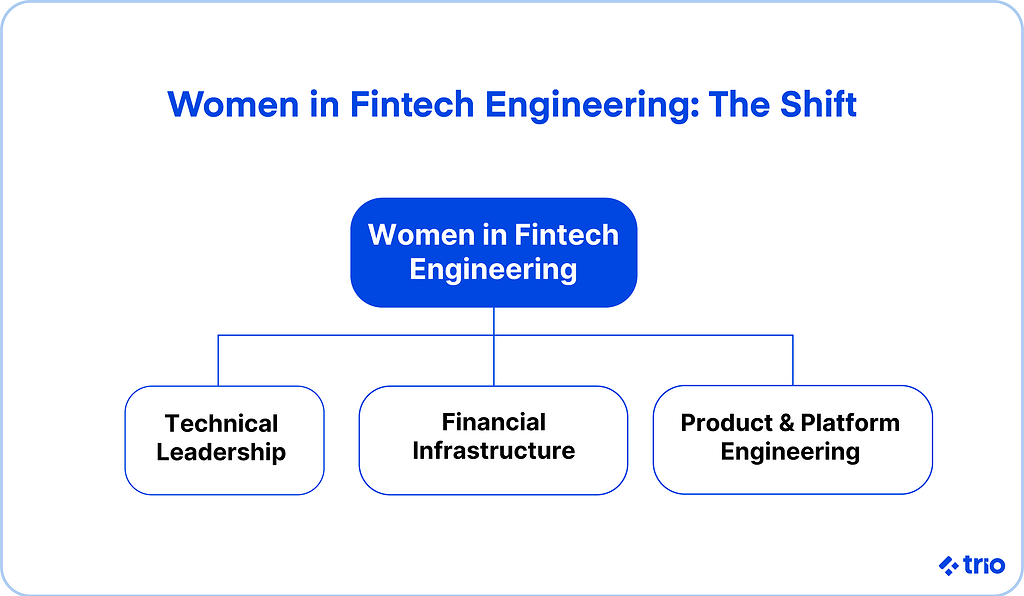
Engineering teams are not only growing, but they are also being reshaped by a wave of talented women in fintech who are working on payment systems, credit models, and digital banking platforms.
At the same time, the industry still leans on old hiring habits and promotion patterns that make it harder for women to move into visible technical leadership roles.
Many women in fintech engineering have had to push through these gaps themselves.
They build expertise in cloud infrastructure, artificial intelligence, cybersecurity, analytics, and blockchain, often while navigating skepticism or limited sponsorship.
Today, the picture looks a little different. Companies are starting to realize that diverse engineering teams usually build safer and more inclusive systems, and that is hard to ignore in a competitive fintech industry.
Understanding what is happening with women in fintech now can help you make better decisions. And with partners like Trio helping organizations connect with experienced engineering talent, there are more practical ways than before to build teams that reflect the customers they serve.
Understanding Fintech and Its Engineering Backbone
Fintech is the code that moves money, the data models that assess risk in real time, and the infrastructure that keeps digital banking systems running.
Engineers design the APIs that connect banks and fintech companies, the databases that store transaction histories, and the cloud environments that allow these services to scale.
A seamless experience for a customer usually hides a lot of complexity.
Behind that quick account opening or instant transfer is an engineer who solved for latency, compliance, data protection, and usability all at once. If the engineering decisions are poor, even the best product vision in the world will fail under stress.
How Engineering Shapes Financial Innovation
In practical terms, engineers are the ones who make payment solutions, robo-advisory platforms, and digital asset custody actually work.
They design real-time payment engines, build analytics pipelines, and experiment with artificial intelligence and machine learning for fraud detection and risk scoring.
The Rise of Women in Fintech Engineering
Over the last several years, more women have moved into roles like senior software engineer, platform engineer, head of AI, and security architect across the financial services industry.
Some started in traditional financial institutions and shifted into fintech. Others came in from pure tech and then specialised in payments or banking and emerging fintech.
Progress is still uneven, but the direction is clearer than ever.
You see women leading technical work in digital banking platforms, embedded finance APIs, and cloud-native payment systems. They are present not only in support roles but in the core engineering teams that ship features and manage incidents.
Momentum From Several Directions
Part of this momentum comes from communities and networks that focus on advancing women in fintech. There are meetups, online groups, and specialised mentorship programmes that pair senior technical leaders with women earlier in their engineering careers.
As these networks grow, they reduce the sense of isolation that often comes with being the only woman in a team.
Why It’s a Pivotal Time for Women in Technical Leadership
Several long-running trends converge. The adoption of AI inside fintech is more mature, regulators expect stronger controls, and many institutions are in the middle of complex digital transformation work.
All of this puts engineering at the centre of decision-making.
Companies that want to compete on fintech innovation cannot treat engineering as a back-office function anymore.
They need technical leaders who understand capital markets, banking and payments, and regulation, but who are also comfortable with modern cloud and data stacks.
That is where women with deep technical experience can step into leadership positions that simply did not exist a decade ago.
Market Forces Reshaping Technical Roles
The growth of embedded finance, blockchain-based digital assets, and new payment systems is creating demand for engineering leaders who can balance speed and safety.
Women who combine strong technical skills with an awareness of financial inclusion and customer impact are particularly well-positioned to shape that direction.
The State of Fintech Engineering Roles
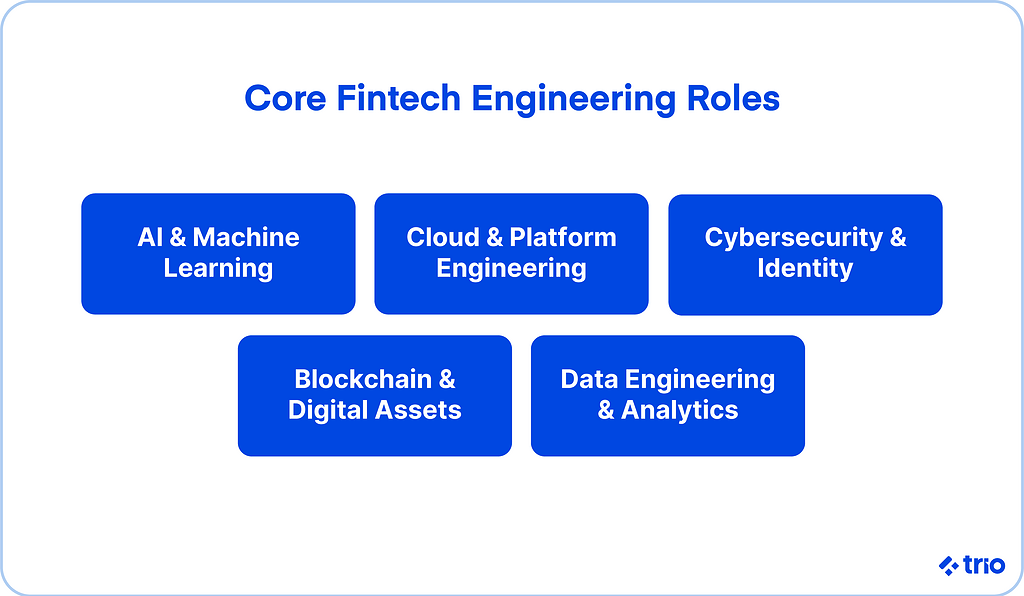
If you look across the financial services industry, engineering roles are not limited to backend dev or mobile dev labels anymore. You will find:
- AI and ML engineers working on fraud detection, underwriting, and behaviour modelling
- Cloud and platform engineers running critical infrastructure for fintech companies and banks
- Security engineers handling compliance-driven encryption, identity, and access controls
- Blockchain engineers building tokenization platforms and settlement rails
- Data engineers and analytics specialists are creating the pipelines that support product and risk teams
These roles exist in major banks, global fintechs, startups, and even specialist firms that combine business and technology consulting.
Companies Advancing Women in Fintech Engineering
Some big names in banking and fintech stand out for their work with women in engineering and leadership roles.
Citi has increased visibility for women in leadership, including engineering and digital roles, under the leadership of Jane Fraser, who now serves as both CEO and Chair. Citi’s digital and banking solutions strategy depends heavily on engineering teams, and that helps keep technical roles close to the top table.
JP Morgan and JP Morgan Chase have invested for years in technology, with leaders like Lori Beer, Global Chief Information Officer, overseeing thousands of technologists and large AI, data, and infrastructure programmes.
The bank’s work on AI-driven risk systems and the Chase Digital Assistant shows how central technical leadership is to its direction.
Beyond banks, FT Partners has built its brand as an investment bank focused exclusively on the fintech sector, and firms like Fintech Partners Ltd operate in similar spaces.
These organisations may not be purely engineering shops, but they sit in the middle of deal flow and can influence which technical teams and founders get funding and visibility.
Profiles of Leading Women in Fintech and Engineering
Below is a combined set of women frequently recognised in fintech. The emphasis here is on those who influence engineering, technology offerings, or technical strategy across global markets.
Major banking and payments leaders
These leaders sit at the intersection of technology, strategy, and large-scale financial services:
- Jane Fraser – Chair and CEO, Citi, leading one of the world’s largest global financial institutions and pushing digital banking and risk transformation.
- Lori Beer – Global Chief Information Officer, JPMorgan Chase, overseeing extensive engineering, security, AI, and banking technology teams.
- Charlotte Hogg – Previous CEO, Europe, Visa, shaping global payments and digital payment solutions across the region. Now CEO at Alter Domus.
- Yolande Piazza – SVP and GM, Americas, PayPal, former CEO of Citi FinTech, and a passionate advocate for financial inclusion.
- Maria Black – President and CEO, ADP, running a global technology company delivering payroll and HR tech with strong links to the fintech ecosystem.
- Bridget Engle – Senior Executive Vice President and Head of Technology, Wells Fargo, driving large-scale digital transformation and AI adoption.
- Adena Friedman – Chair and CEO, Nasdaq, leading a major exchange that increasingly operates as a technology and data analytics platform.
- Hilary Packer – Executive Vice President and Chief Technology Officer, American Express, responsible for modernising core systems, payments technology, and data platforms.
- Stephanie Ferris – CEO, FIS, guiding a key infrastructure player in banking and payments, including embedded finance and banking-as-a-service offerings.
Founders, CEOs, and fintech entrepreneurs
These leaders blend engineering awareness with fintech product and platform building:
- Jane Mason – Founder and CEO, Clarifire, recognised for workflow automation platforms that support servicers and lenders.
- Neha Narkhede – Co-founder and CEO, Oscilar, and co-founder of Confluent, bringing deep streaming and data experience to risk decisioning for banks and fintechs.
- Monica Eaton – Founder and CEO, Chargebacks911 / Fi911, known for building technology to manage disputes and fraud for merchants and payment systems.
- Julie Chatterjee – Group CEO, Northmill Bank, a Swedish digital bank with a strong focus on technology and customer-centric banking products.
- Colleen Wilson – Chief Product Officer, Best Egg, nominated in the Banking Tech Awards for Women in Technology for her work on lending and financial wellness products.
- Lia Müller Peña – AI and blockchain strategist, Chief Strategy Officer and founding partner at BitGPT.network, recognised by Microsoft and active in discussions about artificial intelligence ethics and blockchain infrastructure.
- Sabine VanderLinden – CEO and Managing Partner at Alchemy Crew Ventures, a long-time fintech and insurtech leader who works closely with startups and financial services providers across global markets.
Engineering, AI, and technology leaders
These women are closer to the core of what your readers might think of as fintech engineering:
- Christine Tu – Managing Director and Head of AI, ML, and Knowledge Management, Wealth Management Technology at Morgan Stanley, leading AI strategy and enterprise frameworks.
- Gogutsa Gelashvili – Platform Systems Tribe Lead, TBC Bank, responsible for integration architecture, lending platforms, and settlement systems across a fast-growing bank.
- Shruti Patel – Executive Vice President and Chief Product Officer for Business Banking at U.S. Bank, overseeing banking products, banking and payments, and software that supports business clients.
- Barb Morgan – Chief Product and Technology Officer, Temenos, steering core banking and technology offerings, including AI-enabled banking software used by banks and credit unions.
- Soruja Yasmin Mazumdar – Senior Director, Publicis Sapient, leading large-scale transformation projects in banking and emerging fintech for global financial institutions.
- Sofia Rossato – President and General Manager, Floify, recognised for her work on mortgage point-of-sale platforms and customer journeys.
- Anita Hayrapetian – Vice President of Sales, Ingo Payments, with experience in the payments industry and embedded banking, including real-time disbursements.
Product, operations, and ecosystem builders
The following leaders often sit between technology, operations, and customer experience:
- Christine Wang – Chief Operating Officer, LendingPad, celebrated for scaling cloud-based lending and analytics tools.
- Angel Romero – HFA Relationship Manager, Down Payment Resource, recognised for integrating down-payment assistance into lender workflows and promoting greater financial inclusion.
- Sasha Stair – Chief Marketing Officer, Xactus, works closely with credit and data services in mortgage technology.
- Kathy Rasmussen – Senior Vice President, Client Success, LERETA, with roles in technology-driven servicing and strong advocacy for diversity and inclusion.
- Heather Zeller – Marketing leader at Veros Real Estate Solutions, involved in positioning analytics and valuation technology for lenders and investors.
- Kelly Zitlow – Executive Vice President, Sales and Marketing, Cornerstone Capital Bank, is known for combining content, digital tools, and relationship-driven origination.
This group does not cover every influential woman in the fintech ecosystem, but it gives a realistic sense of the breadth of leadership across engineering, product, data, and platforms.
Cross-Industry Influence of Women Engineers in Fintech
Women in fintech engineering are having a direct impact on payment solutions, credit decisioning, identity verification, and banking products in markets across the world.
Their work affects whether systems can handle high-volume days, how quickly transactions settle, and how fair lending and risk models actually are.
You see these influences in places like mortgage tech, capital markets infrastructure, cross-border payment systems, and neobanks focused on financial literacy and financial inclusion.
Many of the women listed above are not just working on one product; they are helping to steer entire organisations toward safer, more accessible financial services.
Challenges Women Face in Engineering Leadership
Despite all the momentum, there are still real challenges. Promotion into senior engineer or architect titles can be slower for women.
High-visibility projects sometimes go to the same familiar names. And in some teams, women still find themselves as the only technical woman in a room, which can add extra pressure.
Without strong mentors and sponsors, it is easy to stall just below the “decision-making” layer of engineering.
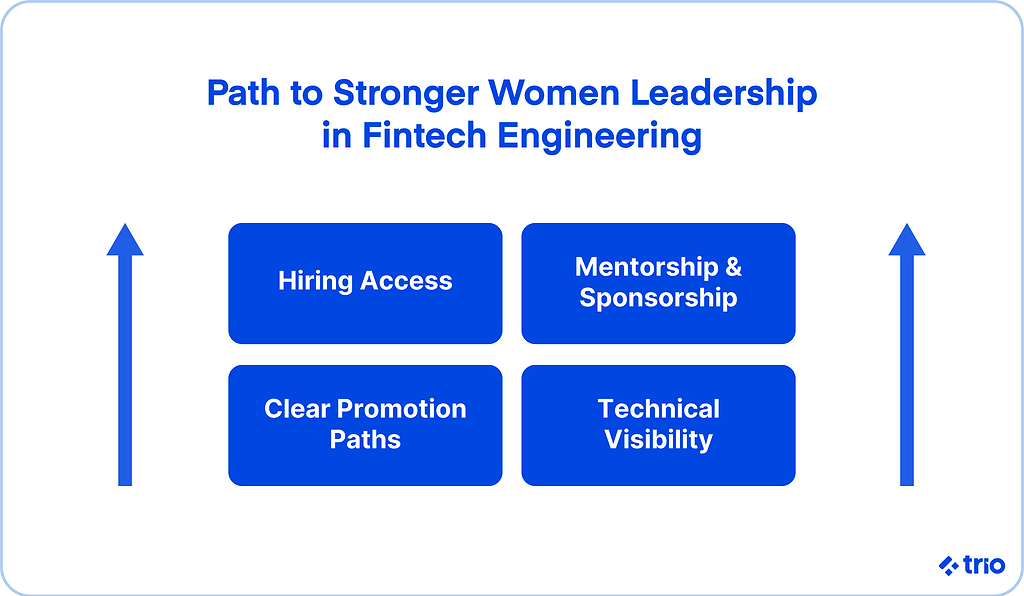
That is where formal mentor programmes, internal sponsorship, and clear promotion criteria become more than nice-to-haves. They are essential if you want a healthy, sustainable leadership pipeline.
Why Representation in Engineering Matters
Representation matters because it shapes both who feels welcome and how products are built.
When women hold leadership positions in technical teams, younger engineers can see concrete examples of what a career in fintech engineering can look like.
That visibility is especially powerful around Women’s Day, International Women’s Day, and Women’s History Month, when the stories of women in executive roles at Barclays, Citi, or other major players receive more attention.
From a product perspective, diverse technical teams bring diversity of thought that can help uncover edge cases, reduce harmful bias, and support new revenue streams in markets that might otherwise be overlooked.
This is as true in commercial banking and capital markets as it is in consumer-facing apps.
Conclusion
Women in fintech engineering are helping to define what financial technology looks like today. Their influence touches everything from digital banking to capital markets, global payments, and banking-as-a-service offerings.
The field is not perfectly balanced yet, but the direction appears to be shifting.
As more women move into leadership positions, supported by better hiring practices and more realistic career paths, the fintech ecosystem becomes stronger, more resilient, and closer to the kind of system that serves everyone fairly.
Get in touch to hire skilled fintech developers!
FAQs
What does women in fintech engineering mean?
Women in fintech engineering refers to women who build or maintain financial technology systems, and this group includes software developers, AI specialists, and security engineers.
Why are women important in fintech engineering?
The importance of women in fintech engineering lies in the diversity of thought they bring, which often leads to safer and more intuitive financial service products.
How are fintech companies supporting women in technical roles?
Support for women in technical roles usually involves mentorship, clearer promotion paths, and engineering training programs tailored to underrepresented talent.
What challenges do women face in fintech engineering?
Challenges for women in fintech engineering often involve uneven promotion structures and reduced visibility in complex technical environments.
How can companies increase women’s participation in fintech engineering?
Increasing women’s participation in fintech engineering typically means improving hiring practices, offering meaningful sponsorship, and creating balanced technical leadership paths.
Why does representation matter for women in fintech engineering?
Representation for women in fintech engineering matters because it helps younger engineers see viable career paths and encourages more inclusive product development.