

Hire by Technology
SERVICES



Mexico has become one of the more popular nearshore destinations for US companies, largely on the strength of near-complete timezone overlap and a cost structure that makes senior talent genuinely affordable.
But despite the many benefits, hiring from a nearshore location carries certain risks that you need to be aware of, and difficulties you need to know how to avoid.
Let’s take a look at what you need to know once you’ve decided to hire from Mexico, including how to vet candidates properly and which parts of Mexican labor law are worth understanding before signing anything.
If you want LATAM developers while still dealing with a U.S. company, we can help.
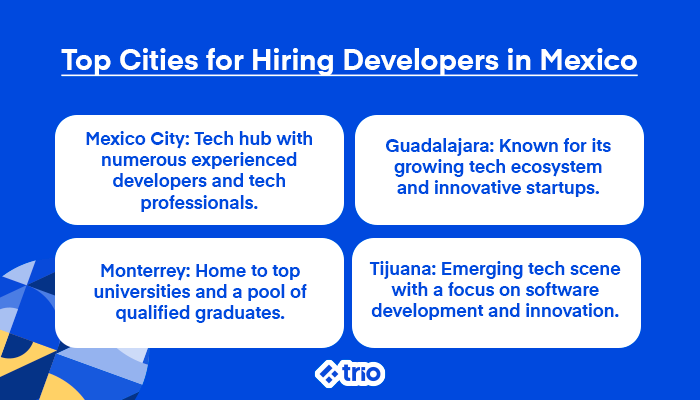
Mexico City holds the largest concentration of tech companies and the deepest bench of senior developers with real international client experience.
If you are looking for a genuinely niche skill set, then the sheer density makes Mexico City the likeliest place to find it. Just know that that density comes with a real premium on rate.
Guadalajara has earned its "Mexico's Silicon Valley" label, anchored by a strong university ecosystem (including ITESM's Guadalajara campus) and a growing base of tech multinationals and startups.
The city's industrial history also shows up in the talent pool: manufacturing and logistics specialists concentrate here more than in the other two hubs.
Monterrey rounds out the picture with a business-oriented culture and proximity to the US border, a real advantage if you want the option of occasional in-person visits.
Well-known job portals, LinkedIn, Glassdoor, Indeed, along with developer-specific boards, cover the broad search.
This can be resource-intensive on its own, though, particularly for a first hire in an unfamiliar market.
Local recruitment agencies with existing networks cut down considerably on that overhead. A nearshore partner like Trio works well specifically for companies that want candidates already pre-vetted for fintech or another regulated domain.
Networking events and hackathons connect a company with active, skilled developers directly, but, naturally, this route needs you to take a more hands-on approach that you might not have bandwidth for.
Partnering with universities is worth considering specifically for internship pipelines or junior hiring.
Once a candidate is in front of you, three things are worth evaluating deliberately:
Mexico's labor framework includes mandatory employer contributions and benefits that get complicated quickly for a company hiring directly.
Working through an established partner, or an Employer of Record, keeps a team compliant without requiring anyone in-house to become an expert in Mexican labor law.
This matters more since Mexico's 2021 outsourcing reforms tightened classification rules considerably.
Under this framework, if a developer works exclusively or primarily for one company over an extended period, that relationship can look like employment regardless of how the contract is labeled, and misclassification carries real liability.
Related Reading: Software Developer Salary in Mexico
There are a couple of hiring mistakes outside of legal and compliance considerations that we see people fall into.
Uniform salary benchmarking across cities creates a lot of confusion, since Mexico City rates run noticeably higher than Monterrey or smaller cities.
If you are offering Mexico City-level compensation everywhere, you erode a lot of the cost advantage that makes Mexico worth considering in the first place. At the same time, underbidding an actual Mexico City candidate creates friction from day one.
Vetting quality at scale is also harder than it looks, given how large the talent pool actually is.
The gap between a strong senior developer and someone with a senior title on a resume can be substantial, which is why a structured technical assessment is so important.
But by far the most expensive mistake is treating labor compliance as an afterthought.
Trio handles the sourcing, vetting, and compliance side directly, so the portfolios that reach a hiring manager are already matched to fintech or general engineering needs.
To hire pre-vetted Mexican developers without needing to deal with any of the difficulties associated with labor laws, talk to us.