

Hire by Technology
SERVICES



Bitcoin and blockchain were once breakthrough technologies, but even established financial institutions that are usually slow to get on board with the latest technology are now using blockchain to enhance their cross-border payment infrastructure.
They're also exploring CBDC (Central Bank Digital Currency) technology to promote economic stability and make real-time payments more feasible.
With that increased use comes a mix of real challenges and real opportunities for fintech companies.
Let’s look at the relationship between cross-border payments and CBDCs, so you can prepare your infrastructure for the future of payment infrastructure early.
For skilled fintech developers who can help prepare your infrastructure for technological and regulatory requirements, we can assist.
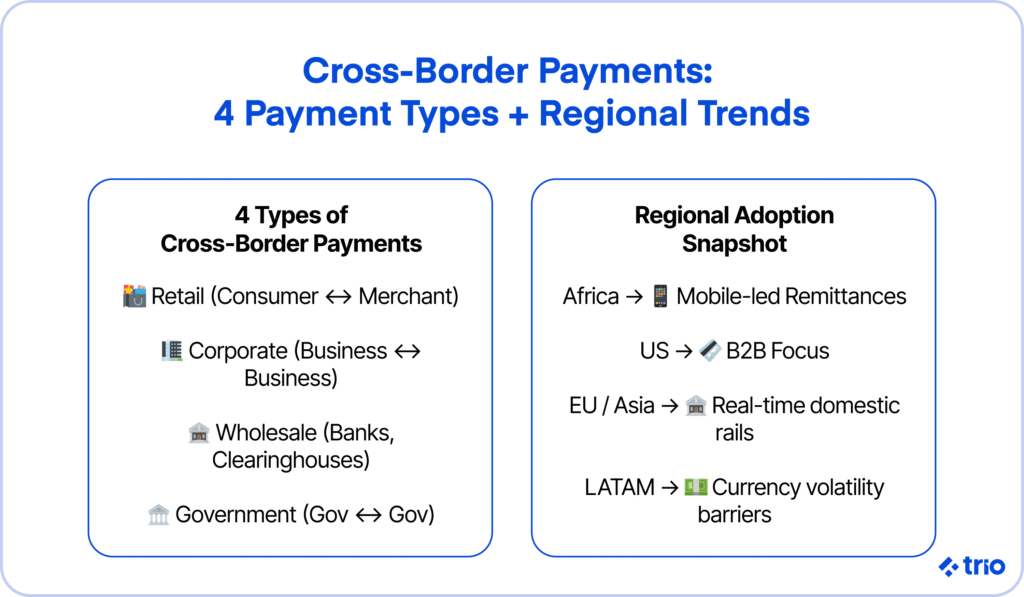
Cross-border payments are transactions where the payer and payee are located in different countries.
If you were to make a payment in cash, the money would physically have to cross a border. Fortunately, that's rarely how it happens today. Instead, the process runs through electronic methods, B2B transfers, card payments, e-commerce settlements, and interbank settlements.
Considering how remote work has been made a lot easier in recent years, every country has an interest in faster cross-border payments, but the motivation and the providers involved differ a great deal by region.
In Africa specifically, mobile-led remittances have gained real popularity. Sub-Saharan Africa accounted for almost 70% of total global growth in mobile money accounts.
Traditional cross-border payments move through a chain of correspondent banks, and each additional hop in that chain adds cost, delay, and a genuine chance of something going wrong along the way.
A transfer that should settle in seconds can end up taking several business days, and fees stack up at every intermediary along the route.
CBDCs, digital forms of a country's own currency issued directly by its central bank, are one of the more serious attempts to address this at the infrastructure level rather than patching around it.
Cross-border CBDC arrangements generally fall into three broad models, a framework that traces back to joint BIS and World Bank research on the topic.
mBridge is the most advanced world test of multi-CBDC interoperability.
The project began as a bilateral effort between Hong Kong and Thailand's central banks in 2019, expanded to include the People's Bank of China and the UAE, and reached minimum viable product status in mid-2024 when the Saudi Central Bank joined as a full participant.
Built on its own purpose-built ledger, mBridge supports real-time, peer-to-peer settlement across CBDC systems without routing through correspondent banks at all.
What matters most for fintech firms is that, in October 2024, the Bank for International Settlements formally exited its leadership role in mBridge, handing the project over to the participating central banks directly.
From what we observed, this was probably because of geopolitical tensions around the project's association with BRICS-aligned economies.
Under central bank leadership, mBridge scaled from roughly $22 million in pilot-phase transaction volume to an accumulated total in the tens of billions by 2026.
The same year, BIS launched Project Agorá, working with seven G7-aligned central banks and more than forty private institutions, including JPMorgan, Citi, HSBC, and SWIFT.
Where mBridge was built to let central banks settle directly with each other and reduce dependence on existing infrastructure, Agorá works within the existing correspondent banking system, tokenizing it rather than routing around it.
After watching mBridge and Agorá develop in parallel rather than merging, we have to conclude that a globally unified CBDC interoperability system looks increasingly unlikely.
What's emerging instead looks more like distinct blocs, each built around its own technical and political alignment, with interoperability solved within a bloc more successfully than across them.
mBridge and Agorá are the most prominent multi-CBDC efforts, but they aren't the only relevant infrastructure developments.
Single-access and bilateral-link models, where a correspondent entity bridges two CBDC systems directly, are still in active testing by individual central bank pairs.
However, it seems that the correspondent-based approach is going to scale poorly as more jurisdictions join, since each additional pair requires its own gateway.
Stablecoins also continue to serve a different but overlapping function, providing dollar-denominated settlement rails that move faster than most CBDC infrastructure has managed to deploy so far.
If you are building cross-border payment capability, the practical takeaway is that settlement infrastructure is becoming genuinely plural rather than converging toward one standard.
If your architecture assumes a single future rail, you need to start thinking about designing around that future risk now.
Building for multiple settlement paths, existing correspondent banking, CBDC-based rails as they mature, and stablecoin infrastructure, without hard-coding assumptions, is the same abstraction discipline that applies to integrating more than one payment processor.
Teams that understand both the regulatory and technical dimensions of this shift are increasingly valuable. Those are exactly the kinds of teams we provide at Trio.
If you need industry experts at affordable rates, we can help.