

Hire by Technology
SERVICES


Breaking into an emerging market as a fintech startup can feel exciting at first, then slightly intimidating once you see how many pieces need to line up.
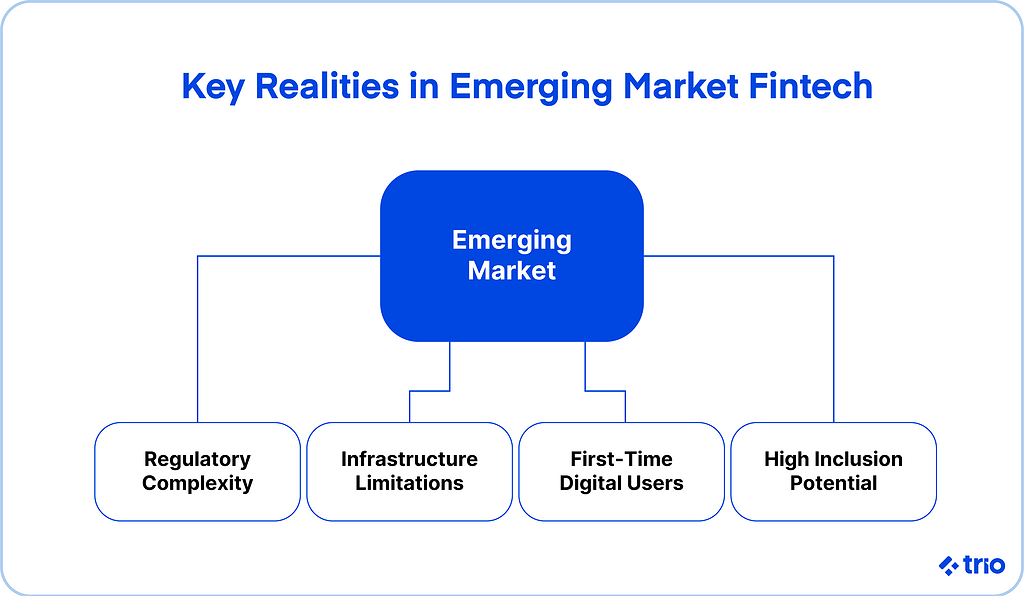
You have huge opportunities for financial inclusion and new access to financial services, but you also face regulatory complexity, inconsistent banking infrastructure, and users who might be experiencing digital financial services for the very first time.
Some entrepreneurs that we have worked with say they only realized how tricky things were when early traction stalled or when onboarding dropped sharply because users struggled Fintech for Emerging Markets: How to Build a Fintech Startup That Works
Breaking into an emerging market as a fintech startup can feel exciting at first, then slightly intimidating once you see how many pieces need to line up.
You have huge opportunities for financial inclusion and new access to financial services, but you also face regulatory complexity, inconsistent banking infrastructure, and users who might be experiencing digital financial services for the very first time.
Some smaller fintech firms that we have worked with say they only realized how tricky things were when early traction stalled or when onboarding dropped sharply because users struggled with something they thought was simple.
Others ran into difficult conversations with regulators or underestimated how local behaviors shape adoption. Problems like these may suggest a product has deeper gaps, even when the idea itself is promising.
For many fintech leaders, the real challenge begins after early traction, when scaling securely across emerging markets puts pressure on engineering capacity, compliance, and delivery timelines.
There is a way through it.
When you approach product development with a clear understanding of the region in terms of both regulation and user requirement, and you get guidance from experienced engineering teams such as those at Trio, you can build fintech solutions that work for real people and scale across emerging economies.
Understanding how people use financial services in an emerging market gives you the foundation you need before you design or code anything.
These regions are growing fast, but they rarely behave like traditional banking markets.
Thinking that you'll see the same patterns in economic activity and will be able to offer the same systems as you would in North America or Europe would be a massive mistake.
Fintech describes financial technology that supports digital payments, lending, banking services, insurtech, wealth tools, micro-lending, and more.
We have helped companies build a variety of these products, targeting both individuals and businesses.
In many emerging economies, fintechs have stepped in where traditional banking systems never gained traction, or perhaps have not even attempted to offer their services.
The opportunity is significant.
You see it in countries like Kenya, where mobile money services changed daily life, or in Latin America, where adoption of mobile payments accelerated after the COVID-19 pandemic.
New fintech solutions can support small businesses, improve access to financial services, and give people better control over their financial lives.
Emerging economies offer a mix of high-potential opportunities and stubborn challenges that require patience and a practical mindset.
Digital wallets, lending tools for small and medium enterprises, micro-loans, blockchain-based remittance tools, and mobile money services often resonate strongly.
They are tailored to the unique needs of people who have never had access to formal banking or where a more formal situation would not be possible.
Regulatory complexity varies widely between countries. Fraud pressure appears to be rising across many emerging markets, partly due to cheap identity spoofing tools.
There is also the constant issue of limited infrastructure, both digital and physical.
Understanding these realities early on helps you avoid product decisions that look efficient on paper but collapse under real-world conditions.
As you move into building fintech systems, the goal is to create something flexible and grounded in the local environment.
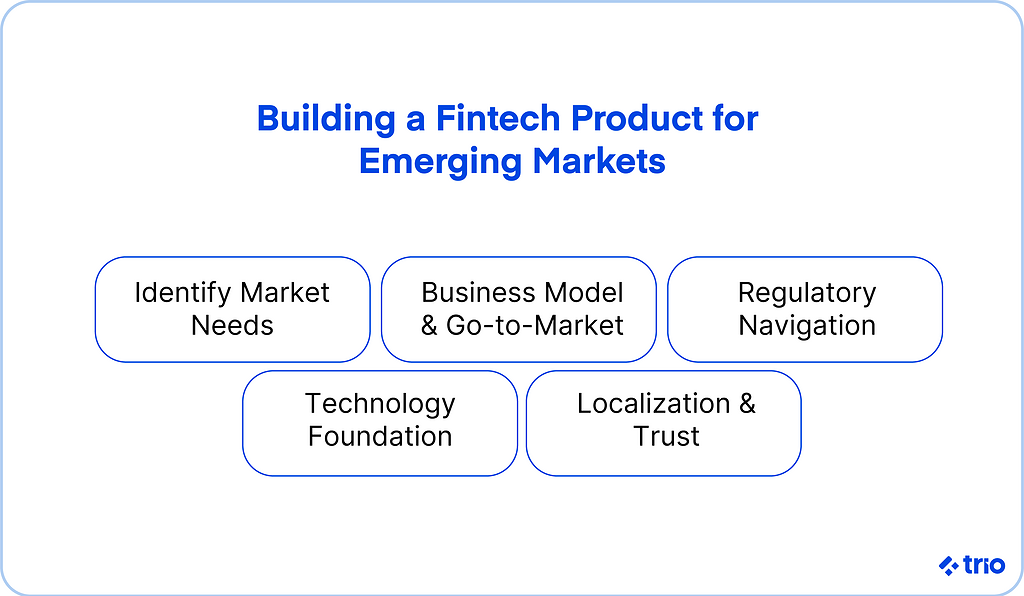
Start by figuring out what people actually want instead of just making assumptions.
Visit small businesses that rely on cash. Talk to people who use informal lenders. Watch how individuals top up mobile wallets or pay utility bill payments.
These observations may reveal deeper insights than a market report ever could.
A realistic business plan helps you define clear revenue models and go-to-market strategies.
Investors want proof that you understand local competition and how people already access financial services.
Some teams choose to operate in smaller regions first before expanding, which may be a safer approach in many emerging markets.
Investors increasingly look to invest in fintech solutions for emerging markets because of the combination of high mobile adoption in these underserved communities and the resulting measurable fintech growth.
What they scrutinize closely, however, is operational maturity and engineering execution, not just vision.
Regulation can change slowly in some countries and very quickly in others. This becomes especially complicated if you are going to try to offer the same services across different regions.
Licensing structures vary widely, and laws like GDPR influence how you manage user data.
If you plan to operate across borders, expect to spend time understanding multiple frameworks and compliance expectations.
Regulatory sandboxes now exist in several markets and may offer a good path for controlled early testing.
Your tech stack should be secure and resilient, while still flexible enough to integrate with banking systems, payment rails, and mobile money platforms.
Security-by-design principles matter a lot when users already have low trust in digital financial systems.
Some teams lean on machine learning for credit scoring or transaction monitoring. Others prefer simpler, more transparent methods at first.
Both approaches can work, depending on your product and region.
If you think your team is going to need to scale up, the bigger risk often lies in under-resourced engineering rather than flawed product ideas.
You need to make sure that you have senior fintech engineers who understand secure architecture, compliance boundaries, industry standards, and performance under infrastructure constraints.
As you grow, you also need to remember that infrastructure decisions extend beyond cloud architecture, but the best way to ensure your fintech startup's growth is to invest heavily in a cloud-first architecture with strong redundancy and regional failover. This tends to outperform heavy on-premise investments.
Low bandwidth, intermittent connectivity, and lower-cost, outdated devices are normal in many emerging markets. These limitations affect everything from transaction volumes to the way people complete onboarding.
You may need offline-friendly features or lightweight client-side interactions so your services can be accessed when the internet is very sporadic, or make sure that you support devices you might otherwise consider redundant.
Identity verification is another challenge. Biometric ID systems exist in some places, such as in countries like Kenya, but others rely heavily on alternative verification methods or community-based trust.
Localization is not only about language. It also means designing user-centric flows for people who might be new to digital financial services.
Clear fees and other visual trust signals make a big difference.
Many fintech startups overlook embedded financial education. Yet onboarding tends to work better when users understand why you need certain information or how wallet balances operate.
Fraud tends to be a daily concern. You may need to combine know your customer checks with behavioral analytics, biometric patterns, or consortium fraud data.
Some teams rely heavily on AI-driven models, while others prefer simpler rules during early growth.
A layered approach usually works best.
Launching a fintech startup is rarely a straight line. You adapt constantly as you learn what real users need.
An MVP should focus on essential financial services but still reflect local realities.
A wallet might need offline balance snapshots. A lending product might need repayment reminders that work without push notifications.
MVPs that ignore infrastructure constraints or compliance expectations often stall during early scaling. Designing for regulatory flexibility and transaction resilience from day one reduces costly rebuilds later.
Local talent helps you understand cultural expectations around money.
Partnerships with banks, telcos, or mobile money operators open doors faster than going alone.
Some fintechs choose to partner with specialist staff augmentation firms like Trio because the combination of global engineering support and local insight can shorten development cycles.
One overlooked advantage of fintech emerging markets lies in talent density.
Strong engineering hubs across Latin America, Africa, and parts of Asia produce developers who understand payment rails, identity constraints, and compliance realities firsthand.
For startups wondering how to access emerging market talent without sacrificing quality or security, structured staff augmentation models with clear delivery systems, overlap hours, and defined security controls tend to outperform ad hoc outsourcing. Execution discipline, not geography, determines outcome.
Pilots help you understand user behavior in small, manageable environments.
A market like Nairobi or Lagos often becomes a testbed for early adoption.
Sandboxes or small community partnerships may reveal problems long before a major launch.
For fintech in emerging markets, pilots also serve another purpose: demonstrating operational maturity to regulators and investors. Clear reporting, measurable milestones, and stable sprint velocity build credibility beyond user metrics alone.
Funding can be uneven across emerging markets, but it is not impossible.
It only requires a clear story and a realistic plan.
Capital can be unevenly distributed. Some regions have strong investor networks, while others rely more heavily on grants or strategic partnerships.
Compliance requirements may also raise early costs.
Investors look for traction tied to transaction volumes, retention, or successful onboarding.
They also check your economic foundation and your path to regulatory compliance.
A predictable plan often matters more than flashy technology.
As fintech growth in emerging markets accelerates, investors increasingly compare execution quality across regions. Teams that demonstrate secure infrastructure tend to attract stronger long-term backing.
Revenue-based financing, cross-sector partnerships, and grants can be useful stepping stones.
Some founders partner with financial institutions to test fintech solutions before raising a larger round.
Partnerships help you move faster than trying to build everything alone.
Banks provide the regulatory structure you need, and telcos often own the mobile money platforms that dominate local payments.
These relationships give your fintech startup access to real networks and local trust.
Strategic partnerships often reduce regulatory friction and accelerate go-to-market timelines more effectively than expanding internal teams alone. Strong technical integration capabilities make these partnerships viable at scale.
Relationship-building is a long game.
It may not feel urgent at first, but regulators tend to support companies that show transparency and willingness to follow the rules.
Fintech in emerging markets evolves alongside regulatory frameworks, not outside them. Teams that document controls, security processes, and data flows early tend to avoid painful compliance retrofits later.
Accelerators across Nairobi, Cairo, Lagos, and parts of Latin America may give you market insights, local introductions, and early pilot opportunities.
They can speed up your understanding of what people actually need.
Real examples often explain things better than theory.
These companies did not succeed on product vision alone. Each invested heavily in scalable infrastructure, regulatory navigation, and engineering capacity that could sustain rapid fintech growth in emerging markets.
The future of finance in these regions is moving fast, though never in a perfectly predictable line.
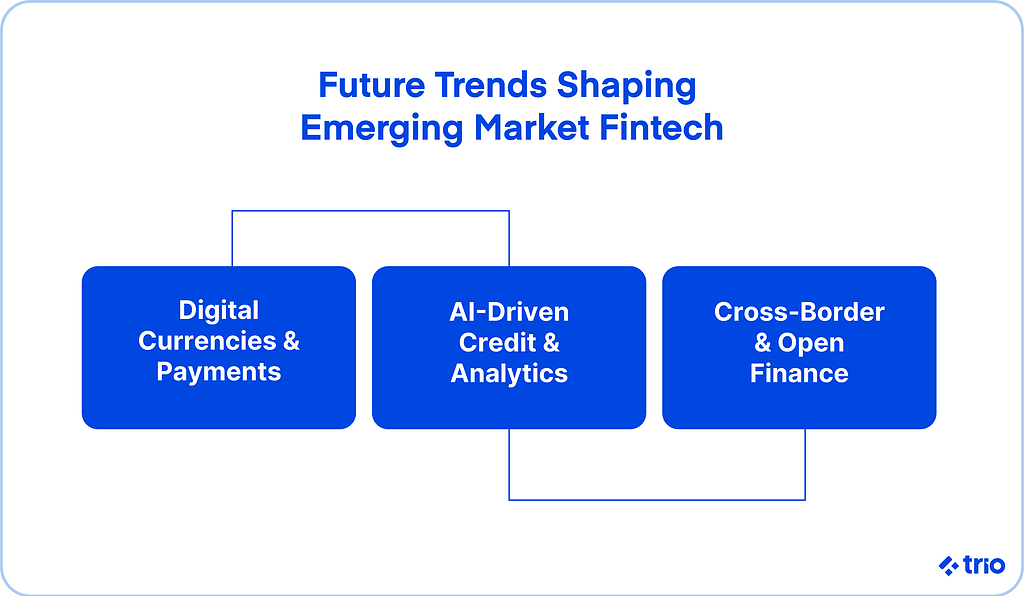
With the stablecoin craze underway, we expect growth in digital currencies, AI-driven credit scoring, unified QR ecosystems, and greater interest in blockchain-based cross-border payments.
These shifts may reshape digital technology and open new opportunities for entrepreneurs.
Infrastructure resilience and fraud prevention will likely matter as much as feature expansion. Sustainable fintech growth in emerging markets depends on operational depth, not hype cycles.
Africa is widening its use of mobile money services. Latin America is leaning harder into open banking and cleaner regulatory frameworks.
Southeast Asia is experimenting with new digital wallet and cross-border remittance models.
If you want long-term scalability, you will need adaptable systems that evolve as new regulations arrive.
Teams at Trio often encourage fintech founders to think about building and maintaining flexible infrastructure rather than betting on a single architecture.
For fintech leaders scaling across emerging markets, adaptable engineering capacity often becomes the limiting factor, and the ability to add senior fintech engineers quickly, without sacrificing compliance or delivery standards, frequently determines whether expansion succeeds or stalls.
Fintech in emerging markets offers tremendous opportunities for entrepreneurs, but it also asks for patience, local understanding, and thoughtful product choices.
With the right research, partnerships, and technology, you can create cutting-edge solutions that improve financial inclusion and support a more inclusive financial system.
The fintech startups that win in emerging markets rarely win because of ideas alone. They win because their engineering capacity, compliance posture, and delivery systems scale as fast as their ambition.
Building fintech is never simple, but it becomes far more manageable when you have experts on your team. Get in touch to request a consult.
A fintech startup in an emerging market is a financial technology company operating where traditional banking is limited. These startups aim to improve access to financial services through digital tools.
Building fintech products for new markets begins with researching real user needs and designing around local behavior. You then validate your assumptions through small pilots. Do not assume that you understand the needs of the community you are trying to reach through assumptions.
Fintech startups in emerging economies deal with infrastructure gaps, regulatory complexity, and fraud risks. These obstacles need to be carefully considered when you design and deliver your services.
Regulation affects a fintech startup by controlling licensing, data rules, and compliance demands. Understanding frameworks early prevents delays and unexpected costs and ensures you are seen as trustworthy.
Onboarding matters in fintech solutions because users often try digital finance for the first time. A clear, simple flow helps build trust and reduces drop-offs.
Small businesses benefit from fintech in emerging markets because they get access to credit, payments, and digital wallets. These tools help them manage cash flow more easily.