

Hire by Technology
SERVICES


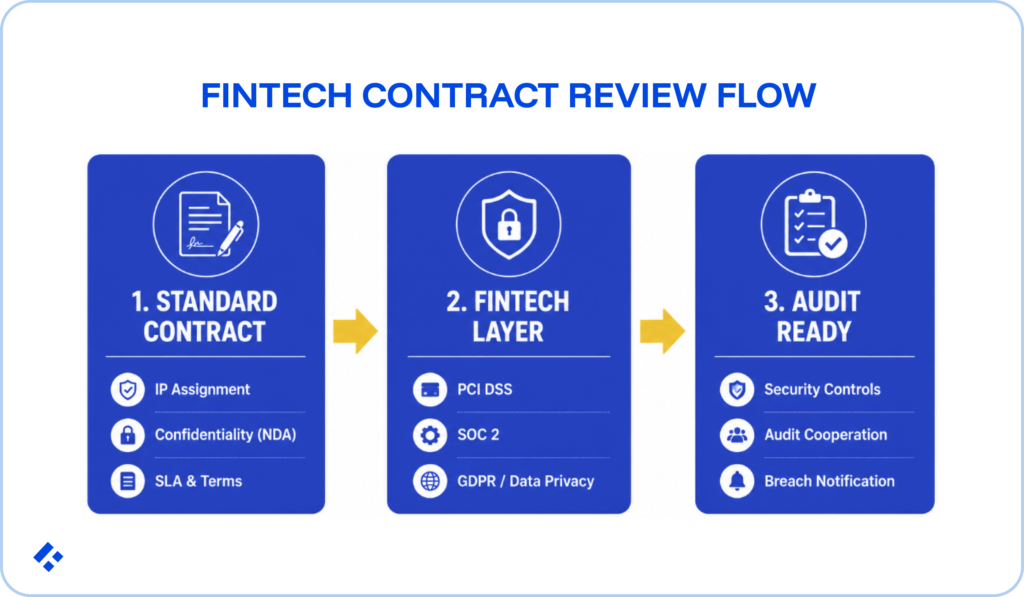
A staff augmentation contract should cover standard clauses like the scope of work, rates and payment terms, IP assignment, confidentiality, replacement guarantees, termination, SLAs, liability, and non-solicitation.
However, only looking for these standard clauses in any agreement that you sign can leave you open to vulnerabilities in heavily regulated industries like financial services.
Fintech engagements need additional provisions that cover data security, specifically tied to PCI DSS and SOC 2, compliance-accountability allocation, audit cooperation, and breach notification.
It is critical that you always review the final contract with qualified legal counsel.
However, to help you get started with basic contract evaluation and immediately identify red flags, we will go over some of the most important considerations, ensuring that you understand them and providing a staff augmentation contract checklist for both general and fintech provisions.
At Trio, we focus exclusively on working with fintech clients, providing them with the necessary talent without forcing them to sacrifice data security or regulatory compliance.
These nine clauses appear in virtually every well-constructed staff augmentation agreement.
It is essential that your contract defines what the engaged engineer will do, the roles, and the reporting structure.
In staff augmentation specifically, the scope typically defines the engagement (capacity, roles, duration) rather than a fixed deliverable because you manage the work.
Does the agreement make clear that you direct the work and the engineer operates as part of your team?
The distinction between staff augmentation (input-based, client-managed) and managed services (output-based, vendor-managed) should be unambiguous in the scope language because vagueness here creates disputes about who owns the delivery.
The financial mechanics should also be specified. Are you being charged an hourly or monthly rate? What’s the billing frequency, and what are the payment due dates? How are they approaching expense handling and rate-adjustment provisions?
Before any development starts, contracts must establish that the work product belongs to you.
The strongest formulations use present-tense assignment ("hereby assigns all right, title, and interest") rather than a promise to assign in the future, include a moral-rights waiver where applicable, and use jurisdiction-appropriate language.
We always recommend that you scrutinise this with counsel. They can help you analyze if the IP assignment is present-tense and unambiguous, or if there are carve-outs for pre-existing work that could swallow the assignment.
Missing or vague IP assignment is one of the most common red flags that we come across.
Ensure the agreement protects your confidential information from disclosure.
Best practice involves dual coverage: the vendor entity and the individual engineer are each separately bound, so there's no gap if the engineer's confidentiality obligations run only to the vendor.
Ask yourself: Does the agreement bind both the provider and the individual engineer?
An NDA that covers only the vendor entity leaves the engineer's obligations to the discretion of the vendor's internal policies.
Does the contract define what happens if an engineer leaves mid-engagement or proves a poor fit?
Strong agreements specify a written replacement timeline (commonly 14–30 days) and provide no-cost replacement within that window.
You need to make sure that the replacement timeline is specific and in writing.
A vendor unwilling to commit to a timeline in writing signals precisely how they'll behave when you actually need that commitment honoured.
A well-structured termination clause addresses the notice period for termination for convenience (30 days is common, with some agreements offering shorter notice for the client), conditions that permit immediate termination for cause, knowledge transfer and offboarding obligations on exit, and the final payment and handoff terms.
In fintech, it is incredibly important that critical information doesn't leave with the engineer.
SLAs are service-level commitments covering onboarding timelines, productivity ramp expectations, and response obligations.
For staff augmentation specifically, SLAs around onboarding speed (when the engineer starts, how quickly they're productive) tend to matter more than output-volume metrics that are better suited to managed-services contracts.
Legal protections should cover limitation of liability (usually capped at total fees paid over a prior period), indemnification for IP infringement and data breaches, the jurisdiction whose law governs the agreement, and how disputes are resolved (litigation, arbitration, mediation).
This section warrants particular attention from your counsel because the specifics matter considerably and vary by jurisdiction.
Whether and how you can hire the engineer directly, any restrictions on the vendor soliciting your employees, and the conversion fee structure fall into this category.
The conversion fee is the clause that surprises companies that want to hire an engineer full-time after a long and successful engagement. Often, it can be as much as 15–25% of the engineer's first-year salary.
Regarding non-compete/non-solicitation restrictions more broadly, enforceability varies widely by jurisdiction. Some are largely unenforceable, while others are enforceable with significant limitations.
Confirm the position with your legal counsel in the applicable jurisdiction before treating any such clause as a binding constraint.
For a fintech company, the standard nine clauses are necessary but not sufficient.
When augmented engineers work on regulated financial systems like payment processing, KYC pipelines, ledger systems, and fraud detection, the contract should address provisions that standard templates typically omit.
Make sure that you discuss each of the following with your counsel and your compliance lead before signing.
Because the engineer may access systems and data subject to PCI DSS, SOC 2, GDPR, or other frameworks, the agreement should include or attach a data processing addendum (DPA) that ties the engagement to your data-protection obligations and requires the engineer to operate within your security standards.
This defines the security baseline the vendor is contractually obligated to meet and provides the documentation your auditors may ask to see.
This is the most important and most misunderstood fintech-specific provision that we encounter.
Regulatory accountability for a regulated financial system stays with the regulated entity.
Generally, it cannot be contractually transferred to a staffing vendor.
For you, that means that hiring an augmented engineer does not transfer your PCI DSS, SOC 2, or banking-partner obligations to the vendor.
What the contract can and should do is require the vendor and engineer to follow your compliance standards, cooperate with your compliance processes, and meet defined security obligations.
Fintech companies undergo regulatory examinations, SOC 2 audits, and PCI DSS assessments by Qualified Security Assessors (QSAs).
The contract should require the vendor and engineer to cooperate by providing access logs, attestations, and evidence that auditors require, within the timelines your audit processes demand.
A vendor who is not contractually obligated to cooperate with your audit can create compliance gaps at exactly the wrong moment.
If the engineers that you are going to be working with will access financial data, the contract may specify background check requirements, mandatory security awareness training, and endpoint security standards.
Some common examples of the latter that we have worked with include specified managed devices, disk encryption, screen-lock policies, and approved network access.
PCI DSS v4.0, which came into full enforcement on March 31, 2025, includes requirements around personnel security controls for anyone with access to cardholder data environments.
Where the engineer accesses data from and where data may be processed or stored can matter for GDPR data residency requirements and some banking-partner or licensing agreements.
GDPR restricts transfers of personal data to countries outside the EEA without an adequacy decision or appropriate safeguards in place.
This is a contractual commitment that the engineer will operate within your access-control framework, including scoped access provisioned to role, no credential sharing, and no access to systems beyond what the engagement requires.
The requirements usually map directly onto PCI DSS Requirement 7 (restrict access to system components) and SOC 2's access-management criteria.
Regulatory frameworks impose specific breach-notification timelines that your contract should support.
GDPR requires notification to the supervisory authority within 72 hours of becoming aware of a personal data breach.
DORA (the EU Digital Operational Resilience Act, effective January 2025) imposes incident-reporting requirements on financial entities operating in the EU.
The contract should require the vendor and engineer to notify you of any security incident or suspected breach within a defined window that is short enough that you can meet your own notification obligations.
It should also require the vendor to cooperate with your incident response.
The engineer you contracted should be the engineer who works. In the case of an agreement with Trio, this will be the person we vetted and you interviewed.
Undisclosed substitution is among the most common sources of mid-engagement disputes in staff augmentation.
For fintech engagements, you aren’t just worried about engineer quality. You will have completed security screening based on a specific person. Substituting without disclosure invalidates that screening.
In some jurisdictions, it may also create legal exposure. Mexico's REPSE framework, for instance, imposes registration and compliance requirements on subcontracting arrangements.
Standard IP assignment establishes ownership, but for regulated financial systems, the operational continuity provisions matter just as much.
When an engagement ends, the compliance-critical knowledge that lives in the engineer's head needs to survive the transition through documented source-code handover, architectural decision records (ADRs) capturing why key decisions were made, and access continuity to ensure regulated systems don't have a gap in maintainable ownership.
The contract structure depends on which engagement model you're using, and that choice affects which clauses carry the most weight.
Certain contract characteristics signal risk and warrant extra scrutiny and a direct conversation with counsel:
You can use this as preparation for your legal review, but keep in mind that it is not a substitute for that review.
It is critical that you always have a qualified attorney review the final contract before signing. This checklist helps you prepare for that review, but it doesn't replace it.
At Trio, our staff augmentation engagements are built for fintech from the start.
Since we are focused only on fintech, the contractual provisions that regulated companies need, like data-security commitments, audit-cooperation obligations, breach-notification timelines, security and background screening for engineers accessing financial data, and support for your least-privilege access framework, are all part of how Trio structures every engagement.
You direct the work, the engineer integrates into your team, and you retain the management control and compliance accountability that regulated work requires. Trio handles employment, payroll, and compliant engagement structuring.
Placement can happen in as little as 3–5 days, with costs of $40–$80/hr ($7,000–$14,000/month).
For more information, book a staff aug consult.