
Hire by Technology
SERVICES


We have noticed that two misconceptions about GDPR and nearshore engineering consistently produce compliance gaps for fintech companies using LATAM staff augmentation.
The first is that GDPR only applies to EU-based organisations. Realistically, GDPR applies to any organisation that processes the personal data of EU residents, including a US-based fintech with EU customers, regardless of where the company is incorporated.
The second is that keeping data physically on EU servers eliminates the GDPR transfer question.
Allowing a LATAM engineer to remotely access EU personal data, to read it, process it, or work with systems that handle it, constitutes a GDPR data transfer regardless of where the data is stored.
Let’s get into the details to ensure that both misconceptions are cleared up, so that you can understand what a practical and workable compliance framework for LATAM staff augmentation looks like.
At Trio, we specialize in augmenting staff with Latin American developers, including for companies that are subject to GDPR and DPA compliance.
GDPR applies whenever an organisation processes the personal data of EU residents, regardless of where the organisation itself is based.
For a fintech company, the trigger is EU customers, EU-based users, or EU personal data in any form. This could be things like transaction records, KYC documents, or account data flowing through the systems that augmented LATAM engineers will access.
Three scenarios where GDPR applies to a LATAM staff augmentation engagement:
If GDPR does not apply to your engagement, which may be the case if your fintech processes exclusively US customer data with no EU residents, you may still need to consider other frameworks (CCPA, SOC 2, GLBA).
The most consequential misconception that we see in LATAM staff augmentation GDPR compliance is the assumption that keeping data on EU servers eliminates the transfer question. It does not.
Under GDPR Article 44, any transfer of personal data to a third country, including making data accessible to a person or entity in a third country, triggers the transfer framework.
When a LATAM engineer in Argentina, Colombia, or Mexico accesses a production database, reads a KYC record, or works with a system that processes EU personal data, that access constitutes a transfer within the meaning of Article 44, regardless of where the database runs.
A fintech that stores EU customer data in an AWS eu-west-1 region but allows LATAM engineers to query it remotely has made a transfer. The data has not moved, but the access has. The Article 44 analysis concerns the access event, not the storage location.
This rule is why the transfer mechanism must be in place before a LATAM engineer accesses EU personal data. Retroactive compliance doesn't work under GDPR. Instead, the transfer was either covered by a valid legal basis at the time it occurred, or it wasn't.
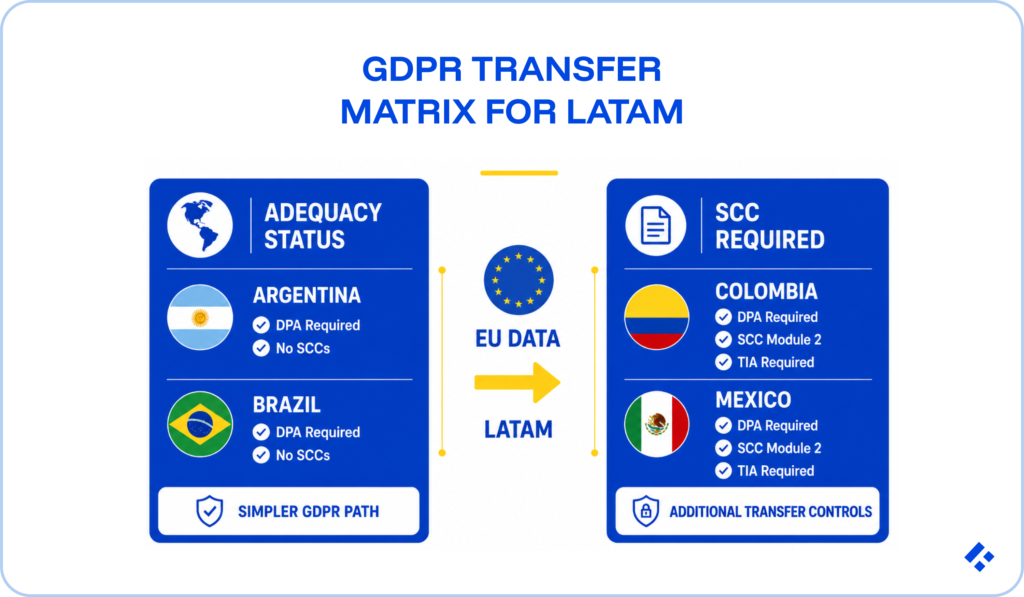
The applicable GDPR transfer mechanism depends on which LATAM country the augmented engineers are in.
The matrix below covers the four primary hiring locations here at Trio.
However, adequacy decisions and regulatory developments can change, so it’s important to verify current status with counsel before any engagement begins.
Argentina holds EU adequacy status, originally granted by the European Commission in 2003 and reviewed and confirmed again on January 15, 2024, following the Commission's first periodic review of all pre-GDPR adequacy decisions.
Argentina was the first country in Latin America to receive EU adequacy status and currently holds it alongside Uruguay as the only Trio-market LATAM countries that had adequacy status before 2026.
This means that EU personal data can flow from the EEA to Argentina without Standard Contractual Clauses or any additional transfer safeguard under GDPR Article 45.
The adequacy decision provides the legal basis for the transfer.
You are still going to need an Article 28 DPA because adequacy covers the transfer mechanism, but the DPA governs the processing relationship, so the SCC layer is not needed.
However, having said that, there are two important things to take into account.
First, adequacy is not permanent. The European Commission reviews decisions periodically and can withdraw or modify them.
Second, the adequacy decision was originally assessed against the pre-GDPR Directive 95/46/EC framework and continues in force under GDPR Article 45(9). It has not been reassessed against GDPR's full requirements.
Related Reading: Contract Developers vs Full-Time Software Engineers
Brazil achieved mutual EU adequacy on January 26–27, 2026, when the European Commission adopted Implementing Decision (EU) 2026/179 under Article 45 GDPR and Brazil's ANPD adopted Resolution CD/ANPD No. 32/2026.
This means that Brazil no longer requires SCCs for EU personal data transfers. Personal data can now flow from the EEA to Brazil, and the other way around, without SCCs or other Article 46 safeguards.
However, the Article 28 DPA is still required.
The same caveats apply as for Argentina. Adequacy is reviewed every four years and can be withdrawn. The EU-Brazil adequacy decision also excludes transfers for public security, national defence, and criminal investigation purposes.
Colombia does not have an EU adequacy decision. Instead, it has its own data protection framework (Law 1581 of 2012, regulated by Decree 1377 of 2013) and has created an "adequacy list" for outbound Colombian transfers under its own framework.
But this is Colombia's domestic determination, not an EU finding. For EU personal data transferred to Colombia, SCCs are required.
This means that Standard Contractual Clauses (Module 2: controller to processor, using the June 2021 European Commission SCCs) must be executed between the EU-side controller and the Colombian-side processor before any EU personal data is accessed by Colombian engineers.
A Transfer Impact Assessment must also be conducted to evaluate whether Colombian law undermines the SCC protections.
Another factor to consider is that Colombia's data protection enforcement sits with the Superintendencia de Industria y Comercio (SIC). The country does not have known aggressive personal-data surveillance legislation comparable to frameworks in other jurisdictions.
Mexico does not have an EU adequacy decision either.
Mexico's Federal Law on Protection of Personal Data Held by Private Parties (LFPDPPP), effective since 2010, establishes a privacy framework but has not been deemed adequate by the European Commission, so SCCs are required for EU-to-Mexico transfers.
Breach notification timelines differ from GDPR's 72-hour supervisory authority notification requirement. The SCCs impose GDPR-aligned breach notification obligations contractually on the processor, closing this gap for the EU personal data in scope.
Additionally, Mexico's subcontracting compliance framework (REPSE, from the 2021 labour reform) is separate from the GDPR framework but applies simultaneously to the staff augmentation engagement. Both need to be addressed.
Related Reading: In-House vs Staff Augmentation for Fintech
Regardless of which country the augmented engineers are in, and regardless of which transfer mechanism applies, an Article 28 GDPR Data Processing Agreement between the fintech (data controller) and the staffing partner (data processor) is required whenever the staffing partner processes EU personal data.
Processing includes accessing, reading, working on systems that contain EU personal data, or modifying EU personal data.
Article 28(3) mandates the following DPA contents:
The June 2021 European Commission SCCs have four modules covering different transfer scenarios:
| Module | Scenario | Does it apply to staff augmentation? |
| Module 1 | Controller to Controller | No, the staffing partner is not an independent controller of the fintech's EU customer data |
| Module 2 | Controller to Processor | Yes, the fintech is the controller; the staffing partner is the processor |
| Module 3 | Processor to Processor | Only if the staffing partner receives EU personal data from an EU-based processor, rather than directly from the fintech controller |
| Module 4 | Processor to Controller | Not applicable to this scenario |
The Module 2 SCCs must be executed between the fintech and the staffing partner. Where individual engineers hold direct system access independently of the staffing partner, counsel should advise on whether a sub-processor chain requires additional SCC execution.
A Transfer Impact Assessment is required whenever SCCs serve as the transfer mechanism. It evaluates whether the laws and practices of the destination country undermine the protections the SCCs provide.
For current LATAM staff augmentation, TIAs are required for Colombia and Mexico engagements.
A TIA assesses:
Article 32 GDPR requires appropriate technical and organisational measures for the security of processing.
For a LATAM staff augmentation engagement, the measures to document in the DPA and implement in practice include the following.
Technical measures:
Organisational measures:
Article 28(2) requires that a processor obtain prior written authorisation from the controller before engaging a sub-processor.
In a staffing engagement, sub-processors are any further subcontractors the staffing partner uses, including other staffing firms, individual contractors placed through a sub-vendor, or tools that process EU personal data on the partner's behalf.
The "no undisclosed subcontracting" clause serves a dual function here, since it is simultaneously a security control (the vetted engineer is the one doing the work) and a GDPR Article 28(2) compliance mechanism (no unauthorized sub-processors process EU personal data without controller consent).
Structuring these protections as standard contract terms rather than negotiated additions reduces the friction of putting them in place.
Trio's staff augmentation engagements are structured to support the fintech client's GDPR compliance posture for EU personal data accessed by LATAM engineers.
We provide a Data Processing Agreement that is compliant with GDPR Article 28 as part of our standard engagement documentation, covering all nine mandatory contents.
For engagements involving Colombian or Mexican engineers accessing EU personal data, Trio supports SCC Module 2 execution as part of the engagement structure.
For more information or to start hiring, book a staff aug consult.