
Hire by Technology
SERVICES


It’s becoming more common to see US fintech companies bring on a talented backend engineer through a LATAM nearshore partner.
However, once the contract ends, sometimes even several months later, during Series B due diligence, an acquirer's legal team might flag an IP gap because the contract's assignment clause says the engineer "agrees to assign" rather than "hereby assigns."
If there is no direct written assignment from the engineer, or the work-for-hire doctrine doesn't apply because the engineer was never a direct employee, deals may stall while the IP chain gets reconstructed.
This article explains what a complete IP assignment requires for nearshore fintech engagements, how moral rights interact with it, and how the staff augmentation contract chain creates an unbroken ownership path from engineer to client.
Understanding requirements and common mistakes in IP assignment for nearshore fintech developers can help ensure you are set up for success going forward.
At Trio, we work strictly with fintech staff augmentation, and our agreements have held up under incredible scrutiny, including mergers and acquisitions.
The belief that paying someone to build software automatically transfers ownership seems intuitive, but it is far from the case. We often see this misconception cause issues during M&A due diligence rather than during the original engagement.
Under US copyright law (17 U.S.C. § 101), a "work made for hire" applies in exactly two situations. The first is when a work is created by an employee within the scope of employment. The second is when an independent contractor creates a work that (a) falls into one of nine specific statutory categories, and (b) is covered by a signed written agreement.
Those nine categories are: collective works, motion pictures or audiovisual works, translations, supplementary works, compilations, instructional texts, tests, answer material for tests, and atlases.
General software development appears nowhere on that list. Computer software instead falls under copyright law as a "literary work.”
Congress has amended the Copyright Act multiple times since 1976 and has still not added software to the work-for-hire categories, so we don’t expect this to change any time soon.
What this means for those hiring nearshore fintech developers through staff augmentation is that, without a written assignment signed by the contractor, copyright in the software vests with the contractor, not with the company that paid for it.
A contract that labels the work "work for hire" without meeting the statutory requirements changes nothing.
The LATAM layer adds complexity on top of this, because even where a written assignment exists, the local law of the country where the engineer works affects the scope and enforceability of that assignment.
Never assume ownership of software written by a contractor without a signed, present-tense written assignment of economic rights.
An unresolved IP question in a general web application might cost legal fees and slow down a deal, along with creating other, fintech-specific risks that compound across multiple dimensions at once.
The applicable copyright defaults, moral rights frameworks, and assignability rules vary meaningfully across Argentina, Colombia, and Mexico.
Let’s summarize the current law, but keep in mind that these guidelines evolve continuously, and you should make sure to involve country-specific legal counsel.
Argentina's core IP statute, Law 11.723, establishes the author as the original owner of copyright. For software created by a contractor, ownership stays with the contractor unless explicitly assigned in writing.
If a developer works for you as a direct employee under an Argentine employment contract, then you could presume to own work created within the scope of employment, but this presumption doesn’t hold up for contractors engaged through a staffing partner.
Under Law 11.723, moral rights (derechos morales) cover the rights of attribution and integrity.
They are inalienable and perpetual, which means they cannot be transferred or waived by contract. A fintech company cannot contract away an Argentine engineer's right to be credited as the author or to object to modifications that harm the work's integrity.
What can be assigned are economic rights (derechos patrimoniales) for reproduction, distribution, transformation, public communication, and related modes of exploitation.
The assignment should be explicit, cover all economic rights, and specify scope and territory.
A practical note here is that Argentina holds EU adequacy status under its Personal Data Protection Act (PDPA), which matters if the engagement involves EU personal data, but this does not affect the IP assignment framework itself.
Colombia's copyright framework operates under a dual layer, combining the domestic Law 23 of 1982 and Andean Community Decision 351 of 1993, which is a regional instrument with direct, supranational effect across Colombia, Peru, Ecuador, and Bolivia.
Under both frameworks, copyright vests in the author by default. A contractor in Colombia owns the code they write unless it has been explicitly assigned in writing.
Decision 351, Article 11, establishes moral rights as inalienable, unattachable, imprescriptible, and unrenounceable.
Colombian law arguably goes further on moral rights protection than even the minimum standards required by Berne. Economic rights are treated separately and can be fully assigned.
What can be assigned is, again, all economic exploitation rights around reproduction, distribution, transformation, and public communication.
What is important to keep in mind is that Colombia's 2025 labour reform introduced updated contractor classification scrutiny and new contract structure requirements.
If a contractor is reclassified as an employee post-engagement, the IP analysis shifts because the assignment came from someone whose employment status may now be in dispute.
Mexico's Federal Copyright Law (Ley Federal del Derecho de Autor) establishes in Article 26 that "the author is the original owner of the economic rights."
For a LATAM contractor building software, this means economic rights stay with the engineer by default, and a commission or payment does not transfer them in any way.
Article 19 of the Federal Copyright Law states explicitly: "Moral rights shall be regarded as vesting in the author and shall be inalienable, imprescriptible, unrenounceable and unattachable."
Unfortunately, there is no path to contracting around this, and any attempts to waive or assign moral rights are unenforceable under Mexican law.
However, like with the other countries we have mentioned, all economic rights can be assigned by written agreement. Mexico's law generally limits copyright assignments to a maximum of 15 years, defaulting to five years if no term is specified.
But Article 103 of the Federal Copyright Law creates an explicit exception for computer software, exempting software assignments from the term limitation.
This makes Mexico's framework actually quite workable for fintech software engagements if properly structured.
Mexico's 2021 subcontracting reform (REPSE) changed how employer-of-record and staffing arrangements must be structured, but it does not alter the IP assignment requirement.
Most IP assignment problems in nearshore engagements exist because a clause is missing one of four key elements:
Related Reading: Hire Fullstack Developers
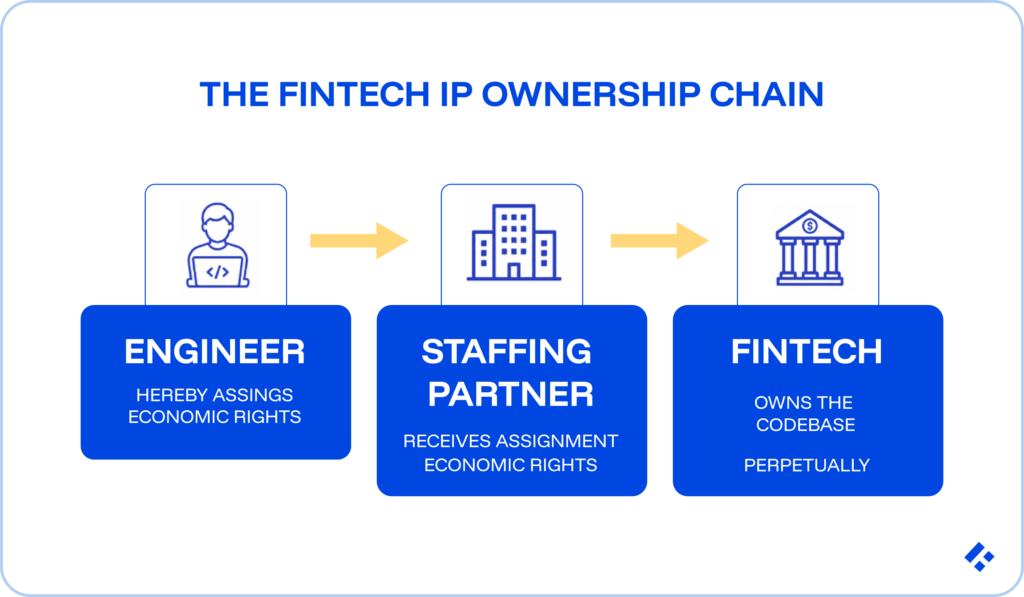
In a direct contractor engagement, IP assignment follows one path, since the engineer is assigned to the client. In a staff augmentation engagement, a second link in that chain becomes required.
Some staffing agencies assign an IP from an engineer to a partner correctly in their internal employment agreements, but then only grant a licence to the fintech client in the MSA or SOW rather than an assignment.
A licence is revocable, while an assignment is permanent. A fintech company that holds a licence to its own payment codebase, rather than owning it outright, remains exposed to licence revocation in a dispute with the staffing partner.
A complete IP chain in a staff augmentation engagement runs:
Both links must exist, use present-tense assignment language, and be producible on request during due diligence.
What to verify before signing:
IP assignment covers the code created during the engagement, but it does not automatically resolve the right picture for what the engineer brought into the engagement or what they embedded in the codebase without necessarily flagging it.
Engineers routinely incorporate pre-existing utility code, framework components, and reusable modules into client work.
After the engagement, the fintech's codebase may contain this material, and without an explicit licence grant, the fintech technically has no right to use it.
The assignment clause should carve out background IP (defined as any code, tools, or libraries pre-existing the engagement) and replace the assignment with a perpetual, irrevocable, royalty-free licence to use that material as embedded in the deliverables.
If a LATAM engineer embeds GPL-licensed open-source code in a proprietary fintech payment system, GPL's copyleft provision may require the fintech to open-source the surrounding code when the product is distributed.
If your company’s payment routing logic, fraud-scoring algorithm, or KYC state machine represents genuine commercial value, this is a serious worry.
The IP clause should include an explicit warranty against unlicensed open-source incorporation, with a named prohibition on GPL-licensed material without prior written approval, and a mechanism for reviewing open-source dependencies before they appear in the codebase.
A copyright assignment does not protect the ideas, algorithms, and business logic embedded in that code.
In fintechs, this means it doesn’t cover things like the payment routing approach, the credit scoring model, and the transaction monitoring ruleset.
Trade secret protection requires confidentiality agreements (NDAs), so you will need both.
Trio's staff augmentation engagements use the double-assignment structure described above. The fintech client receives ownership of its codebase from day one.
Our employment agreements with engineers include present-tense assignment of all economic rights in work products created during the engagement. The transfer happens at the moment of creation, not at the end of the engagement.
Contracts also distinguish foreground IP (assigned to the client) from background IP (licensed to the client on a perpetual, irrevocable, royalty-free basis).
As always, review the specific IP assignment terms in your engagement agreement with your own qualified legal counsel.
If you want to find out more or get started with the hiring process, book a staff aug consult.