

Hire by Technology
SERVICES



Signing the contract and getting a start date is just the first part of the hiring process. After that, there are often two or three weeks where the sprint board barely moves, while everyone politely assumes the new hire is still finding their footing.
That delay very rarely has anything to do with the engineer or your codebase, and can instead be attributed to a variety of administrative tasks that are required to ensure compliance.
Background checks and access requests are just two examples of tasks that extend the time it takes before your engineer can contribute. Multiply a couple of days’ delay across however many hires a fintech team makes in a year, and it becomes a real issue.
On the other hand, being aware of compliance gates and running them alongside the technical ramp, starting before day one, means the sprint you'd normally lose comes back.
At Trio, we have extensive experience in onboarding nearshore engineers into a fintech sprint. This step-by-step playbook walks you through everything you need to know to do that.
For assistance in hiring and onboarding, book a call.
How fast does a new engineer actually start shipping? The reality is that the numbers vary depending on who's measuring.
Teams operating at the top DORA performance tier typically land a first merged pull request in one to two days. Strong teams, a notch below that ceiling, usually take three to five business days.
From what we have observed, the median across the industry seems to be about two to three weeks.
However, instead of just tracking speed to start shipping, we recommend that you track time to the tenth pull request.
A one-line typo fix proves nothing about actual contribution, so considering the first ten pull requests gives a more honest read on when someone starts genuinely productive work.
Major companies like Spotify utilize this metric.
Depending on the codebase and the seniority of the role, this tends to land somewhere in the month-plus range for a lot of organizations, and it's a useful gut check against a first commit that came too easily.
In a regulated codebase, the first commits sit behind a background check, a training attestation, an access approval, and a decision about which systems this person can even go near.
Each of those steps takes real days to clear, so if you run them after the start date, you can draw the ramp time out.
If you run them in parallel, starting before day one, a nearshore engineer can be shipping inside the first sprint.
The productivity curve follows a similar shape.
Without a structured onboarding process, a new engineer may spend their first month operating well below full output, and reaching full productivity can take three to six months.
Good onboarding can shrink that window substantially, down to something closer to eight or twelve weeks.
Then there's a cost that a lot of people forget to account for: mentor time.
When you pull a senior engineer into ramp support for a new hire, this support ends up consuming a notable proportion of their hours.
| Track | Owner | Starts | Blocking? |
| Compliance (background check, training, attestations, scope determination) | Security or compliance lead | Day -5 | Yes, blocks everything |
| Access (identity, repo, tooling, environments) | Platform or IT | Day -3, once compliance clears | Yes, blocks code |
| Technical (environment, codebase orientation, first task) | Engineering buddy | Day 1 | No |
| Domain (what the product does, why the money moves that way) | Tech lead or PM | Day 1, ongoing | No |
Unfortunately, compliance and access depend on each other in sequence. You can't provision repo or cloud access to someone whose background check hasn't cleared yet.
However, both of those tracks can finish entirely before day one, since most of the work involved is paperwork and sign-off. The technical and domain tracks can then start clean on day one, with nothing blocking either of them.
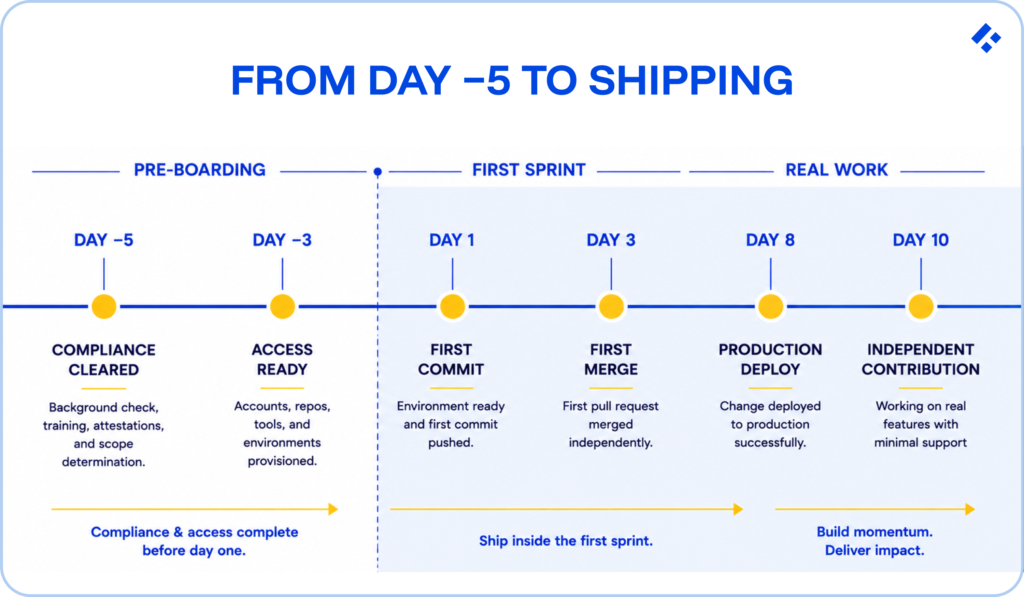
Like we already mentioned, pre-boarding tends to shave days off time-to-first-commit for general engineering teams. In fintech, the amount of time you can save is even more because there's more sitting in the queue to clear.
Everything downstream depends on what happens here, so it's worth treating this work quite seriously.
Don’t forget to keep maintaining the audit trail in view here too, since the access decisions made this week are exactly what an auditor will ask about later.
If you have done your due diligence and ensured that the necessary steps have been taken to prepare for the engineer’s first day, then you could compress their onboarding time into the first week.
Target: environment running, first commit pushed to a branch but not merged yet.
The engineer’s first official day.
Here, you want the buddy to walk the new engineer through the codebase: repo topology, service boundaries, where the money-moving code actually lives and where it doesn't.
Every piece of access needs to be confirmed.
This is also the day to introduce domain vocabulary if they are new to the industry, or new to the specific role, since fintech has so much of it.
Target: a PR sitting open on the pre-selected task.
This day tests the pipeline, including branch protection, review requirements, CI, and whether commits attribute correctly to the right person.
Attribution problems often tend to surface here, which can be frustrating, but it’s better than them surfacing later during an audit.
Whatever the audit trail setup can't answer cleanly this week is worth fixing now rather than later.
Target: that same PR, merged.
If your team is particularly elite, you may even hit this milestone on day one.
But, in a regulated codebase, with a required reviewer and a compliance-aware CI pipeline, day three is a good goal.
Note whatever took longest here, since that same friction is probably slowing your existing team too,
You want to walk the actual money flow, start to finish, with the developer. The goal is to ensure that they understand the entire process, so they don’t make any decisions that can negatively affect other developers downstream.
Make sure to cover where funds enter, what the ledger does with them, where reconciliation happens, and what it looks like when any piece of that fails.
Target: a task picked up without a buddy walkthrough first.
Assuming everything has gone well, this is where your developer tries to complete an entire task on their own.
However, the caveat here is that you shouldn’t put a new nearshore engineer on sprint-committed work during this first week. Give them real tasks, but know there is a high probability of an issue, so it shouldn’t be on any critical path.
You can finish off the week reviewing your process.
Ask something like, what do you wish you'd known on day one?
Whatever the new engineer says in answer to that is usually the gap in your process your existing team stopped noticing a long time ago.
Days 6 and 7 bring the first task onto the actual sprint board, sized conservatively.
Make sure that you still pair the developer on anything touching money movement or a regulated data path, since that's not the place for a new engineer to be working alone just yet.
By day 8, aim for a first production deployment on something that has been heavily supervised.
This milestone tests the release process, the approval gates, and whether the engineer genuinely understands the rollback path if something goes sideways.
Days 9 and 10 are where we recommend their first code review, and it's also when you find out whether they understand the correctness properties of the domain.
Then comes the two-week checkpoint, which comes down to three honest questions:
If the answer to all three is yes, the ramp worked. Software development KPIs are worth tracking from here on out.
At Trio, we have walked through this process with a variety of companies and have advised them on how to improve their processes going forward.
Along with our pre-vetted fintech experts, this allows companies to successfully find the right talent and get them productive as soon as possible. Book a staff aug consultation.