

 Read Client Stories





 Alex Kugell
 Key Takeaways
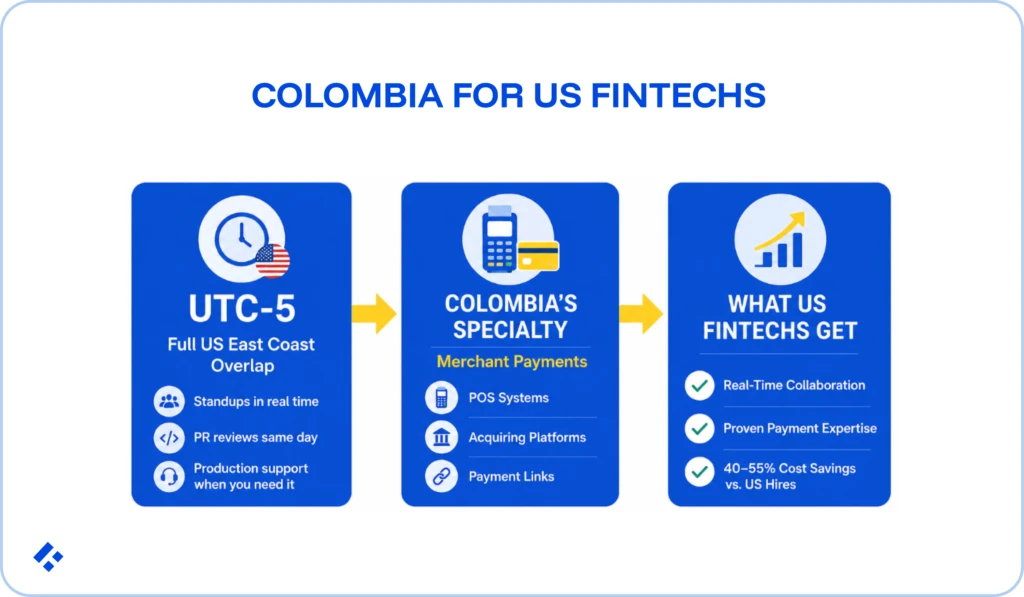
- Colombia’s timezone (UTC-5) matches US Eastern Time exactly, offering full working-day overlap with New York, Boston, and Miami.
- The fintech ecosystem here produced engineers with real production experience. Nequi, DaviPlata, Bold, and Nu Colombia have all trained engineers on the kinds of problems US fintechs actually face.
- Merchant acquiring is a Colombian specialisation. Bold’s platform has produced a pool of acquiring-side engineers that’s harder to find in other LATAM markets, making Colombia particularly strong for US fintechs building payment-acceptance products.
- Senior fintech developer rates run $60K–$80K/year, which is roughly 48% below equivalent US roles, with Medellín and Cali typically 10–20% below Bogotá for comparable experience.
Colombia has become one of the more compelling LATAM destinations for fintech engineering talent. There are many reasons for this outside of just the reduced cost that comes with a lower cost of living.
Two things converge here that rarely do elsewhere: exact timezone parity with the US East Coast and a fintech ecosystem deep enough to have produced a genuinely experienced developer talent pool.
However, these benefits do not automatically make them the right choice for your fintech company. It is important that you truly understand the talent pool in Colombia to prevent a hiring mistake that could set you back several months or create compliance issues.
This article profiles the Colombian fintech engineer specifically. We will cover the ecosystem that trained them, the domain skills it produced, what they cost, and how to vet whether an individual candidate’s experience matches what your product actually needs.
At Trio, we pre-vet Colombian developers for financial applications. We start every engagement with a consultation so that we can place the best person for your specific requirements, with replacement guarantees.
Why Colombia Works Well for US Fintech Engineering Teams
Two structural factors make Colombia a consistently strong choice. It is important to understand them together to get the full picture.
The timezone advantage
Colombia operates on UTC-5, matching US Eastern Standard Time precisely.
Unlike Argentina (UTC-3, which sits two hours ahead of EST) or Brazil (UTC-2 or UTC-3 depending on state and season), a Colombian developer’s working day aligns completely with an East Coast team’s.
What this means for international fintech teams is that daily standups happen in real time, and pull request reviews don’t queue overnight.
When a PCI DSS scope question surfaces mid-sprint or a KYC state transition breaks in production, the fix doesn’t wait until morning.
Having said this, it is important to note that Colombia doesn’t observe daylight saving time.
During US DST months (roughly March through November), the alignment shifts so that Colombia effectively matches US Central Time rather than Eastern.
The neobanking and payments ecosystem
Colombia’s fintech sector grew out of a large underbanked population and relatively progressive open-finance regulation.
This combination pushed companies to build quickly and at real scale.
The neobanking market is led by Nequi (originally a Bancolombia initiative that became independent in 2022), DaviPlata from Davivienda, and Nu Colombia, which has grown from near zero to approaching 5 million customers in a few years.
Merchant payments are anchored by Bold, which raised a $50M Series C from General Atlantic in February 2024 and now serves over 150,000 monthly active merchants nationwide.
BNPL is led by Addi. The instant-payment infrastructure Transfiya has reached tens of millions of Colombians.
What this means for hiring is that engineers from this ecosystem have built the same things US fintechs build.
It is far easier than in some other places to find people with experience in digital wallets at massive scale, merchant onboarding flows, consumer credit origination, and financial-inclusion infrastructure for users without bank accounts.
The Colombian Fintech Talent Pool and Its Hubs
Colombia’s tech workforce sits at an estimated 150,000–165,000 software developers, making it LATAM‘s third-largest tech talent pool.
On top of that, thousands of STEM graduates enter the pipeline annually, and Colombian developers rank in the top 50 globally on HackerRank assessments.
The government’s National Digital Strategy 2023–2026 directed significant public investment into digital skills, AI, fintech, and cybersecurity.
The talent concentrates in three cities:
- Bogotá: The capital and primary tech hub, it holds most of Colombia’s startup ecosystem, the densest concentration of senior fintech engineers, and the headquarters of Nequi, Bold, and most of the major ecosystem companies. It also has the highest rates in the country.
- Medellín: Anchored by the Ruta N innovation district, Medellín has developed a genuine fintech and startup engineering community and regularly hosts major tech events, including JSConf’s first-ever LATAM edition.
- Cali: This city is the growing third hub with a developing tech ecosystem and the lowest rates of the three cities. However, the depth of fintech-specific talent thins out here compared to Bogotá, so senior fintech-specific hiring may require more search effort.
Colombia’s developer pool is large, but not all of it carries fintech domain experience.
The country’s JavaScript and React communities (3,000+ members, meetups across eight cities) produce strong web engineers, many of whom haven’t worked in a regulated financial context. It is important that you vet for production financial experience specifically.
Common Fintech Skill Sets Among Colombian Developers
Colombia’s fintech talent pool clusters around four profiles, each of which is shaped by a specific part of the local ecosystem.
1. High-volume digital banking engineers
These are engineers from the Nequi, DaviPlata, and Nu Colombia ecosystems.
Nequi’s record of 66 million transactions in a single day on June 28, 2024, gives some sense of the engineering constraints these teams worked under, forcing genuine solutions to scaling, reliability, and reconciliation challenges.
Engineers from this part of the ecosystem have built account systems, digital wallets, transaction processing pipelines, and the ledger infrastructure that underpins neobanks serving tens of millions of users.
They tend to have concrete opinions about event ordering, eventual consistency, and what happens when payment confirmation fails partway through.
2. Merchant acquiring and payments engineers
Merchant acquiring and payments are something of a Colombian specialisation, anchored by Bold’s merchant-acquiring platform.
Bold handles both card-present and card-not-present payments, which means engineers on that stack built merchant onboarding flows, POS and payment terminal integration, payment link infrastructure, and the acquiring-side systems that process transactions at SME scale.
We don’t see this profile as prominently in other LATAM markets, making Colombia a particularly strong source if your fintech is building payment-acceptance or merchant-facing products.
3. BNPL and consumer credit engineers
These are engineers from Addi and Colombia’s broader lending ecosystem. Their experience covers loan origination, credit scoring models, repayment scheduling, and the risk and underwriting systems that consumer credit products require.
Given that BNPL adoption in Colombia has previously skewed toward underserved borrowers, these engineers also tend to have experience building for users with thin credit files, which can be incredibly useful if you are working on credit access.
4. Financial inclusion and underbanked infrastructure engineers
This experience in creating offerings for underserved communities leads to another distinctive Colombian strength.
Building financial services for users without traditional bank accounts through agent networks, cash-in/cash-out systems, prepaid cards, and the KYC onboarding flows that bring underbanked users into the formal financial system all require specific engineering patterns.
Movii, the first SEDPE-regulated fintech in Colombia, pioneered much of this infrastructure.
Engineers from this context have built for low-bandwidth environments, feature phone users, and KYC verification without the documents typically required in wealthier markets.
Common stack across the pool:
- Backend: Node.js (dominant), Python, Java, Go
- Frontend: React (dominant), React Native (reflecting Colombia’s consumer-first, web-first fintech market)
- Cloud: AWS (dominant), GCP
- Data and streaming: PostgreSQL, Redis, Kafka
The ecosystem skews toward scalable payment system architectures on Node.js and React, driven by the web-first nature of its consumer fintech products.
Fintech Developer Rates in Colombia
From what we have observed, Colombian fintech developer rates run 40–55% below US domestic equivalents.
The average senior software developer in Colombia earns approximately $63,800/year, compared to roughly $122,000 for an equivalent US role.
If you go through a firm like Trio, we charge between $40-$90 per hour, depending on your specific requirements, with no additional costs.
Total savings versus US hiring, factoring in benefits and overhead, typically land between 40–55%.
Annual salary and hourly ranges for US-facing remote roles (2026):
| Seniority | Annual (USD) | Hourly equivalent |
| Junior (0–2 years) | $24,000–$35,000 | ~$22–$32/hr |
| Mid-level (2–5 years) | $40,000–$58,000 | ~$38–$58/hr |
| Senior (5+ years) | $60,000–$80,000 | ~$60–$80/hr |
| Tech lead / specialised fintech | $80,000–$110,000 | ~$85–$110/hr |
Regional variation matters. As we have already mentioned, Bogotá commands the highest rates as the primary hub. Medellín and Cali typically run 10–20% lower for comparable skill levels, but it may be more difficult to find what you are looking for there.
It is also important to note that the fintech premium also exists, but is often worth paying. Developers with fintech, payments, or compliance experience typically charge 20–30% more than general developers at the same seniority.
That premium reflects the genuine scarcity of fintech-domain engineers. It often ends up with overall savings, since you tend to avoid the cost of a 4–8-week domain ramp that a general developer requires before they can contribute safely in a regulated environment.
How to Vet Colombian Fintech Developers
Whether a specific Colombian developer has the domain skills your product requires still depends on vetting. Country of origin doesn’t substitute for that.
The five fintech competencies worth screening for are:
- Monetary precision: Does the candidate know why monetary amounts must be stored as integer minor units or DECIMAL/NUMERIC types, and never as FLOAT?
- Payment idempotency: Can they describe the client-generated idempotency key pattern and explain the write-ahead log gap in payment retries?
- KYC/AML state machine design: Would they design KYC as a stateful lifecycle with ongoing monitoring, or as a one-time verified boolean?
- PCI DSS scope management: Do they understand the difference between SAQ A and SAQ D, and how hosted payment page decisions affect scope?
- Regulatory awareness: Do they know which compliance frameworks apply to the systems they’ve built, and what those frameworks actually require at the implementation level?
English proficiency across Colombia’s tech sector has improved a great deal in recent years, and most senior engineers working in US-facing roles communicate well.
However, proficiency varies a great deal by individual and should be assessed during the interview process, particularly for roles that involve client-facing work or complex architectural discussions. You need to assess the language level of the developer you are considering.
Related Reading: How to Outsource Developers in Colombia: 8 Steps
Practical Hiring Considerations
Outside of fintech-specific vetting, there are some practical considerations you will need to weigh.
Timezone
UTC-5, identical to US Eastern Standard Time. For US East Coast teams, this means full working-day overlap, which facilitates daily standups, live code reviews, and real-time debugging.
During US DST months, the alignment effectively matches US Central Time.
Legal hiring models
There are four common structures for hiring Colombian developers from the US:
- Managed platform/staff augmentation: A partner like Trio employs the developer and places them with your team. You manage the work; the partner handles employment, payroll, and compliance with Colombian labour law, so it carries the lowest operational overhead for most US fintechs.
- Employer of Record (EOR): A third party employs the developer on your behalf in Colombia, handling local compliance without requiring you to establish an entity.
- Independent contractor: This is a direct engagement. You manage the relationship and payments directly. Colombia’s 2025 labour reform tightened enforcement around contractor classification, so compliant structuring has become more important.
- Local entity: You could establish your own Colombian entity. This is only justified at a significant scale since the overhead is substantial for smaller teams.
Economic stability
Colombia offers a more economically stable environment than some LATAM peers, with inflation well within historically normal ranges and a tech ecosystem backed by sustained public investment.
Hiring Colombian Fintech Developers Through Trio
Trio places pre-vetted Colombian fintech engineers with US and EU fintech companies, alongside engineers across LATAM.
Because we focus exclusively on fintech, the Colombian developers from our pre-vetted pool arrive with domain context from the local ecosystem.
This means they can be placed in 3–5 days at $40–$80/hr ($7,000–$14,000/month).