



Fintech software development companies are a great way to get skilled talent and development when you need it faster than a traditional hiring process allows.
However, picking the wrong partner, or a generalist agency that underestimates the compliance and security requirements of financial software, tends to be an expensive mistake to unwind in any development project.
The top fintech software development companies include:
- Trio
- Brainhub
- ScienceSoft
- Binarks
- 10Clouds
- SDK.finance
- Velmie
- BairesDev
- Praxent
- HatchWorks
- Appinventiv
- Netguru
- ThoughtWorks
- EPAM Systems
- Accenture / Deloitte / KPMG Fintech Practices
If you are ready to hire, request talent with Trio. We can get you tailored portfolios in as little as 48 hours, and onboard your first developer in as little as a week.
Key Takeaways
- The right fintech software development company brings domain-specific experience (payment infrastructure, compliance frameworks, security engineering) and a transparent vetting bar for senior engineers.
- The ability to scale your team up and down easily, without the whole project falling apart, is invaluable.
- Generic software agencies are great, but fintech development requires a very niche understanding and skillsets that they cannot deliver reliably.
Top 15 FinTech Software Development Companies
We evaluated companies below on their fintech domain experience, security and compliance posture, delivery track record, and suitability for tech startups and scaleups specifically.
A large enterprise consultancy may be technically excellent but poorly matched to a development team that needs candidates in days and delivery that doesn't require extensive management overhead for fintech projects.
Related Reading: Hiring Fintech Developers: Roles, Skills, and Where to Find Them
1. Trio
Trio operates as a fintech-exclusive staff augmentation and dedicated team partner, with engineers based across Brazil, Argentina, Colombia, and Chile working in the US Eastern and Central time zones.
African developers are also available for European time zones.
Every engineer passes domain vetting that goes beyond basic technical skill, and covers things like actual exposure to KYC, AML, SOC 2, and PCI DSS requirements.
Previous experience also factors into each placement decision, so developers can start contributing immediately instead of learning the nuances of fintech from scratch.
Our expertise in agile, nearshore fintech development ensures that projects are delivered quickly, allowing your complex FinTech innovations to go to market faster and capture opportunities as they arise.
All of this culminates in Trio placing engineers in 3 to 5 days, with a 97% placement success rate and 95% developer retention.
Best for: Tech startups and scaleups needing rapid, senior fintech engineering capacity with low management overhead, particularly Post-Seed through Series C teams that have technical execution gaps to fill.
Limitation: LATAM-focussed talent pool. Not the right fit for companies with a hard requirement for US-based W-2 contractors or teams.
2. Brainhub
Brainhub focuses on accelerating the growth of FinTech businesses with its expertise in .NET, JavaScript, and cloud-based technologies.
They are known for their excellent project management and effective communication and are a top choice for startups and medium-sized companies looking to scale their operations.
Best for: Mid-sized fintech products in wealthtech, crypto-adjacent, and expense management verticals.
Limitation: Less depth in core banking or compliance-heavy US regulatory environments. Strongest on product-facing fintech work.
3. ScienceSoft
ScienceSoft brings 36 years of operation and a dedicated fintech practice covering insurance, banking, lending, investment, payments, and corporate finance.
They handle large-scale BFSI systems and excel in banking apps serving millions of users, payment integrations for enterprise e-commerce, and AI-powered fraud detection.
Compliance coverage includes PCI DSS, NYDFS, CCPA, and SEC-relevant standards.
Best for: Enterprise fintechs and traditional financial institutions needing a long-term, full-service technical partner with genuine regulatory depth.
Limitation: Engagement sizes and timelines skew toward enterprise-scale projects. Growth-stage startups may find the process too heavyweight for an early MVP.
4. Binariks
This is a nine-year-old specialist firm with a dedicated fintech unit staffed by engineers with real financial services depth.
Binariks covers payments infrastructure (issuing, acquiring, tokenization, gateways), core banking integrations, lending platforms, and QA automation.
They emphasize their "shift-left" security model, which embeds compliance from the earliest architecture stage, making a measurable difference in how much rework surfaces at audit time.
Best for: Mid-size fintechs building payments infrastructure, lending platforms, or compliance systems that need a hands-on delivery partner with genuine fintech domain depth.
Limitation: Eastern European delivery means US timezone overlap requires structured async processes. Some clients have flagged operational continuity concerns post-2022 worth raising directly in vendor conversations.
5.10Clouds
10Clouds focuses on FinTech and blockchain software development, offering secure and user-friendly solutions for banking and finance.
Their partnership with Trust Stamp for identity verification solutions showcases their commitment to high-security standards in FinTech. The company is also known for its UX work and its experience with robust DeFi platforms.
Best for: Mobile wallets, payment apps, crypto wallet development, and consumer-facing fintech products where design and security need to coexist.
Limitation: Less suited to teams building backend-heavy compliance infrastructure or core banking integrations rather than consumer-facing products.
6. SDK.finance
SDK.finance is a white-label fintech company with 15+ years of experience building payment and banking applications.
They are known for e-wallets, neobanks, and payment gateways. Their modular backend covers account management, payments, compliance, and KYC through ready-made APIs.
Their biggest differentiator is a level of reliability that a greenfield build at the same stage typically can't match.
Best for: Companies wanting to launch neobanks, digital wallets, or payment platforms faster using a proven modular platform rather than building from scratch.
Limitation: Platform licensing means adapting to their architecture. Custom logic outside the platform scope still requires traditional development resources.
7. Velmie
Velmie builds cloud-native white-label solutions for institutions like neobanks or anyone else who needs digital wallets and card programs.
Their "banking-in-a-box" platform includes compliance, payments, and KYC pre-built, making it a great option to get started if you need to launch within months rather than years.
Best for: Founders launching digital banks or card programs who want a compliant infrastructure baseline they can configure rather than build from scratch.
Limitation: Platform-based approach constrains differentiation. Proprietary fintech logic — custom fraud models, bespoke underwriting — still requires development resources outside the platform.
8. BairesDev
BairesDev is a massive nearshoring firm with more than 4000+ developers in Latin America.
It covers full-cycle development, AI, and staff augmentation across Fortune 500 and startup clients alike. For teams that need to mobilize volume quickly, their scale makes them a viable option.
You do need to keep in mind that while they do custom fintech solutions, they are also a generalist nearshoring agency. Make sure your developers have fintech experience.
Best for: Mid-market and enterprise companies needing to mobilize 10 to 50 engineers quickly, with a dedicated internal team to manage the relationship.
Limitation: Enterprise orientation may produce slower matching and less fintech-specific vetting than a specialist partner at the scale most growth-stage fintechs operate at.
9. Praxent
Austin-based and focused exclusively on fintech and financial services, Praxent maintains a pre-vetted bench of nearshore developers in .NET and JavaScript.
This company goes the extra mile and runs background checks on all candidates. Their core value proposition is essentially fintech talent that doesn't require training on the regulatory environment before contributing to production work.
This is similar to some of the other firms we have discussed, but the value of this is not to be understated.
Best for: Fintechs running .NET or JavaScript stacks who want a vetted pipeline without rebuilding their internal recruiting process from scratch.
Limitation: Narrower stack coverage than generalist providers. Python-heavy or Go-based teams may find the available bench thinner than expected.
10. HatchWorks
HatchWorks is a US-headquartered nearshore staff augmentation provider with LATAM delivery.
The nearshore nature of the delivery means it’s positioned for agile teams thanks to the timezone alignment and cultural fit with US-based engineering teams.
Best for: Product-centric technology companies that prioritize agile process fit and US business culture alignment over fintech domain specificity.
Limitation: Less fintech-specific domain vetting than specialists. Functions better as a general tech staff augmentation partner than a fintech-focused one.
11. Appinventiv
Appinventiv is recognized for creating high-quality, scalable FinTech solutions. They specialize in mobile app development with a focus on user experience, making them a top choice for startups targeting the B2C market.
The expertise of their FinTech professionals extends to blockchain integration and AI-driven financial tools.
Best for: Startups targeting the B2C fintech market who need fast MVP delivery with polished mobile UX.
Limitation: Less documented depth on backend compliance infrastructure. Better suited to consumer-facing fintech products than regulated core banking or payment processing systems.
12. Netguru
This Polish consultancy firm has more than 900 developers on hand and has made waves in European markets.
The company is popular for its big data, trading systems, and large-scale builds, making it a great choice if you need comprehensive apps.
Best for: Data-intensive fintech products, trading platforms, and teams needing broad development capacity at scale.
Limitation: European delivery model with limited LATAM or US nearshore coverage. Timezone coordination requires deliberate planning for US-based teams.
13. ThoughtWorks
ThoughtWorks combines deep technical expertise with financial services experience across core banking, AI-powered analytics, and blockchain integrations.
The company is known for engineering excellence and agile transformation, with LATAM engineers embedded in cross-functional client teams.
Best for: Established financial institutions or large-scale fintechs undergoing architectural transformation or major system overhaul.
Limitation: Day rates sit at the high end of the market, and engagement sizing targets enterprise budgets. Growth-stage teams tend to find better cost-to-outcome ratios elsewhere.
14. EPAM Systems
EPAM Systems offers a wide range of services, including digital payment solutions, blockchain integration, and secure financial software development, making them a reliable partner for enterprise-scale projects.
Best for: Large financial institutions and enterprise-scale fintech projects with complex compliance requirements.
Limitation: Engagement sizes and day rates skew toward enterprise budgets. Growth-stage fintech teams typically find better cost-to-output ratios with smaller specialists.
15. Accenture / Deloitte / KPMG Fintech Practices
While the Big Four are technically consulting firms, their fintech practice arms remain the standard option for regulatory compliance mapping (SOC 2 readiness, PCI DSS gap analysis, DORA compliance for EU-facing products), pre-IPO audits, and large-scale core banking transformations.
While they can be a good option, rate ranges typically run $250 to $600/hr at the partner level, making them inaccessible to most.
Best for: Post-Series C and enterprise fintechs managing complex regulatory events or institutional-grade audits.
Limitation: Cost structure excludes growth-stage fintechs almost by definition. They also typically deliver recommendations rather than engineering execution.
Quick Comparison: Top FinTech Software Development Companies
Here's a condensed reference for evaluating the companies above against your specific situation.
| Company | Best For | Typical Fit | Category |
| Trio | Rapid senior fintech capacity, staff augmentation | Startups and scaleups | Nearshore staff augmentation |
| Brainhub | .NET/JS fintech, strong PM | Mid-size products | Full-cycle agency |
| ScienceSoft | Enterprise BFSI, full-service delivery | Enterprise fintechs | Full-cycle agency |
| Binariks | Payments infrastructure, compliance-first builds | Mid-size fintechs | Full-cycle agency |
| 10Clouds | Mobile wallets, blockchain, UX-heavy | Consumer fintech | Full-cycle agency |
| SDK.finance | Neobanks, digital wallets, platform launch | Faster time-to-market | Specialist platform vendor |
| Velmie | Digital banks, card programs, white-label | Launch-stage fintechs | Specialist platform vendor |
| BairesDev | Volume staff augmentation at scale | Mid-market and enterprise | Nearshore staff augmentation |
| Praxent | .NET/JS fintech bench, vetted pipeline | Fintechs with defined stacks | Nearshore staff augmentation |
| HatchWorks | Agile fit, US culture alignment | Product-centric tech companies | Nearshore staff augmentation |
| Appinventiv | B2C mobile fintech, fast MVP | Consumer apps | Full-cycle agency |
| Netguru | Big data, trading, and large-scale builds | Data-intensive products | Full-cycle agency |
| ThoughtWorks | Architectural transformation, core banking | Enterprise fintechs | Enterprise consultancy |
| EPAM Systems | Enterprise compliance engineering | Large institutions | Enterprise consultancy |
| Accenture / Deloitte / KPMG | Regulatory events, pre-IPO audits | Post-Series C and enterprise | Enterprise consultancy |
Which Type of Fintech Software Development Company Do You Actually Need?
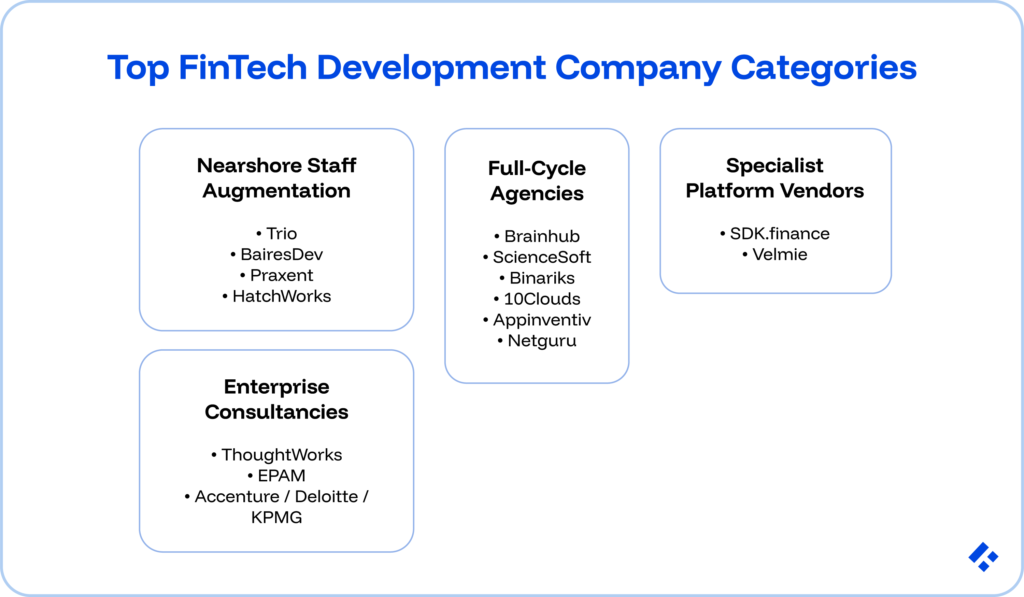
When you are thinking about hiring developers, you need to carefully consider what type of fintech company you actually need. There are some massive differences between them that will make some suitable in only certain circumstances.
- Full-cycle agencies own end-to-end delivery under their own project management layer. The right choice when you lack internal technical leadership or have very specific guidelines.
- Nearshore staff augmentation partners embed engineers directly into your team. You manage the work and own the IP. The partner handles sourcing, vetting, and payroll, providing incredibly cost-effective ramping.
- Specialist platform vendors provide pre-built fintech infrastructure that you build on top of rather than from scratch, so you can get products to market quickly.
- Enterprise consultancies are all about strategizing and specialist knowledge, so they fit complex one-time decisions rather than ongoing execution.
What Is FinTech Software Development?
Understanding what separates fintech development from general software work helps explain why partner selection matters so much.
The short version: financial software carries consequences that most software does not.
A bug in a consumer app, like a mobile game or something similar, creates a bad experience. The same class of bug in a payment system creates a balance dispute, a failed audit, or a compliance incident.
PCI DSS, SOC 2, ISO/IEC 27001, KYC/AML frameworks, PSD2, DORA for EU-regulated entities, and a bunch of other regulations all add engineering constraints that don't appear in typical software projects.
Developers who haven't worked inside these constraints before tend to underestimate them. If you can't stay compliant, you not only have the monetary consequence of a fine, but you also lose trust.
Types of FinTech Software
Different fintech product categories carry different technical and regulatory requirements, so it helps to know where your product fits before evaluating vendors.
- Payments and payment gateway development handle high-volume transaction processing, encryption, tokenization, fraud filtering, and regulatory reporting. Errors here have direct financial consequences.
- Digital banking and neobank platforms cover account management, KYC/AML workflows, onboarding flows, and integrations with core banking providers or banking-as-a-service infrastructure.
- Lending and underwriting software requires credit scoring models, risk assessment engines, loan servicing workflows, and regulatory compliance specific to consumer and commercial lending.
- Wealth management and investment platforms involve portfolio management, securities regulation compliance, real-time data feeds, and often low-latency execution requirements.
- InsurTech covers policy management, claims processing, and underwriting automation, with its own regulatory environment that varies significantly by geography.
- Blockchain and DeFi include smart contracts, decentralized ledgers, crypto exchange infrastructure, and blockchain-based identity verification and fraud prevention.
- RegTech and compliance tools handle AML monitoring, audit trail generation, regulatory reporting, and the increasingly complex work of automating KYC/KYB workflows.
Conclusion
The market changes every day. That is why you need an experienced fintech software development company that stays on top of emerging trends and the latest compliance best practices.
If you hire a generalist agency, they will be left learning the domain on your budget or making incredibly costly mistakes.
If you are interested in getting some of these top fintech developers on your team, you're in the right place. At Trio, we provide staff augmentation and outsourcing hiring models, putting together a custom plan based on your requirements.
For more information or to get started, book a discovery call.
Frequently Asked Questions
What do fintech software development companies actually do?
Fintech software development companies build digital financial products like payment systems, banking apps, lending platforms, and fraud detection tools.
How much does fintech software development cost?
Fintech software development costs vary widely depending on scope, team geography, and compliance complexity. LATAM nearshore staff augmentation typically runs $7,000 to $14,000 per engineer per month; full-cycle agency work runs $12,000 to $25,000+ per month for a comparable senior developer equivalent. At Trio, costs range between $40 and $90 per developer per hour.
What is the difference between a fintech development company and a general software agency?
A fintech development company works in financial services and understands the regulatory and security requirements that general agencies tend to underestimate. Their developers stay current with compliance frameworks like PCI DSS, KYC/AML, and SOC 2 because those constraints appear in every project they touch.
How long does it take to build a fintech app?
A fintech MVP typically takes three to six months, depending on complexity and team size. Teams using a specialist platform vendor for neobank or wallet infrastructure can sometimes compress that substantially.
Which fintech software development company is best for startups?
Startups with tight budgets, aggressive timelines, and internal technical leadership tend to benefit most from a fintech-specialist nearshore staff augmentation partner rather than a full-cycle agency. Trio's 3-to-5-day placement timeline, domain vetting for compliance exposure, and LATAM time zone alignment make it the strongest option for most US-based fintech startups in this position.
Which countries have the best fintech software developers for US companies?
For US-based fintechs, LATAM countries appear to offer the best combination of timezone alignment and cost value. Eastern Europe delivers strong technical depth on a more async schedule.