


 Read Client Stories





 Alex Kugell
 Key Takeaways
- Define the problem, the product vision, and the delivery approach before you hire, so you recruit for the work that actually needs doing.
- Make the first key hire count. A senior engineer or technical lead who sets the stack, standards, and architecture early shapes every hire after them.
- Startups move faster with generalist or T-shaped teams; maturing products lean toward matrix or specialist structures for stability.
- In regulated spaces like fintech, security, compliance, and QA depth matter as much as raw development skill.
- Manage for outcomes and communication. Clear goals, active listening, and protection against burnout do more for delivery than piling on headcount.
Building a software development team comes down to a clear sequence. First, you need to define what you’re building; then you make a strong first technical hire to set the foundation, add the cross-functional roles the product needs, and put simple ways of working in place so the team can move.
In reality, building a successful development team is often not as easy as it seems. What differentiates a good software developer from a great one is when team members have confidence in achieving their goals, you have clear communication, and everyone is aligned.
In fact, most development projects fail early due to a lack of collective and individual confidence in the project’s success.
Let’s walk through each part, from team structures and roles to what to look for when hiring and ten steps to manage the team well.
We’ve been putting together successful teams since 2019. If you need experienced developers, used to working in a variety of situations with many different people, our outsourcing and staff augmentation hiring models may be the right move for you.
Our developers are experts in financial software development and have proven work in payments, ledgers, lending, and much more.
What Is a Software Development Team?
Software development teams work together to build a technical project or product. Every person on the development team plays a part in making this happen and should be held accountable for their work.
Most importantly, software development teams should be self-organizing and cross-functional. Structured and efficient work at an individual level optimizes the overall effectiveness of the development team.
At the same time, team members must make a collaborative effort when it comes to communicating and implementing shared responsibilities.
To achieve this synergy of team structure and empowerment, it is crucial that development teams have the following characteristics in mind:
- The team is naturally self-organizing, where productivity depends on collective contributions.
- Teams are well-equipped and cross-functional; they possess all the team skills necessary to advance the product across all development stages.
- Although individual members on the development team may have specialized skills and domains of focus, accountability belongs to the software development team as a whole.
- Automate repetitive processes to reduce risk and accelerate delivery.
- Leave the codebase cleaner than how they found it.
- Know and share the interests of their customers.
- Rather than directly criticizing people, they criticize their ideas.
- Share past and present experiences to offer new team insights.
- Have fun with each other and trust each other.
Team Structures: How Modern Development Teams Are Organized
Building a software development team only works if you organize your people so they can deliver effectively.
Your structure defines how information flows, how decisions are made, and how quickly your team can move from idea to execution. Four primary structures dominate the industry: specialist, generalist, matrix, and T-shaped teams.
Specialist Teams
Specialist teams are made up of professionals who each focus deeply on one discipline, like frontend, backend, design, testing, or infrastructure.
They shine in projects that require technical precision and domain expertise, such as financial systems. The trade-off is more coordination across disciplines and slower delivery cycles.
Generalist Teams
Generalist teams take the opposite approach. These groups consist of multi-skilled developers who are comfortable contributing across different layers of a product.
This model fits best for startups or small teams building new products with limited resources.
Because responsibilities overlap, generalist teams can move fast and iterate quickly, reducing the need for hand-offs between roles. The trade-off is depth.
Without dedicated experts in critical areas such as security or database architecture, quality may suffer as the product scales.
Matrix Teams
Matrix structures combine both philosophies. Team members keep their functional alignment (e.g., engineering, product, design) while collaborating on shared project goals. It’s a structure that allows organizations to leverage deep expertise without losing agility.
A matrix team often reports to a functional lead and a project or product lead. This dual reporting can create competing priorities if ownership isn’t clear.
T-Shaped Teams
T-shaped teams are a modern evolution of the generalist idea. Each member has deep expertise in one area and broad competence across others.
A backend engineer, for instance, might also understand UX principles and CI/CD pipelines.
This structure promotes empathy, cross-disciplinary collaboration, and shared ownership, making it ideal for agile and DevOps environments. The challenge is finding and nurturing T-shaped professionals; not everyone thrives outside their primary specialty.
Choosing the Right Structure
There’s no universal answer to which team structure works best. You need to think about what fits your goals, and constantly reassess to see if you need to change your strategy.
Smaller companies and early-stage startups often start with generalist or T-shaped teams because they can deliver faster and adapt on the fly.
As the product matures, shifting toward a matrix or specialist structure usually brings the stability and governance needed for long-term scalability.
Reassessing your structure evolves alongside your product. What worked for an MVP might hold you back in post-launch growth.
What Are the Roles and Responsibilities in a Software Development Team?
It is critical that software development teams clearly define their collective roles and responsibilities to allow for effective development.
Below are the most essential business- and technology-centered roles and responsibilities for any typical software development team.
However, before looking at this list of roles, you need to keep in mind that you rarely hire all of these at once.
From what we have seen, the first hire that matters most is a senior technical lead or architect who can set the stack, standards, and structure. The rest of the roles below get added as the product and team grow.
Business Unit Manager
A business unit manager is a task manager of sorts. Their job is to make sure goals are being met and contribute to the company’s success in the long term. Some of their responsibilities include:
- initiating the project
- providing a clear project/product vision and strategic plan
- signing off on key milestones
In agile organizations, this role may overlap with or delegate responsibilities to a senior product owner or portfolio manager, ensuring alignment between business strategy and execution.
Product Manager
Though smaller business teams may have the business manager act as a product manager, it’s important to distinguish their roles and responsibilities.
A product manager is responsible for overseeing the success of a specific product, rather than the business as a whole. Key responsibilities of a product manager include:
- translating the project vision into a roadmap
- developing and defining the criteria and features of the product
Business Analyst
Business analysts work as liaisons between the technical and business sides of development. They use data to improve processes and generate reports.
Product managers and business analysts work together to further refine and define product features, along with a technical lead, to ensure they are prepared for development. Business analysts may:
- Clarify product features
- Resolve queries between the technical lead and the product manager
- Ensure developers aren’t disrupted by business fluff
In data-driven environments, modern analysts may also perform lightweight data modeling or analytics to inform product decisions.
Project Manager
Project managers reflect business managers, but on the technical end. They make sure that the software development team completes their project on time and on budget. To accomplish this, they are in charge of:
- Scheduling, hosting, and documenting any relevant meetings.
- Securing the software development team with the necessary resources to deliver their project
- Monitoring the performance of the software development team and making helpful suggestions
In smaller teams, this role often merges with the technical lead, removing blockers and maintaining delivery rhythm.
Technical Lead
A technical lead acts in conjunction with the software development team, providing the corresponding project manager and business analyst with a key point of contact.
They serve as a senior figure in software development and supervise the technical direction of the company. Their role involves:
- Taking responsibility for the entire technical project
- Implementing the coding standards and procedures that work best
- Detailing the structure of the project and meeting requirements
Developer
Developers make up the bare meat of the software development team.
Given that developers’ performance has a critical impact on product development and deployment, their time is spent wisely doing the following:
- developing and deploying features
- updating the technical lead and project manager with project reports
UI/ UX Designer
These designers will be thoroughly involved from start to finish. To be clear, user experience (UX) designers work on the behavior of a software product while user interface (UI) designers handle the graphic design or layout of the product.
They are responsible for:
- Cooperating with the product manager to create a viable user experience that meets requirements
- Supporting the software development team throughout the build process
Quality Assurance / Product Tester
Simply put, a quality assurance tester makes sure product features are up to par. Key responsibilities include:
- Certifying that developers meet the criteria and conditions defined in the requirements.
- Actively engaging with the development team and guiding them through the quality assurance process.
Modern QA teams increasingly blend manual and automated testing using frameworks like Cypress, Playwright, or Selenium to maintain rapid iteration cycles.
Some organizations now integrate QA into continuous delivery pipelines, enabling quality checks on every commit.
Security Engineer / DevSecOps Specialist
A Security Engineer or DevSecOps Specialist protects the product’s integrity throughout the development lifecycle. They make sure that code, systems, and infrastructure meet security best practices and compliance requirements.
Key responsibilities include:
- Embedding secure coding and testing practices into the development process
- Automating vulnerability scanning and penetration testing
- Collaborating with developers to remediate risks early
In fintech specifically, this role is rarely optional.
A payments or banking product has to satisfy PCI DSS, SOC 2, and data-privacy requirements from day one, so many fintech teams bring security- and compliance-aware QA in far earlier than a typical consumer app would.
Data Engineer / Data Scientist
A data engineer or data scientist turns raw data into valuable insights for both technical and business teams.
They are responsible for:
- Designing and maintaining reliable data pipelines and infrastructure
- Collecting, cleaning, and transforming data into usable formats
- Applying analysis or modeling to reveal performance trends and user behavior
- Supporting product managers and developers with data-driven feedback for continuous improvement
Solutions Architect / Platform Engineer
A Solutions Architect or Platform Engineer oversees the technical foundation that supports your product’s growth.
They focus on scalability, infrastructure, and integration across the organization. They are responsible for:
- Designing architectures that balance performance, cost, and maintainability
- Defining integration strategies across systems and environments
- Implementing deployment automation, monitoring, and observability tools
- Ensuring that developers have stable, secure environments to build and test efficiently
4 Things To Look For When Building a Software Development Team
Assembling the right software development team means more than having employees who will collaborate and develop your project. In choosing the right team members, you are choosing the business partners who will bring your vision to life.
Make sure you understand the roles for the software development team that you are hiring for. Who will be managing the team? How many developers will you have?
Remember, software development and collaboration can last from a few months to several years, so it is crucial that the team you build is the right fit for both the project and your business.
The following tips will lead you in the right direction when hiring for your software development team.
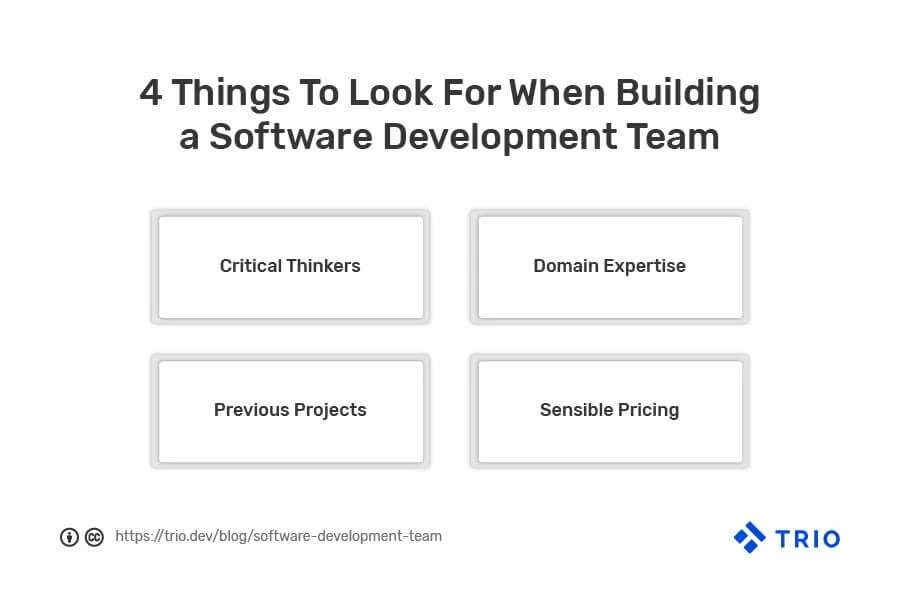
1. Critical Thinkers
Ideally, you want to select a software development team that is able to provide you with the best solution and the optimal way to reach it.
Sometimes this means your team disagrees with your initial ideas. But saying ‘no’ can be more powerful than agreeing to everything. A strong team challenges vague goals and offers multiple ways forward instead of a single prepackaged answer.
2. Domain Expertise
Every software development project is a complex process that involves more than just writing code. Your software development team should be able to simultaneously meet business needs while keeping the final user in mind.
Look for developers and technical leads with experience in your specific industry or product type.
For instance, healthcare or fintech software requires strict compliance awareness, while consumer apps depend heavily on UX insight and scalability.
A team with domain expertise will anticipate risks, design more efficient solutions, and communicate in your business language. A fintech team that has shipped regulated products already knows what an auditor will ask, how to handle cardholder data, and where the security review will slow you down, which saves months of avoidable rework.
This is exactly the kind of domain-matched team Trio specializes in placing.
3. Previous Projects
Prior projects that potential team members have executed are an indicator of the quality of their work. You can see what kind of clients they worked with and how they managed to meet the project requirements to solve the given problem.
Don’t forget to check references and portfolios where you can.
4. Sensible Pricing
Cheap work simply means low quality.
Poor communication, lack of experience, poorly written code, lack of tests, and bad documentation describe some of the problems you could experience if you simply fall for the lowest price.
Custom software development projects are more expensive than off-the-shelf software solutions, but the benefits they create are worth the price tag.
10 Steps for Building and Managing a Successful Software Development Team
Running a successful software development team requires taking an active part in any and all efforts that are imperative to building and managing that success.
1. Take Control of the Hiring Process
If you take ownership of the hiring process, you can ensure that you target the right candidates to apply for the role.
Below are some recommended sub-steps that streamline the initial stages of building a software development team.
Define the job, not the skills for the job. By describing the job as a series of performance objectives rather than a list of requirements, you avoid generic postings that alienate passive candidates.
Start the post by adding a compelling tagline to your title that captures the ideal candidate’s professional interests.
If the given candidate is interested, have them submit a two-paragraph write-up delineating what they have accomplished in terms of past project work and experience.
This method will narrow down your applicants to those who are genuinely qualified.
2. Hire People Who Are Passionate About Their Work
Find developers who code their own personal projects and have passion projects just for fun!
Some findings show that developer autonomy and low friction correlate with higher performance and retention.
3. Evaluate and Cultivate Soft Skills
Believe it or not, it is usually soft skills rather than technical skills that define the success of your software development team. Cross-functional project-oriented teams have grown more important for businesses that want to distinguish themselves and stay competitive, especially in the technology sector.
Recruiters often look for candidates who are suited for collaborative teamwork. They also want people who aren’t afraid to introduce a second opinion or shake up project teams.
Prioritize social skills and communication. It’s easy to place too much focus on technical output at the cost of team-building and communication when managing a software development team.
Establish a clear priority for your team that empathy and emotional intelligence are just as essential as delivering high-quality work. To do this, you should:
- Create opportunities for peer learning and teaching
- Recognize distinct personality types amongst the team, and learn to work with their strengths and weaknesses
- Make time for conversation!
4. Provide Tools and a Good Work Environment for Your Team
Cross-functional and collaborative work on a development team could lead to rampant burnout and high amounts of stress.
Extend tools and resources to your team, whether that be the technology to help them grow further and faster without frustration or mental health references.
5. Listen Actively and Communicate Proactively
Communication goes both ways. As a business manager, it’s essential that you actively listen to your software development team to understand the ongoing status of the project.
Ask questions such as:
- What did you work on?
- Did it come together as you expected? Why or why not?
- What can be improved?
In addition, communicate proactively and check in on individuals and teams without being asked. By establishing genuine interest in each person and division of the team, you’ll establish meaningful relationships.
6. Make an Effort To Improve Team Communication
Sometimes communication isn’t as easy as just asking a couple of questions. When that’s the case, there are still several steps you can take.
- Define roles and goals from the beginning: During kick-off, you must discuss what the various roles will be and their expectations. There should be an escalation overview that highlights how to identify and resolve problems when they arise.
- Encourage questions: Encourage the team to ask questions. Never dismiss a question or make someone feel inadequate for asking. Questions lead to important clarifications, discoveries, and, many times, process improvements that the team wouldn’t have recognized before.
- Make mistakes: For people who haven’t gotten their feet wet in agile before, mistakes are inevitable and are a core part of the learning process. Mistakes should be encouraged and openly discussed, especially at the beginning of a project.
- Host retrospective meetings: Via roundtable meetings, the team can focus on what went well and what can be improved.
- Give feedback: A transparent model of feedback with the team places everyone on the same playing field for further improvement.
7. Avoid Burnout
Don’t force teams to produce results beyond their capacity. And don’t dump multiple projects on your team to juggle all at once.
This will inevitably lead to burnout, especially if you’re taking on a single long-term product/project.
As mentioned, it’s important to provide resources to your team and prioritize their mental health just as much as their technical abilities. A happy developer is a good developer.
8. Don’t Add Extra Manpower for a Quick Fix
Do not add extraneous development team members in an attempt to speed up the development process.
According to Brooks’s Law, adding extra people will counterintuitively delay the project by dividing work into too many small parts. If you deem it necessary to add more team members, gradually recruit more individuals one or two at a time and evaluate results accordingly.
9. Create Software That People Love and Enjoy
Regardless of the technical and business requirements, if users love your software, team members will have that extra motivation to keep improving it.
10. Consider Hiring Remotely
Although many traditional employers would taunt the idea of transitioning to remote work, remote outsourcing has key advantages, including:
- Heightened productivity
- Businesses save money in the process
- Workers avoid the stress of commuting
- Employees save money
- Access to global talent
- Reduced employee turnover
Conclusion
With the ever-modernizing demands of software and product development, building the right software development team has never been more important.
Using the steps above with a carefully hired software development team of technical professionals, you can accelerate your projects and maximize productivity in the process.
Trio is your software development partner.
We offer small and medium companies competent software developers on demand.
Trio offers unparalleled software expertise and access to South American developers. Meet our elite Argentinean developers, Chilean developers, and Brazilian developers for outsourcing excellence, with production experience in regulated markets like fintech.
If you are looking to expand your fintech software development team, we can help.