

Hire by Technology
SERVICES



React developers are software professionals who use the React JavaScript library to build user interfaces.
Since React sits on top of JavaScript, every React developer is also, by extension, a front-end developer and a JavaScript developer.
In fintech, React tends to power the client-facing layer, like the dashboard where users monitor their account balances, the onboarding flow that walks a new customer through KYC verification, and the transaction history view that surfaces payment data in real time.
Even though back-end compliance infrastructure, payment rails, ledgers, and other highly regulated features are run elsewhere, the interface through which a user trusts your product with their money is React's territory, and it needs to be built well.
Hiring the wrong person, or misunderstanding the skills needed by a React developer, can lead to mistakes that may prove to affect your reputation and long-term success.
Let’s take a detailed look at what React developers do, the skills required in a fintech context specifically, what you can expect to pay, and how to hire effectively.
At Trio, we pre-vet React developers with production experience in fintech applications, so we can provide placements in as little as 3–5 days.
React is an open-source JavaScript library for building user interfaces and UI components.
Facebook (now META) developed it and released the first version in 2013, and continues to maintain it alongside a large developer community.
The most common misconception about React is that it is a framework. This is often how it shows up in comparisons and statistics, but the reality is that it is not.
A framework provides a full application structure, like routing, state management, and even server communication.
React just handles the view layer, building the components that users see and interact with. The library also manages how those components update when data changes. Everything else requires additional libraries.
In practice, this is why the React ecosystem looks so dense from the outside.
React itself is lean, so it requires surrounding tooling (Next.js, Redux, React Query, React Router, Tailwind) to fill the gaps.
One of the biggest appeals of React components is that they combine JavaScript logic with JSX, a syntax extension that lets developers write HTML-like markup directly in JavaScript.
By doing this, components can range from a single button to an entire page section, and they compose into larger interfaces the way building blocks combine into structures.
The day-to-day work of a React developer covers the full lifecycle of the front-end. That means it includes everything from translating a designer's wireframes into working code to optimising how the interface performs under real-world conditions.
Here are some primary tasks they may encounter:
There are several skills that a React developer needs in the fintech industry to be able to create applications that satisfy both user experiences and regulatory requirements.
JavaScript: React sits on JavaScript, and advanced JS features like closures, event loops, prototype chains, async/await patterns, and ES2015+ class syntax surface constantly in React development. JavaScript fundamentals are required for fintech products with complex state and real-time data requirements.
HTML and JSX: React developers work with JSX rather than raw HTML, but they need to understand the HTML semantics that JSX compiles to. Semantic HTML matters in fintech for accessibility reasons (WCAG compliance).
CSS and styling: React developers implement visual designs using CSS, often through libraries like Tailwind CSS, styled-components, or CSS modules. In fintech, brand trust is communicated partly through visual consistency.
State management: Managing application state is one of the more demanding aspects of React development in fintech. A dashboard that displays real-time account balances, pending transactions, and session state simultaneously needs organized, predictable state management. Redux is our developers’ preferred state management library for larger codebases. React Query and Zustand are also popular.
TypeScript: TypeScript catches type errors at compile time that JavaScript would only surface at runtime. In financial interfaces, a type error that mishandles an amount, a currency string, or an account status has regulatory consequences.
React-specific tooling: React Hooks (useState, useEffect, useCallback, useMemo, useContext) are the day-to-day building blocks of modern React development. React Router handles client-side navigation, while Next.js adds server-side rendering and static generation.
Version control: Git fluency is a baseline expectation. In fintech codebases with compliance audit requirements, clean, documented commit history occasionally matters for more than just engineering hygiene.
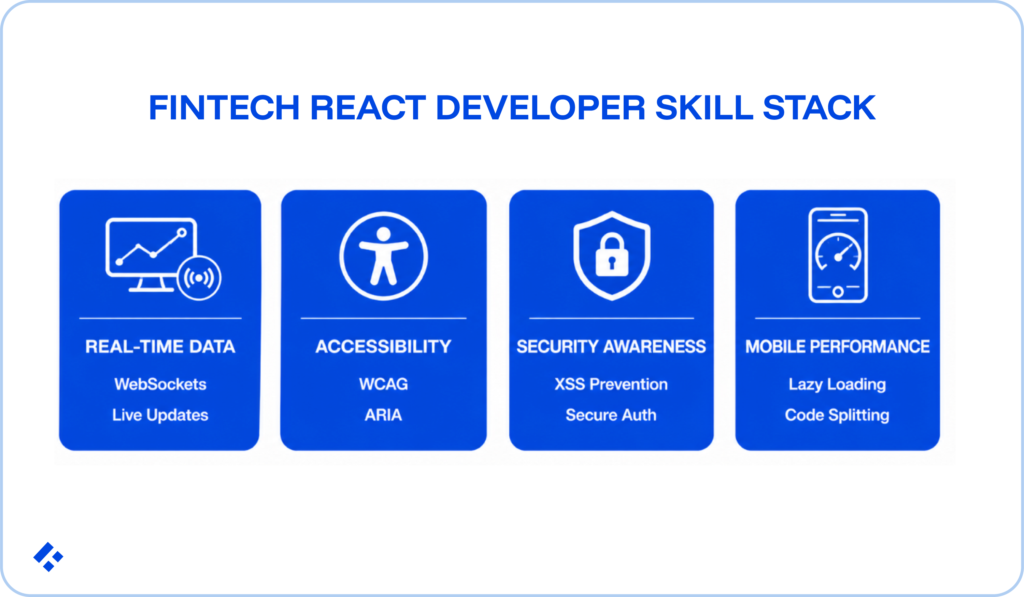
While many of the above skills are important for any web application, there are several that are fintech-specific.
Real-time data handling: Fintech interfaces frequently update in real time. React developers who understand WebSocket connections, optimistic UI updates, and how to handle data synchronisation gracefully in the UI layer bring immediate value.
Accessibility: Financial products serve broad user populations, including users who rely on screen readers, keyboard navigation, and high-contrast display modes. An understanding of ARIA attributes, focus management, and semantic HTML produces more accessible interfaces.
Security awareness at the UI layer: React developers in fintech should understand why certain patterns are risky, such as storing sensitive data in localStorage (accessible to any JavaScript on the page), rendering financial data in ways that are vulnerable to XSS, or building authentication flows that don't protect against common front-end attacks.
Performance on constrained devices: Code splitting, lazy loading, bundle size awareness, and image optimisation are all performance tools that matter more in fintech's mobile-first global user base than in many general web products.
Based on May 2026 Glassdoor data, the average annual salary for a senior React developer in the US runs approximately $141,000 per year. With top earners reaching more than $180,000.
| Seniority | Average Annual (US) | Approximate Hourly |
| Junior | ~$89,000 | ~$43/hr |
| Mid-level | ~$112,000 | ~$54/hr |
| Senior | ~$141,000 | ~$62/hr |
| Senior (top 10%) | ~$167,500–$180,000 | ~$80–$88/hr |
Developers in major tech hubs like San Francisco and New York tend to earn a lot more than the average because of the higher cost of living in these areas and the increased competition between companies.
Fintech developers earn about 10-15% more than developers with similar skillsets in other industries. This can be attributed to the time and effort it takes to build these fintech-specific skills, the rarity of these developers, and the value that they provide.
Hiring senior React developers with fintech expertise who are based in Latin America averages around 40%-60% lower than the same people in the US.
At Trio's hourly rates of $40–$80/hr, a senior React developer costs roughly $83,000–$166,000 per year in fully loaded engagement costs, depending on hours and seniority.
You also have the additional cost savings that would typically be incurred in the hiring process.
React is one of the most commonly used JavaScript web frameworks worldwide.
Major companies like Amazon, IBM, McDonald's, Deloitte, and Accenture have all reported using the library in some way. We have also seen large financial services companies using React to build their web services.
We expect any growth in neobanks and embedded finance to proportionally increase the demand for React developers, especially as more financial products now live primarily or entirely in the browser and on mobile.
The mistake most of our clients make before turning to Trio is assessing React ability without assessing fintech domain judgment.
A developer can score well on a standard React interview and still produce interfaces that mishandle sensitive data, fail on mobile, or break under real-time data load.
In order to ensure your success, it is important to follow a structured approach.
This process can take several weeks, and you need to have the technical ability in-house to be able to assess developers thoroughly.
Working with Trio eliminates the domain assessment problem. Our React developers are pre-vetted for fintech production experience alongside React ability, and can be placed in your team in 3–5 days at $40–$80/hr.