

Hire by Technology
SERVICES



Looking for tech talent? Brazil is becoming more and more popular for American companies seeking senior developers who are not only skilled technically but also incredibly affordable.
At Trio, we have a host of thoroughly vetted Brazilian developers on hand.
Our focus is on fintech software development. By providing skilled financial technology developers with opportunities to work on international projects, we've been able to retain some of the top talent, which you can make use of through staff augmentation or outsourcing.
But this only works because Brazilian developers have a unique skillset that makes them ideal for these kinds of heavily regulated products.
Let's go over some of the top reasons you'll want to hire Brazilian software developers for your fintech project.
To hire talent from Latin America through Trio, request regional talent.
Brazil has plenty of tech professionals, and produces more than 200,000 STEM graduates every year, giving you a wide, continuously replenished talent pool to draw from.
BRASSCOM, Brazil's IT industry association, puts the country's active developer population above 500,000. This would make it one of the largest concentrations of software talent anywhere in Latin America, and second only to the US across the whole Western Hemisphere.
That scale matters a great deal because it means a specific, narrow skill is more likely to exist there.
Think about finding a senior payments engineer with regulated-industry experience. Looking for them amongst a larger group is more likely to turn one up, rather than requiring you to compromise on seniority or domain fit just to fill a seat.
Of course, the skill set is not evenly distributed. Java, Python, JavaScript, and TypeScript are particular strengths. Fortunately, this lines up well with the stacks most fintech products are built on.
There are a couple of reasons for this particular fintech-suitability.
Brazil's own fintech sector has produced globally recognized engineering teams at companies like Nubank and PicPay. Developers who have worked here have the required experience and are used to the high standards that the industry demands.
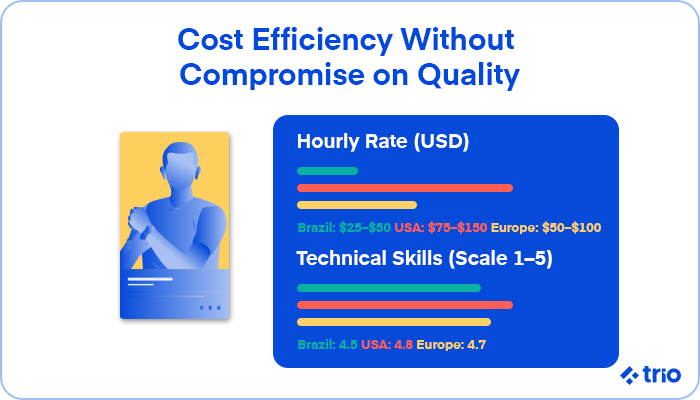
Cost-effectiveness here means the developers often offer the same high-quality work as their US or European counterparts, but at significantly lower rates.
In other words, you get more value for your investment.
In our experience, companies that hire Brazilian developers typically save 40-50% compared to equivalent US or European hires, but the exact number varies based on what you need.
At Trio, for example, our senior fintech specialists range from $40 to $90 per hour.
There's also a structural advantage that you get when hiring from Brazil specifically, because the Brazilian government supports nearshore IT partnerships through a tax incentive program called the Lei do Bem, which offers exemptions on technology services.
However, having said all of that, it’s still important to know that Brazil isn’t the cheapest option in LATAM. Many other markets can run lower on pure rate.
What Brazil offers instead is the combination of talent depth, timezone overlap, and market maturity together. Often, this is more cost-effective.
Brazilian developers are culturally compatible with North American and European businesses.
Since many of the developers you will be working with likely have experience with international remote work, they also tend to bring strong soft skills to international teams, like clear communication and a genuine problem-solving mindset.
In recent years, English proficiency has also become a much smaller risk factor than it once was.
Brazil operates on UTC-3 (Brasília Time), putting most developers within one to three hours of US Eastern time.
The result is that these developers end up sharing four or more working hours with US East Coast teams on a typical day. Standups can happen live, code review turns around the same day, and developers stay present in standups, planning, and reviews.
When it comes to fintech, all of this is critical because regulations tend to be on a strict timeline, and issues need to be dealt with promptly for you to stay compliant.
Thanks to the existing market, Brazilian engineers with fintech experience tend to have real production exposure to payments, lending, banking, insurtech, and wealthtech platforms.
That domain grounding can be a great asset, since the failure modes in payments and compliance code are genuinely different from a typical consumer app.
You want someone who has already made those mistakes elsewhere, not someone making them on your project.
Three real paths exist when hiring a developer in Brazil:
Each one of these shifts risk differently.
An EOR buys speed and compliance certainty for a steady fee, and it's usually the right call for a first hire or a team that isn't yet certain it's staying long-term.
A subsidiary, on the other hand, lowers the long-term cost per hire once you're at real scale, but adds ongoing tax, audit, and payroll complexity.
Whichever path you take, it’s important that you ask directly who legally employs the developer and what happens to that relationship if the engagement structure ever changes.
Overall, Brazilian software developers offer an incredible combination of technical skill, affordability, English proficiency, and even cultural compatibility, making them a smart choice for a variety of businesses.
Whether you're building an MVP from scratch or scaling your team, Brazilian developers might be a strategic move to help you reach your goals.
To find the right people for your project, talk to us.