
API Development for Fintech Apps

Listen to this content

Contents
Share this article

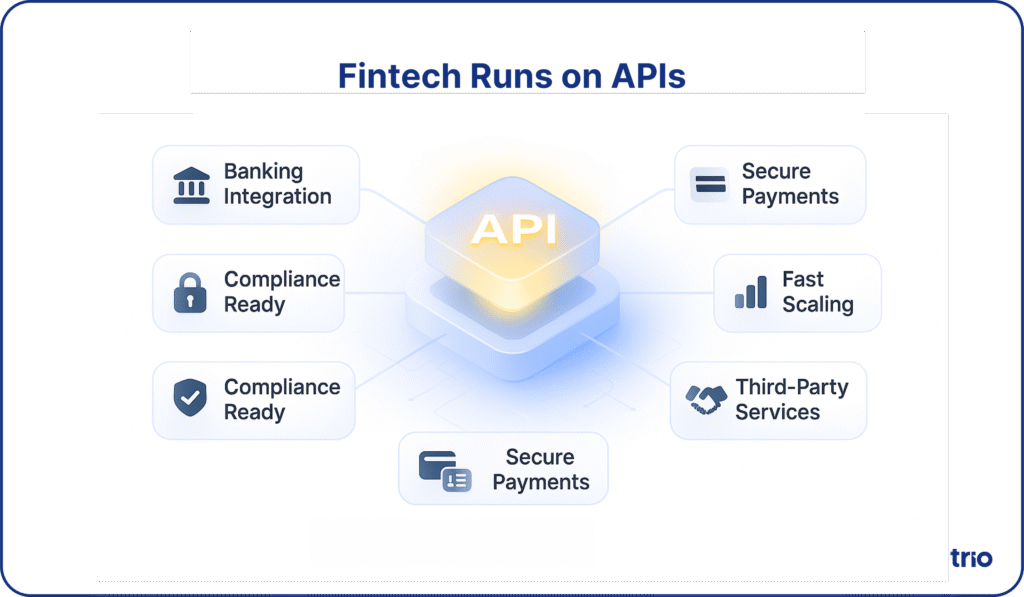
A big reason why fintech has been advancing so quickly is the use of APIs (Application Programming Interfaces). API development for fintech apps has allowed companies to integrate with banking and regulatory frameworks, existing payment infrastructure, and even third-party services.

If you use APIs in your app, you can utilize all of these fintech solutions and even collaborate with large financial institutions to help API development for fintech apps allows companies to integrate with banking and regulatory frameworks, existing payment infrastructure, and even third-party services. If you use APIs in your app, you can utilize all of these fintech solutions and even collaborate with large financial institutions to help you scale rapidly.

In this article, we’ll take a look at everything you need to know about APIs in fintech app development so that you can take advantage of all the financial service integrations they offer. We will also go into some examples of how APIs have become a critical part of many fintech companies, so you can better understand how your competitors are taking advantage of these tools.

If you are interested in API development for your fintech, you are in the right place. At Trio, we specialize in fintech development.

View capabilities.

Key Takeaways

  • Developer experience (DX) affects your own team, too. Sandbox environments and clear documentation reduce integration errors and shorten onboarding time for new engineers and external partners alike.
  • APIs cut development time dramatically. When you can integrate a trustworthy third-party API for payments, KYC, open banking, insurance, or anything else, you get those services instantly, without needing to code from scratch.
  • Choosing the right API type for your use case matters a lot. The wrong choice takes time and money to fix, and can lead to a loss of customers.
  • Security cannot be bolted on afterward. OAuth2, JWT, TLS 1.3, and rate limiting should be the baseline of API handling financial data. Regulators may ask for documentation.
  • Third-party vs. build-your-own is a difficult decision. Third-party APIs win on speed for most early-stage teams. If you have very specific requirements then a proprietary API may start to make competitive sense.
api 16

What Are Fintech APIs?

APIs are a set of rules that let software connect seamlessly.

Traditional fintech software development used to be heavily focused on building monolithic architecture. This means they would have had to integrate directly and individually with banking and financial services systems. As you can imagine, this was a slow process, with a large propensity for error, and very high upkeep costs.

On the other hand, modern financial APIs are modular and lightweight. These modern APIs let your developers integrate with existing services far faster. Think of it like a standardized connection point that lets sensitive financial data and other information flow seamlessly between software.

Since these financial APIs have become almost standardized, you not only cut down on development costs, but also increase overall development speed.

Related Reading: Guide to Small Business App Development

api 17

Common API Types in Fintech (Open BankinCommon API Types in Fintech

You could, in theory, develop an endless number of financial APIs. This means that development teams need to stay up to date with industry trends so they know what software is available and what market opportunities might be available, specifically in the fintech industry.

Here are some of the most common types of fintech APIs being used at the moment, but it is by no means an exhaustive list:

  • Open Banking APIs: Allow financial information to be shared between institutions and third-party apps. Plaid’s Core Exchange, for example, connects apps to thousands of financial institutions through a single integration rather than requiring individual bank-by-bank connections.
  • Payment APIs: Enable transaction services through existing payment gateways.
  • KYC/AML APIs: Automate security, such as onboarding and identity verification.
  • Investment APIs: Power practical trading and automated investment advice.
  • RegTech APIs: Manage regulatory compliance, reporting, and audit trail management.

A lot of fintech products end up using APIs from more than one category.

For example, a lending app might need KYC for onboarding and a payment API for disbursements. This is why planning and preparing to scale your fintech ahead of time is critical. Without some forethought, you may need expensive reworks later on.

Related Reading: API-First Banking and Automating Processes

Top Fintech API Use Cases

There are many ways companies use the power of APIs in fintech, but a couple of examples stand out, such as the way non-financial companies can integrate financial services into their products, letting retailers, HR platforms, and marketplaces offer embedded payments without becoming regulated entities themselves.

APIs also facilitate secure international payments across multiple currencies with real-time conversion rates and compliance checks built in.

And for Web3 products, APIs allow users to interact with smart contracts and digital wallets without needing to understand the underlying infrastructure.

APIs also appear commonly in real-time market data access, whether for executing trades or just pulling pricing information.

However, one of our favorite ways of using APIs in fintech apps is to simplify onboarding and security measures, which is becoming more critical in fields like finance, healthcare, and even education.

In general, API marketplaces offer bundled packages that can be particularly useful if you are an early-stage company and do not have the resources to license each data source individually.

Real-World Examples of Fintech APIs

Now that you understand what APIs are and what the most common types are, let’s go over some real-world examples of financial APIs in action. Plaid, Stripe, Trulioo, and RazorpayX are some of the most popular examples. You’ve likely heard of many of them or seen them used in web and mobile apps.

Plaid lets payment apps like Venmo or personal finance apps like Robinhood link to banking services, giving them access to users’ bank accounts. Similarly, Stripe is used by SaaS or e-commerce platforms that take advantage of their payment infrastructure.

Stripe’s approach to developer experience has also set something of an industry standard: extensive documentation, SDKs for every major language, sandbox environments, and sample applications make it a reasonable reference point for what good API design looks like in practice.

RazorpayX is another financial API that lets non-fintech apps use embedded payments, while Trulioo is one of the most popular options for KYC and regulatory compliance.

How Fintech APIs Work

To ensure successful fintech API integration, it is important to understand how they work.

1. Request and Authentication Flows

Modern fintech APIs need to focus on security above all else. To do this, the first step is to ensure secure access through authentication.

API keys are seen quite often. They are simple and useful for private or internal APIs. If you are working with the public, OAuth2 is pretty standard too, since it lets users grant scoped access without handing over their credentials.

JWT (JSON Web Tokens) adds stateless, scalable authentication on top, which becomes valuable once your user base grows and you need to verify tokens without hitting a database on every request.

As the industry evolves, new threats emerge, and companies need to ensure they adapt their financial solutions. It is crucial to stay on top of the latest industry trends. Getting a fintech specialist developer on board to evaluate your financial services APIs can help you guarantee all parts of your app are secure, including your APIs.

2. Data Retrieval and Exchange Protocols

Once security has been confirmed, APIs will initiate data retrieval and exchange protocols.

REST is probably the most common and uses HTTP methods for CRUD operations. GraphQL and Webhooks also appear regularly in fintech API platforms: GraphQL for flexible data fetching where clients specify exactly what they need, and Webhooks for push-based updates like payment confirmations or fraud alerts.

An event-driven Webhook approach can significantly reduce unnecessary polling, which matters when you are paying per request or managing rate limits.

Some applications need more than one protocol.

A stock trading app might use REST for account management but require WebSockets for real-time price streaming. Planning for this kind of multi-protocol architecture early avoids painful refactoring down the line.

3. Security and Error Handling

It can be tempting to neglect aspects such as security and error handling, but the most robust APIs provide ways to handle both of these. We recommend that you only consider these APIs if you are a fintech startup or scale-up, as users place an incredible emphasis on security and consistency for platforms that handle their money and personal information.

So, how do fintech API providers ensure their products are suitable?

We’ve seen many use rate limiting and throttling to prevent their APIs from being misused. You should be familiar with how APIs also use structured error codes like 401 Unauthorized or 429 Too Many Requests, as these error codes often make an appearance in user interfaces.

To further guard against more nefarious threats like injection attacks, it’s pretty standard practice to include API security measures like input validation and sanitization.

As a general tool, most of the modern fintech APIs that we have mentioned above include all of these security and error-handling measures, but it is still important to double-check and ensure these features work correctly.

4. API Monitoring and Versioning

Most modern fintech APIs include some monitoring or versioning provision.

In terms of monitoring, you’ll need some knowledge of uptime, latency, and usage.

Tools like Postman and Datadog handle this well: Postman for testing and documentation, Datadog for production alerting and performance tracking.

Versioning keeps older integrations functional as you evolve your API. Teams that skip versioning early tend to face difficult migration conversations with partners or customers when breaking changes become necessary.

Even a simple version prefix in your URL path (v1/, v2/) provides the flexibility to make those changes without forcing immediate upgrades on everyone downstream.

Benefits of APIs in Fintech Development

We’ve already touched on some of these benefits, but it’s important to ensure you fully understand the business potential of fintech APIs so you can decide if it is worthwhile for you to consider building an API or using an existing one in your apps.

  • Faster time-to-market: You don’t need to build every function from scratch every time, and can integrate the relevant services in days instead of months. For seed-stage fintech companies where runway matters, this compression in development time can mean the difference between shipping before a competitor or after.
  • Better user experiences and customization: Features like instant transfers, real-time balance updates, transaction alerts, and personalization now represent table stakes rather than differentiators. APIs enable all of them.
  • Lower development and integration costs: Especially when using third-party APIs, you reduce overhead by avoiding the maintenance burden of infrastructure someone else has already built and proven. The trade-off is vendor dependency, which deserves thought before committing to a core provider.
  • Increased security and compliance automation: Most renowned third-party APIs are compliance-ready, with features like data security, authentication, logging, etc. This matters especially for teams without dedicated security engineers.
  • Platform interoperability and scalability: Microservices architecture, when powered by APIs, can scale modularly. Financial API integration is also efficient on various platforms and ecosystems.
  • Expandable ecosystem for Banking-as-a-Service (BaaS): For companies building on top of banking infrastructure, APIs make it possible to package and market financial services to other businesses, opening a monetization path that would otherwise require significant regulatory overhead.

Key Principles of Building Fintech APIs

What if you decide there are APIs out there that provide exactly what you are looking for, or maybe you want to play a role in creating the latest APIs for fintech companies? In those cases, you can delve into the world of building the best fintech APIs on your own.

Define a Long-Term API Strategy

Before you even start the development process, you need to make sure that you know who you are developing for. If you are developing the API for yourself, then you just need to cover your own needs. But you may want to make it available to others as well.

You can break possible long-term strategies into three options: internal, partner, and public.

Internal tools serve your own modularity and development velocity.

Partner APIs drive growth within a specific ecosystem, which is useful if you have key relationships with banks, payment processors, or data providers.

Public APIs enable any developer to adopt the API in many fintech applications, but require sustained investment in documentation, SDKs, and support. The choice between these three shapes almost every design decision that follows.

Prioritize Developer Experience (DX)

Unlike many other aspects of app creation, where you want developers to build with the users in mind, in the case of APIs, you need to consider developer experience.

You want to make it as easy as possible for developers to integrate your API into their app or to make adjustments and find issues if required. Create clear documentation and SDKs. If you are taking a partner or public approach, consider creating sandbox environments where developers can experiment, and make sure you have responsive support.

Even for internal APIs, investing in DX pays off in reduced onboarding time for new engineers and fewer integration bugs.

Choose the Right Protocols and Standards

A protocol determines how data is exchanged between systems. Picking the right one for your API matters for compatibility with the software ecosystem around you.

OpenAPI works well when compatibility across tools and languages matters; it has a broad ecosystem support and makes documentation generation straightforward.

gRPC suits high-performance, low-latency scenarios, typically internal microservices communication, where binary serialization pays off.

Picking a protocol for the wrong reason, whether familiarity or trend-following, tends to create pain later when your actual performance or compatibility needs diverge from what the protocol was designed for.

Implement Strong Authentication and Rate Limiting

We’ve already mentioned protection mechanisms like OAuth2, JWT, and fine-grained scope controls that you need to look for when looking for an external API. Don’t forget to build them into your own.

Rate limiting protects your infrastructure and demonstrates to potential partners that your API handles load predictably, which matters in due diligence conversations when you are trying to close a partnership deal.

Advertising these steps for security can also be beneficial if you decide to partner with others or take your API public, as it demonstrates compliance and attention to detail. In fintech, that kind of credibility takes time to build and relatively little time to lose.

Related Reading: DevSecOps in Fintech

Designing Secure and Compliant Fintech APIs

Security, we cannot emphasize enough, takes priority when you are providing access to financial services or playing some role in the functioning of financial institutions and fintech apps. Here is what that looks like in practice:

  1. API Security Testing and Monitoring Tools: You always need to test and monitor with tools like OWASP API security or others, and keep track of these tests for potential audits.
  2. Sensitive Data Protection and Encryption: Make sure that you use TLS 1.3 for data transfer security and field-level encryption at other times. Also, avoid storing important information unless you absolutely have to.
  3. Strong Customer Authentication (SCA): Two-factor and biometric authentication have become industry standards and user expectations at this point.
  4. Token Lifecycle and Secrets Management: You need to rotate your API tokens and use secure vaults like AWS Secrets Manager for credential storage.
  5. GDPR, PSD2, and Other Regulatory Considerations: Consent, minimal data storage, and logging are all required to various degrees globally, so make sure you are compliant with regional regulations.

Common Challenges of Implementing Fintech API Development

While hiring experienced developers from a company like Trio can mitigate most issues, knowing where most people tend to go wrong can also help you avoid some of the most common mistakes, regardless of the type of API you are creating.

Some obvious challenges we’ve already alluded to include things like data privacy and regulations, which you need to research before you start developing.

If you are working with banks or similar institutions with outdated legacy systems, you may also struggle with API integration and may have to use some sort of middleware. This is usually worthwhile if these institutions are larger, but you need experience to deal with these issues quickly and efficiently.

You’ll likely be using your APIs across different ecosystems and devices. Be prepared to standardize your error formats, response structures, and anything else that may have some sort of visual response that could be affected by factors like screen size.

api 18

How to Unlock the Full Potential of Fintech APIs

If you are reckless with APIs, you may end up paying for a bunch of features you don’t use or that don’t work adequately for your financial apps. So, how can you unlock the full potential of your APIs?

First, make sure that they align with your business goals, whether that’s onboarding, user experience, providing you with a new form of monetization, or anything else. Once you find the right API or decide to build it yourself, you then need to consider a scalable, modular microservices architecture so you don’t limit yourself now or later.

To ensure your team is happy with the addition, make sure to encourage collaboration. This will also assist them in learning new skills if required. If you are sharing your API externally, include clear onboarding steps for developers, and perhaps offer a variety of pricing options, like usage-based options and subscriptions with a limited free option.

Finally, don’t forget to measure performance so you can make adjustments as you need to and keep your API relevant.

Conclusion

API development for fintech apps can be a game-changer, but only if you do it right.

In many cases, you may benefit from leveraging fintech APIs that already exist. As your company grows and requirements become more specific, building your own API may start to make sense from a scalability and differentiation standpoint.

If you think an API is the right choice for your fintech project, you are in the right place.

Trio’s experienced fintech developers can help you integrate an existing API or build one of your own that works for your scale, security requirements, and compliance obligations.

For more information or to get started, request a consult.

Frequently Asked Questions

What is API development for fintech apps?

API development for fintech apps refers to building or integrating application programming interfaces that connect financial applications to payment processors, banks, identity verification services, and other infrastructure.

What are the most common types of fintech APIs?

The most widely used categories include Open Banking APIs for data sharing between institutions, Payment APIs for transaction processing, KYC/AML APIs for identity and compliance, Investment APIs for trading and portfolio features, and RegTech APIs for regulatory reporting. Most fintech products end up needing more than one.

How do fintech APIs handle security?

Security in fintech APIs typically combines OAuth2 or JWT for authentication, TLS 1.3 for data in transit, field-level encryption for sensitive stored data, rate limiting to prevent abuse, and input validation against injection attacks.

Should I build my own fintech API or use a third-party one?

For most early-stage teams, third-party APIs offer faster time-to-market and lower maintenance overhead than building from scratch. Building a proprietary API starts making sense when you grow enough that you start having very unique needs that cannot be met by existing APIs.

What is the difference between a partner API and an open API in fintech?

The biggest difference between a partner API and an open API in fintech is that a partner API connects one financial institution directly to one app or service, often built for the customers of a single institution rather than the general public, while an open API connects many institutions to many apps through a shared data network, which means a fintech app only needs to integrate once to reach a broad range of bank connections rather than building each one individually.

Unlock the Secrets to Hiring Top Talent

Don’t Miss This Opportunity! Streamline your hiring process with Trio’s comprehensive guide.

Share this article
With over 10 years of experience in software outsourcing, Alex has assisted in building high-performance teams before co-founding Trio with his partner Daniel. Today he enjoys helping people hire the best software developers from Latin America and writing great content on how to do that!
A collage featuring a man using binoculars, a map pin with a man's portrait in the center, and the Brazilian flag fluttering in the wind against a blue background with coding script overlaid.

Brazil's Best in US Tech: Elevate Projects with Elite Developers

Harness the Vibrant Talent of Brazilian Developers: Elevate Your Projects with Trio’s Elite Tech Teams, Pioneering Innovation and Trusted for Global Success

Master Outsourcing and Hiring Developers

Download our free ebook to access expert advice on outsourcing and hiring top-tier software developers. Equip yourself with the knowledge to make informed decisions and drive your projects to success.