
Hire by Technology
SERVICES


With almost 77% of consumers now managing their accounts through an app, banking is becoming increasingly digital.
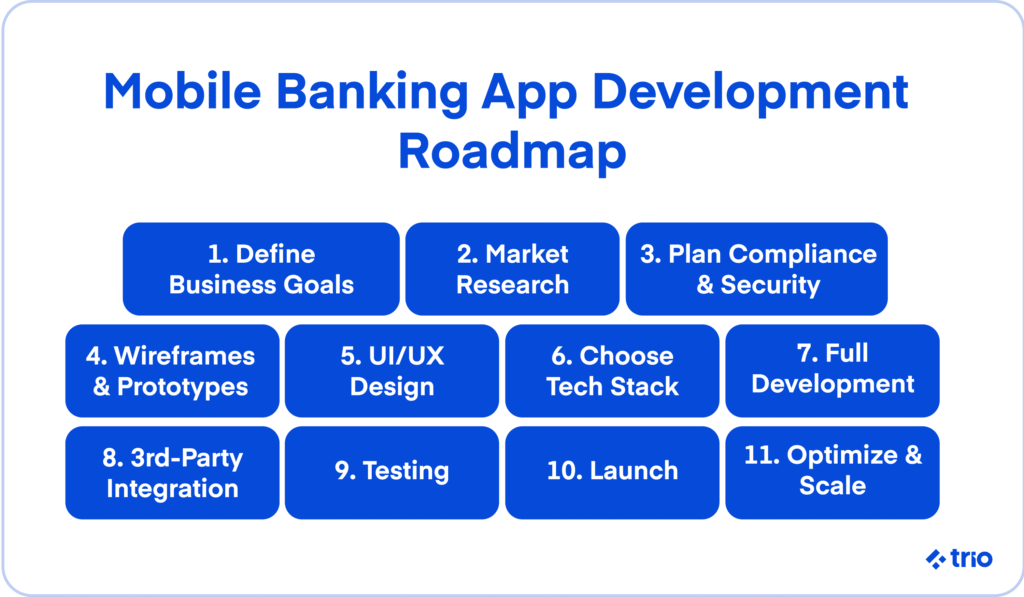
If you're in fintech, having a good understanding of the mobile banking app development process is essential, both to understand how to approach your own build and to react to shifting trends in online banking as they happen.
Let’s go over the entire mobile banking app development process and everything you need to know to create your own.
At Trio, we have expert fintech developers with production experience in mobile banking who can help bring your product to life.
Let’s start by looking at what mobile banking solutions actually involve and the steps you'll take through the product development process.
As the name suggests, mobile banking app development means designing and building a secure application that lets users manage their finances from a smartphone, checking balances, transferring funds, paying bills, and a lot more.
The industry is very unique and requires specialized expertise well beyond typical mobile development.
These developers need to understand things like financial security standards, regulatory compliance, real-time payment APIs, and backend infrastructure built to handle transaction volume without silent failures.
Developers who've worked on similar projects before bring proven experience, which helps you guarantee that they have the right skill set.
Through staff augmentation specifically, they integrate into your existing team. This means that you pay for that expertise only when you actually need it, rather than committing to long-term employment for capacity you won't always use.
Before development starts, you need to research the latest market trends, how client expectations are shifting, and how people actually use mobile banking apps in your specific target regions.
Almost 77% of consumers now manage their accounts primarily through an app, and the global base of online banking users is projected to exceed 4.2 billion.
With this increase in use, client expectations are also increasing.
Real-time payments, biometric login, AI-driven insights, and embedded finance are increasingly the baseline users expect rather than differentiators.
We’ve also seen things like gamified savings or investing features picking up real traction, and it looks like there is a growing interest in alternative currencies, which means digital wallets that can handle crypto and stablecoins are worth planning for.
A mobile banking app typically layers several distinct components:
Mobile specifically often benefits from a Backend-for-Frontend (BFF) service.
Mobile has constraints web banking doesn't share, because your client runs on a device the bank doesn't control.
This means that the network connection can drop mid-session, and the app competes with everything else on the phone for battery and memory.
A BFF aggregates backend data for each specific screen, reducing the number of separate API calls that your app has to make and giving each platform (iOS, Android) a response shaped for exactly what that screen needs.
In 2026, you also need to be thinking about things like API-first design. This is quickly becoming a non-negotiable as open-banking becomes more popular.
Every capability is designed as a versioned API before any UI gets built on top of it.
Event-driven communication then needs ot be the standard between services for loose coupling and genuine real-time reactions.
Finally, developers need to implement best practices like domain-bounded services, each owning its own data and drawn around business domains rather than technical layers, and stateless channel services, so no session state lives in any one instance and any instance can serve any request.
All of this can be incredibly complex and overwhelming to developers who have no industry experience, and the learning curve is both extensive and time-consuming.
Most people aren’t releasing a full banking app with all the possible features in one go. Instead, they are releasing a minimum viable product and validating their services before continuing.
A realistic MVP scope commonly includes:
A banking core is absolutely essential. There are two ways you could go about it.
A Banking-as-a-Service (BaaS) model lets you offer accounts, cards, payments, and even lending without holding a banking license yourself.
If you decide to go this route, some of the most common providers include Stripe, Adyen, and Unit. These handle the underlying infrastructure, including a meaningful share of the PCI DSS burden, while you own the product layer on top.
In our experience, this is the best option if you are just starting out, since it gets a real product to market fastest.
The alternative, owning your own core banking system, requires a lot more development and maintenance on your end, but it's the right call once regulatory ownership, deep customization, or genuine independence from a BaaS provider's roadmap become priorities.
Native apps (Swift for iOS, Kotlin for Android) give the best access to the device capabilities banking specifically depends on. This is really the best way to take advantage of biometrics, hardware-backed key storage, push tokens, or NFC for contactless payments.
Progressive Web Apps and cross-platform frameworks reduce distribution overhead and can work well for less security-sensitive products, but they have more limited access to the hardware security. And, unfortunately, that’s what a real banking app needs to lean on.
Most banks that we have worked with tend to default to native apps for the primary experience, with a PWA reserved for lighter-weight flows like onboarding rather than the core banking experience itself.
You need to start thinking about compliance from the earliest architecture decisions.
Identify the full set of applicable regulations (PCI DSS, GDPR, PSD2, and KYC/AML) as early as possible, since these requirements directly determine encryption approach, data storage design, and which third-party integrations are even viable.
The cost consequence of getting the sequencing wrong can be as much as 3-5x more than designing for it from the start.
Support and operations tooling carries its own compliance weight too, since you need to be able to store real audit trails and allow genuine investigation of a specific transaction or account.
Some of the basics of mobile banking app security include:
In the event of major security events, the trigger has to originate from the core backend, not from the mobile client itself.
Triggering it client-side means a compromised app could simply suppress the alert a user was supposed to see.
Costs scale heavily with scope and compliance depth. Discovery and architecture alone commonly run from roughly $3,000-6,000 for a basic MVP up to $20,000-40,000 for an enterprise-scale build, and that's before any actual development work begins.
Backend development, covering core banking logic, the API layer, database design, and transaction processing, tends to consume the largest single share of the total budget.
The realistic overall build timeline runs anywhere from 6 to 18 months depending on complexity, compliance scope, and how much gets built versus integrated from a BaaS provider.
One of the best ways to mitigate your expenses is to consider alternative hiring models like outsourcing and staff augmentation.
These models allow you to hire an expert team without needing to worry about factors like overhead, healthcare, equipment, or any other costs associated with a permanent employee.
If you are interested in connecting with top fintech developers for your project through either of these hiring models, request a consult.