

Hire by Technology
SERVICES



Fintech DevOps costs $5K–$15K/month for an early-stage product and $15K–$40K/month at the growth stage (Series B).
To estimate your own DevOps cost, you need to consider several different factors:
A fintech startup's DevOps bill doesn't look like a general SaaS startup's DevOps bill because the compliance configuration requirements at each layer push costs substantially above what general DevOps benchmarks suggest.
Making estimations based on general experience, or failing to account for all the costs you will encounter, creates underestimations.
When you fail to plan correctly, you may not have the funds available to cover everything you need to, or you may have to explain the additional costs to investors.
Let's break down fintech DevOps costs by the categories mentioned above, with specific vendor pricing, the compliance cost premium at each layer, and total monthly budget ranges by company stage.
At Trio, we provide pre-vetted fintech developers with extensive production experience in financial applications.
These developers are able to advise based on your specific requirements, so you get the most accurate estimate possible and assistance making architectural decisions that will allow you to scale without costly reworks.
General DevOps cost benchmarks don't translate to fintech planning because four structural differences inflate costs at every layer before any tooling is selected.
Before PCI DSS 4.0, only the production cardholder data environment required PCI DSS controls.
Requirement 6.3.2 extended scope to any system that contributes to the software running in the CDE, including build servers, CI/CD pipelines, artifact registries, and container image registries.
This means that a fintech CI/CD pipeline now requires hardened runner environments, mandatory code review controls, signed artifact verification, SBOM generation, and change management audit trails.
SOC 2 Type II and PCI DSS both require 12-month log retention. Access to production systems must be monitored and logged in tamper-evident storage. Security events need to be captured in a SIEM.
Standard observability dashboards handle metrics and traces well, but compliance observability adds immutable log storage, access audit trails, and automated evidence collection pipelines that most general DevOps stacks don't include.
A general SaaS startup typically runs separate development and production environments.
Fintech needs this to be taken further, with development, staging, production, and a PCI DSS-isolated CDE separate. This means each environment will need AWS accounts or GCP projects with independent networking, IAM configurations, and audit controls.
Multi-region deployments for EU data residency then double the production environment cost again.
Environment variables and basic secrets managers are not enough for production fintech systems.
If you are dealing with anything like payment credentials, database encryption keys, or API signing keys for financial transactions, you are going to need hardware security module-backed key management, automated credential rotation, and access audit logging for every secret access event.
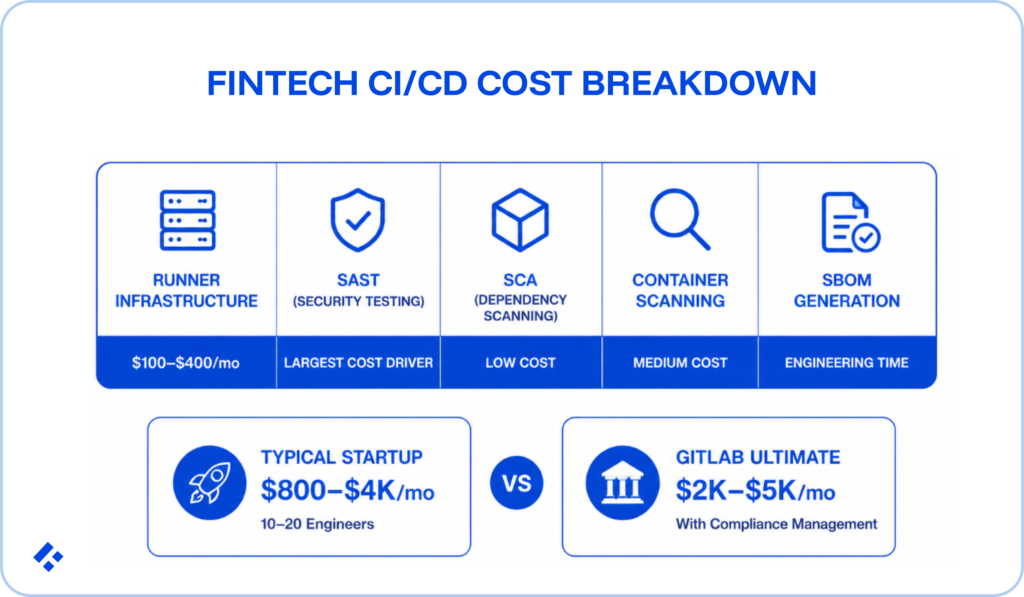
CI/CD covers the continuous integration and deployment pipeline. This includes code testing, building, security scanning, artifact management, and deployment automation.
| Platform | Base cost | Compute cost | PCI DSS suitability |
| GitHub Actions | $4/user/month (Teams) | $0.006/min Linux + $0.002/min platform fee (from March 2026), with 3,000 min/month free. | Suitable with self-hosted runners for CDE isolation. Shared runners may require hardening documentation. |
| GitLab Premium/Ultimate | $29/$99/user/month | Shared runners are included with the self-managed option. | Ultimate includes compliance management, audit trails, and SAST/DAST. This is preferred for PCI DSS compliance features. |
| CircleCI Performance | $15/month base + credits | $0.0006/credit (Linux medium, 10 credits/min) | Self-hosted runner option for CDE isolation. |
| Buildkite | $55/agent/month | Self-hosted runners (your infrastructure cost) | Strong PCI DSS story: pipeline runs on your own infrastructure, data never leaves your CDE |
| Jenkins | Open source (free) | Infrastructure only: $200–$500/month cloud | Full control. Highest compliance flexibility. Highest operational overhead. |
Fintech CI/CD cost drivers beyond the platform fee:
Typical monthly CI/CD cost for a fintech startup (10–20 engineers) ends up being around $800–$4,000/month, covering platform, SAST, and runner infrastructure.
For GitLab Ultimate with compliance management, the final costs will be closer to $2,000–$5,000/month.
Observability covers infrastructure monitoring, application performance monitoring (APM), log management, distributed tracing, and alerting.
It is probably the most variable cost category of all those in fintech DevOps.
Datadog, the de facto standard for production observability at growth-stage fintechs, charges per host and per log volume. These scale with product growth, which means they can be genuinely difficult to predict at planning time.
| Datadog product | Pro plan | Enterprise plan | Notes |
| Infrastructure monitoring | $15/host/month (annual) | $23/host/month | Per VM, Kubernetes node, or cloud instance |
| APM | $31/host/month (annual) | Custom | Distributed tracing across services |
| Log management | $0.10–$0.20/GB ingested | $0.20+/GB | Retention above 15 days adds cost |
| Synthetic monitoring | $5/10K test runs | n/a | API and browser uptime tests |
| Security monitoring (CSPM) | Add-on | Add-on | Required for SOC 2 evidence collection |
| Scale | Monthly estimate |
| Seed (5–10 hosts, basic monitoring) | $1,000–$3,000 |
| Series A (15–25 hosts, APM enabled) | $3,000–$8,000 |
| Series B (40–80 hosts, full stack) | $10,000–$30,000 |
Log management costs scale with ingestion volume, not host count.
Some fintechs can generate as much as 500GB–2TB/month of logs. At $0.10–$0.20/GB, that's $50,000–$400,000/year in log costs.
Structured logging with environment-controlled verbosity can minimise costs here: INFO in production, DEBUG only in staging. Compliance logs (immutable, append-only, required for PCI DSS audit trails) should be kept separate from application debug logs entirely.
SIEM, which is required for PCI DSS continuous monitoring, ranges from Splunk Enterprise ($65+/GB ingested) to Elastic SIEM ($16/month/host).
Other options include Sumo Logic ($5/GB indexed) and AWS Security Hub ($0.001/finding).
Typical fintech SIEM costs can be anywhere from $500 to $5,000/month depending on log volume and platform choice.
12-month log retention per PCI DSS requirement adds $0.023/GB/month in cold storage (S3/GCS/Azure Blob), which usually costs $200–$2,000/month for fintechs who need complete audit logs.
Financial SLO tracking (payment success rate, API availability ≥99.9%) is included in Datadog Synthetic, but standalone alternatives run $50–$500/month.
The open-source alternative stack (Prometheus + Grafana + Loki) runs approximately $300–$1,500/month in infrastructure costs with no licensing fees. That said, it requires 0.25–0.5 FTE of dedicated operational overhead, making it a good fit if you have strong internal DevOps capabilities.
Cloud infrastructure covers compute (EC2, GKE, AKS), managed databases (RDS, Cloud SQL), caching (ElastiCache, Redis), storage (S3, GCS), networking (VPC, load balancers, CDN), and managed container orchestration (ECS, EKS, GKE).
Unlike general SaaS, fintech infrastructure multiplies across four separate environments:
| Scale | Typical services | Monthly estimate |
| Seed (single AZ) | 4–8 EC2 t3.medium, RDS db.t3.medium, ALB | $1,500–$4,000 |
| Series A (multi-AZ, containerised) | ECS/EKS cluster, RDS Multi-AZ, ElastiCache, WAF | $5,000–$15,000 |
| Series B (multi-service, autoscaling) | EKS, RDS Multi-AZ + read replicas, ElastiCache cluster, CloudFront | $12,000–$35,000 |
| Scale (multi-region, compliance-grade) | Multi-region EKS, Aurora Global, data residency routing | $30,000–$100,000 |
Flexera's 2026 State of the Cloud Report found 29% of cloud spend going to idle resources and overprovisioned infrastructure.
In fintechs specifically, development environments running overnight, overprovisioned RDS instances, and idle Kubernetes nodes are consistent sources of preventable spend.
A structured FinOps practice, on the other hand, achieves 20–30% cost reduction, documented across multiple fintech deployments.
Secret management covers several things, including secure storage and rotation of API credentials, database passwords, encryption keys, and payment processing credentials.
Environment variables and basic secrets storage are not enough for production fintech systems.
Payment credentials, database encryption keys, and API signing keys all require HSM-backed key management, automated credential rotation, and access audit logging for every secret access event.
| Option | Cost | Fintech suitability |
| AWS Secrets Manager | $0.40/secret/month + $0.05/10K API calls | Good for AWS-native. Integrates with RDS auto-rotation, not full HSM. |
| AWS KMS | $1/key/month + $0.03/10K API calls | HSM-backed. Preferred for encryption key management. |
| HashiCorp Vault (self-managed) | Free (open source) + $500–$2,000/month infra | Full-featured, highest compliance flexibility, with meaningful operational overhead. |
| HashiCorp Vault (HCP managed) | $0.03–$0.45/secret/month | Managed version reduces operational overhead significantly. |
| GCP Secret Manager | $0.06/version/month + $0.03/10K access ops | Good for GCP-native stacks. |
Seed-stage fintechs can expect to pay around $300–$1,500/month for a combination of AWS Secrets Manager with KMS for encryption keys.
Growth-stage fintechs will look at values closer to $1,000–$4,000/month running HashiCorp Vault.
There are certain tools required specifically because fintech engineering operates in a regulated environment.
Firms of all sizes require security scanning in the pipeline, network intrusion detection, vulnerability management, and policy-as-code enforcement.
Trivy is open source and free, integrating directly into CI pipelines, while Aqua Security runs $5K–$25K/year for container runtime security.
Falco (CNCF project) provides open-source runtime security alerts for Kubernetes with no licensing cost.
Terraform Sentinel (policy-as-code) is included in HashiCorp Terraform Cloud Plus/Business at $20–$65/user/month.
AWS Security Hub typically costs $100–$500/month. Prowler, an open-source cloud security assessment tool, replaces some AWS Config functionality at no licensing cost.
AWS GuardDuty runs $0.002–$4.00/million events (tiered), typically costing $200–$1,000/month for growth-stage fintechs.
Suricata and Zeek are open-source IDS options that cost only infrastructure.
All of this together usually adds up to $1,000–$5,000/month for a Series A fintech with SAST, container scanning, and cloud security posture management.
Those figures are closer to $5,000–$15,000/month at Series B with enterprise SAST/DAST and runtime security.
You need expert developers to implement all the other DevOps categories mentioned above. This engineering cost is frequently overlooked in planning.
| Stage | Typical DevOps team | Monthly labour cost |
| Seed | 0.5 FTE (senior backend engineer with DevOps skills) | $3,000–$6,000 |
| Series A | 1 dedicated DevOps/platform engineer | $5,000–$9,000 |
| Series B | 2–3 platform engineers (SRE model) | $12,000–$25,000 |
| Scale | Platform engineering team (4–6) | $25,000–$55,000 |
A DevOps engineer for a fintech product needs to understand PCI DSS 4.0 pipeline requirements, compliance-as-code implementation, immutable audit log infrastructure, and HSM-backed secret management.
This requires not only a lot of effort to gain but also to keep updated, so developers tend to charge roughly 15–25% more than general DevOps rates.
For seed and Series A fintechs, managed DevOps platform services reduce the labour cost you will require.
For PCI DSS CDE workloads, full self-management of the pipeline infrastructure is typically required.
These ranges take into account all the categories above and assume AWS as the primary cloud provider, GitHub Actions or GitLab for CI/CD, Datadog for observability, and LATAM nearshore rates for engineering labour.
| Cost category | Seed | Series A | Series B |
| CI/CD platform + tooling | $800–$2,000 | $2,000–$5,000 | $5,000–$12,000 |
| Observability (Datadog + SIEM) | $1,000–$3,000 | $4,000–$10,000 | $12,000–$35,000 |
| Cloud infrastructure (all envs) | $2,000–$6,000 | $7,000–$20,000 | $15,000–$45,000 |
| Secret and key management | $300–$800 | $500–$2,000 | $1,500–$5,000 |
| Compliance tooling (SAST, scanning) | $500–$2,000 | $1,500–$5,000 | $5,000–$15,000 |
| Labour (DevOps engineering) | $3,000–$6,000 | $5,000–$9,000 | $12,000–$25,000 |
| Total monthly DevOps budget | $7,600–$19,800 | $20,000–$51,000 | $50,500–$137,000 |
As noted above, Flexera's 2026 data puts wasted cloud spend at 29%. Fintech teams are not exempt, but there is an opportunity to reduce costs by as much as 20–30% through structured FinOps practices.
A fintech DevOps stack at Series A typically needs two engineering profiles that are genuinely difficult to source from the general market.
This person understands CI/CD pipeline architecture, Kubernetes, infrastructure as code (Terraform, Pulumi), observability configuration, and secret management.
They also know that PCI DSS 4.0 brings the CI/CD pipeline into CDE scope, that log retention and immutability requirements differ from standard observability, and that the access control configurations for compliance-grade infrastructure look different from standard cloud deployment.
This person builds and maintains the observability stack, defines SLOs aligned to financial transaction KPIs (payment success rate, p99 authorisation latency), and owns alert routing and incident response infrastructure.
In fintech, SLOs must reflect the financial impact of degradation, since even a 0.5% drop in payment success rate is a revenue event and potentially a compliance obligation depending on your SLAs with banking partners.
At Trio, we place pre-vetted DevOps and platform engineers with production fintech infrastructure experience.
These engineers have built PCI DSS-compliant CI/CD pipelines, compliance-grade observability stacks, and multi-environment fintech infrastructure. Since they are already thoroughly assessed, they can be placed in as little as 3–5 days.