

Hire by Technology
SERVICES


Yuno estimates that enterprises lose between 9% and 20% of annual revenue to payments that could have gone through but did not due to a variety of reasons, like wrong routing, a provider having a bad afternoon, or a payment method the customer wanted and could not find.
Payment orchestration platforms exist to recover some of that.
They sit between your checkout and your payment service providers, routing each transaction to whichever processor is most likely to approve it, failing over when one goes down, and letting you add a new payment method without another integration project.
Below are twelve payment orchestration companies worth knowing in 2026, what each one does well, and the parts of this that vendors tend to leave out, including:
At Trio, we have developers who are used to working with one or more of these at any given time. They can help you not only choose the right one for your payment systems, but also integrate it efficiently.
A payment orchestration platform connects your checkout to multiple payment providers through one integration, then decides which provider handles each transaction.
Without it, adding a processor means building and maintaining another integration, each with its own API, tokenization scheme, webhook format, and error codes.
That means that, if you have three providers across four markets, you have to deal with twelve relationships your team owns. On top of that, every local payment method you add for a new country means starting again.
An orchestration layer normalizes all of that behind a single API.
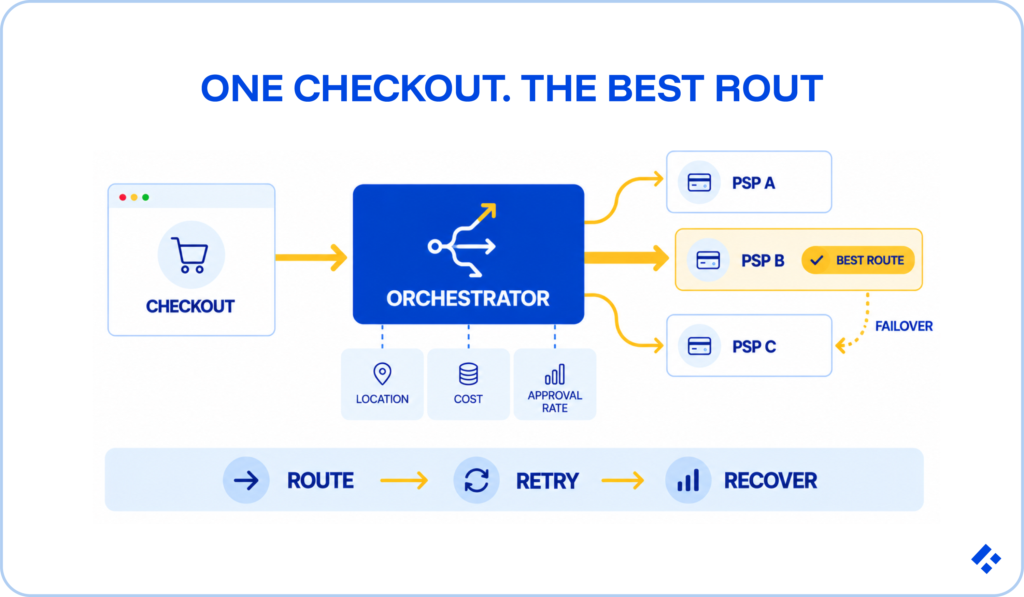
That means you configure routing rules rather than writing integration code, and the platform handles token storage, retries, failover, and reconciliation across every connected provider.
Just keep in mind that orchestration gives you the ability to act. Payment optimization is the analysis that tells you what to do. Knowing you have a false decline problem is optimization, but fixing it requires orchestration already in place.
The payment landscape is very fragmented right now.
A decade ago, a card processor and PayPal covered most of it. Now you need account-to-account payments in Europe, Pix in Brazil, UPI in India, wallets across Asia, buy now pay later in several markets, and even stablecoin settlement for cross-border flows.
Cart abandonment data makes the commercial case directly.
Baymard Institute puts insufficient payment options behind 9% of checkout abandonments and declined cards behind another 10%. The important thing to keep in mind is that both are recoverable with the right payment method available and the right routing behind it.
Resilience matters more than it used to as well.
When a single processor handles everything, and that processor has an outage, you stop taking money entirely. Routing across multiple payment providers turns a total outage into a degraded period, which in payments terms is the difference between a bad hour and a bad quarter.
Smart routing evaluates each transaction against rules or models, then sends it to whichever processor gives it the best chance of approval at an acceptable cost.
The inputs vary by platform and typically include things like card issuer and BIN, transaction amount and currency, customer location, historical approval rates for that combination, current processor health, and processing cost.
A European card on a euro transaction routes to a local acquirer rather than a US one, because domestic processing approves at considerably higher rates than cross-border.
Failover sits alongside it.
When a processor declines with a soft error or stops responding, the transaction retries through an alternative rather than failing at the customer. If you do this well, then the shopper should never learn anything went wrong.
Yuno puts the average authorization uplift from smart routing at around 8%. Spreedly's data on network tokenization, where a stored card number is replaced with a token the card network keeps current, shows roughly 4.6 percentage points added to authorization rates on its own.
Spreedly is one of the longest-established names in the category, built around a portable PCI DSS Level 1 vault, with connectivity to more than 100 payment providers.
Vault portability is the differentiator here.
Your tokens belong to you rather than to a processor, so switching providers does not mean asking customers to re-enter card details. That single property removes most of the leverage a PSP has over a merchant considering a move.
Composer 2.0, released in spring 2026, added a no-code environment combining connectivity with workflow logic and compliance automation.
From what we have observed, Spreedly is best suited to merchants who treat gateway independence as foundational rather than as a nice-to-have.
Primer centers on configurable payment workflows built through a visual canvas, allowing your payments teams to change routing logic, fallbacks, and conditional rules without an engineering release.
In most payment stacks, changing which processor handles Brazilian transactions requires a ticket, a sprint, and a deploy. Moving that into a workflow interface shortens the loop from weeks to minutes, which changes how often teams experiment at all.
Observability and reconciliation are also important, alongside network tokenization and authentication controls.
Overall, Primer is the strongest fit for product-led teams that want to iterate on payment logic frequently.
Gr4vy takes a cloud-native approach with an infrastructure-as-a-service model, giving each customer a dedicated instance rather than shared tenancy, with more than 400 payment methods available.
Single-tenant deployment appeals specifically to regulated and security-sensitive organizations, where shared infrastructure creates questions a compliance team would then need to deal with.
Regional deployment also helps where data residency rules apply.
IXOPAY combines enterprise orchestration with the tokenization capabilities of TokenEx following their merger, connecting merchants to more than 200 payment service providers and 300 payment methods through a normalized API.
Our developers have commented that it serves a slightly different buyer from most of this list, marketing to PSPs and acquirers as well as large merchants.
It offers both white-label and multi-tenant options that let a payment provider run orchestration for its own customers.
The platform launched Payments Intelligence and IXONav in June 2026, moving further into analyzing payment performance rather than only executing routing rules.
It is also one of the few platforms that markets openly to high-risk merchant categories.
Yuno connects more than 1,000 payment methods across 200-plus countries through a single integration, with particular depth in Latin America.
Local payment method coverage is the pitch. It's a great option if you are entering a new market, which usually means discovering that cards account for a minority of transactions there.
Yuno reports that inDrive added ten Latin American countries in under eight months on its orchestration layer, running around a 90% approval rate across a 50-country footprint.
Reserva, a Brazilian retailer, added four percentage points to approval rates within three months by consolidating routing and fraud management, and Livelo lifted approval rates by 5% while recovering half of its failed transactions.
Corefy provides orchestration with a lighter setup than the enterprise platforms. This is aimed at mid-market businesses that need multiple providers without the implementation weight of a large deployment.
From what we've seen, it's probably a reasonable fit where the provider count is growing but has not reached the complexity that justifies an enterprise contract.
APEXX concentrates on cost routing, optimizing which processor handles a transaction based on processing fees alongside approval likelihood.
Most platforms treat cost as one input among several.
Making cost the organising principle in this way is a great option for high-volume merchants, where a few basis points across millions of transactions outweigh marginal approval differences.
CellPoint specializes in travel, which is a genuinely distinct payments problem.
Airlines and travel merchants deal with high average transaction values, long gaps between booking and travel, complex refund and change flows, multi-currency pricing, and interline settlement between carriers.
General-purpose orchestration handles that awkwardly, but CellPoint's vertical specialization is designed for exactly this use case.
BR-DGE is a UK-based orchestration provider with strong coverage of European payment methods and acquirers. This makes it ideal for merchants whose primary market sits in the UK and EU.
The reality is that regional players often beat global platforms on local acquirer relationships and payment method depth in their home market.
This relationship can often matter a lot more than total integration count if that is where your volume is.
Paydock offers orchestration with a focus on integration flexibility and a lighter technical footprint, including in sectors like charity and government where payment requirements differ from retail.
Payrails builds enterprise payment infrastructure for large merchants and platforms wanting substantial control over how payment flows are constructed, positioned closer to building your own payments platform with help than to buying a configured one.
Solidgate combines orchestration with its own processing capability, which makes it a different proposition from the pure orchestration layers.
It seems like subscription and digital businesses make up much of its base.
Just remember that a platform that also processes has an interest in where transactions route.
That does not make it the wrong choice, and plenty of merchants are happy with it, but the incentive structure differs from a neutral layer.
Recovered revenue is one of the most prevalent benefits of payment orchestration.
Authorization improvements of several percentage points may not sound like a lot, but they can add up fast once you apply them to annual processing volume.
Resilience is another great benefit.
Failover across multiple payment service providers means one processor's outage degrades your payment success rate instead of stopping it.
Speed to market changes too. Adding a local payment method for a new country becomes a configuration change rather than an integration project, which compresses market entry from quarters to weeks.
Then there is negotiating position, which rarely appears in vendor materials and probably should.
When you can move volume between processors in an afternoon, your conversations about processing rates proceed differently.
From what our developers have observed, it's clear that leverage is worth more than the routing.
Unified payment data across every provider also gives finance teams reconciliation and reporting in one place.
Nearly every platform here prices on request, which makes it frustrating for someone to evaluate.
What you need to keep in mind is that a platform fee scaled to volume sometimes has a per-transaction component, and implementation costs that are easy to underestimate.
Also keep in mind that you need to take into account platform cost alongside the engineering time currently spent maintaining direct integrations, plus the revenue lost to declines a better-routed transaction would have recovered.
For a merchant running three processors across several markets, the maintenance line alone often justifies it.
Also be careful of market sizing here.
Published estimates for the 2026 payment orchestration market range from about $2.85 billion to $4.04 billion, with projected growth rates from 12% to about 26% annually.
Here are the things you need to think about when evaluating a payment orchestration platform, roughly in order of how often each one turns out to be decisive:
Once you have adopted a payment orchestration platform, you have swapped one dependency for another.
PSP lock-in becomes orchestrator lock-in, and the orchestrator now sits in the path of every transaction you process.
It's definitely a better trade, since a good platform keeps your tokens portable and your processors replaceable, but it's still a trade.
Also keep in mind that a bad checkout stays bad.
Orchestration improves what happens after someone presses pay, but if customers abandon before that because the flow has too many steps or asks for account creation, good routing logic will not help.
Not everything marketed as orchestration is orchestration.
Several PSPs have added routing features and renamed the bundle. The test is whether you can route away from that vendor's own processing, and sometimes the answer is no.
Finally, small volumes rarely justify payment orchestration, since a single processor in one market with modest volume will not recover enough through routing to cover platform and implementation cost.
Platform selection is the visible part. The work after signing consumes more time than teams plan for, and it falls into a few predictable areas.
A realistic first integration covering a couple of providers tends to run several weeks. Teams treating it as a drop-in find the reconciliation work in production.
Payments integration work sits in an awkward spot. It needs backend engineering, financial reconciliation knowledge, and enough familiarity with card network mechanics to know why a transaction declined and whether retrying will help.
We place payment engineers and fintech integration engineers who have shipped this kind of work inside regulated environments, through staff augmentation or as a dedicated team.
If you are scoping an orchestration project, request a consult.