

 Read Client Stories





 Alex Kugell
 Key Takeaways
- Whether a provider owns its legal entity in your target country, or routes employment through a local partner, changes the liability chain, the IP chain, and how fast you can exit, making it a major factor for regulated industries like fintech specifically.
- The employment agreement assigns your engineer’s work product to the EOR as legal employer. A separate pass-through provision is what actually gives you ownership.
- Conversion and exit terms constrain decisions you haven’t made yet. What happens if you set up your own entity in eighteen months is worth asking before you sign?
- Country coverage, pricing structure, and compliance certifications still matter; they’re just not what differentiates providers for fintech engineering hires specifically.
When trying to choose an employer of record for your engineering team, some of the most important factors to get out of the way immediately include country coverage, price, and support.
However, for engineering hires in a financial software development company, or a similarly regulated industry, also consider whether the provider owns the entity in your country or uses a partner, how the employment agreement assigns IP, and whether they can administer equity.
Let’s take a detailed look at everything that you need to know about choosing an employer of record for engineering teams in 2026.
This assumes you’ve already decided an EOR is the right model. If that’s still open, our expert fintech developers can help you figure out exactly what you need, and then source the people for you in record time, providing them through nearshore IT staff augmentation, outsourcing, or even dedicated teams.
Why the Feature Grids Don’t Separate Providers
Country coverage, price per employee, onboarding speed, support quality, and platform usability are some of the most prominent factors to consider. However, most major, reputable providers are broadly similar.
This means considering these factors only will rarely help you choose and will leave you open to certain risks depending on your industry.
For fintech engineering hires specifically, the differences that matter sit in the employment agreement and the entity structure.
1. Owned Entity or Partner Network?
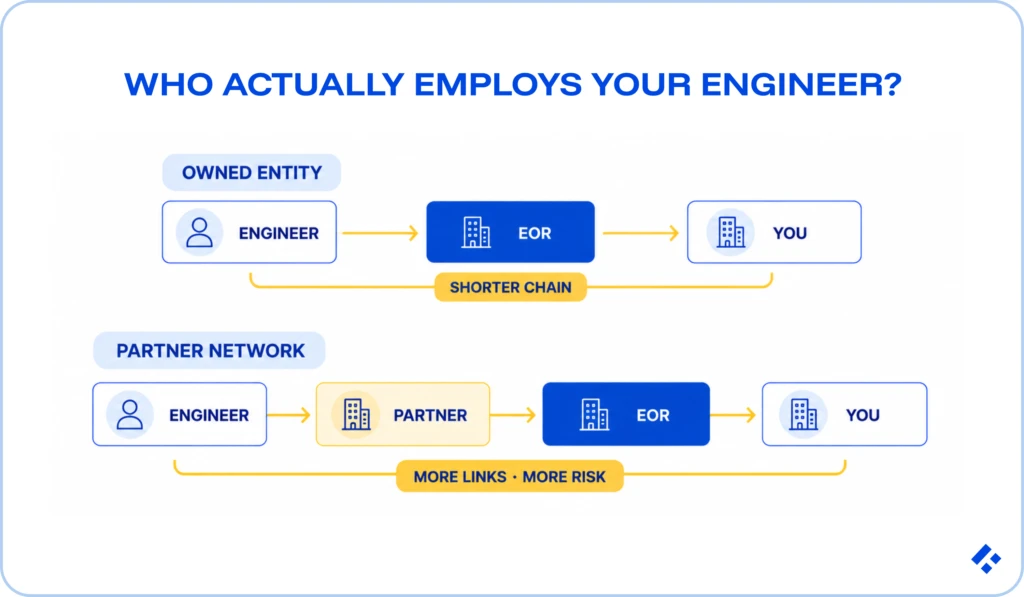
Some EOR providers own legal entities in the countries they operate in, while others need to contract with local partner firms who become the actual employer.
This changes the chain your engineer sits at the end of.
You need to understand which option you are signing up for, as it could mean that the liability chain lengthens.
If your contract is with the EOR but the actual employment contract is with a partner, you are pulling someone into the agreement that you have no relationship with.
The IP chain lengthens too (engineer to partner entity to EOR to you), and every additional link is a place the assignment can fail.
We have also noticed that service quality varies by country in ways a provider’s aggregate reviews don’t always reveal. You can have an excellent experience in one market and a poor one in another through the exact same vendor.
Finally, exit gets more complicated, because the entity you’d actually need to negotiate with isn’t the one you originally signed with.
What to ask: “In the specific countries we’re hiring in, do you own the entity or use a partner? Name the partner.” Ask this per country, since most providers are genuinely mixed.
2. How Does the Employment Agreement Assign IP?
Under an EOR, the provider is the legal employer. So, in the employment agreement, your engineer assigns their work product to the EOR, not to you.
This can be incredibly detrimental if something goes wrong, so we always recommend a separate provision in your service agreement to pass that IP through to your company.
The last thing you want is an ownership dispute on the very payment architecture powering your main products.
It’s also important to keep in mind that moral rights are often not addressed at all, and in several LATAM jurisdictions moral rights aren’t fully waivable, which means the contract needs to handle this explicitly rather than assume US norms apply.
What to ask: “Show us the IP assignment language in the employment agreement our engineer will sign, and the provision that passes it to us.” Ask for the actual clauses. A provider who can produce both quickly has been asked this before.
3. Can They Administer Equity?
Engineers often expect equity, especially when working in a startup environment. Under an EOR, your company isn’t the legal employer, which makes granting options to that person structurally awkward.
You’ll also need to deal with tax obligations and other cross-country legal nuances if you decide to offer any additional compensation.
To prevent unpredicted issues, make sure to check whether they support equity grants at all, or treat it as out of scope entirely, whether they handle the local tax reporting and withholding obligations that a grant, vest, or exercise can trigger, and whether the country in question taxes at grant, vest, or exercise, which changes what the engineer actually receives.
If it’s unsupported, you either can’t offer equity to your LATAM engineers, which creates a two-tier team and a real retention problem, or you offer it anyway and discover the tax handling is nobody’s job.
What to ask: “Do you support equity grants for employees in this country, and who handles the tax reporting at grant, vest, and exercise?”
4. What Are the Conversion and Exit Terms?
First, consider what will happen if you decide to convert to your own entity. At a meaningful headcount in one country, an entity becomes the cheaper structure. What does moving those employees cost, and does the provider facilitate that?
What happens if you need to move to a different provider? If the relationship ends or the provider exits a market, you typically have a limited window, commonly around 30-90 days, to re-employ people who are legally that provider’s employees.
Finally, what do you need to know about ending the engagement entirely? Think about where statutory severance in the target country applies and isn’t the provider’s cost. You should also familiarize yourself with notice periods across LATAM, since they can vary considerably.
There are usually clauses in your contracts that provide information around transition, liability cap, and indemnification, including whether indemnification covers a pre-conversion contractor period, which is a common gap providers don’t volunteer.
What to ask: “What happens to our employees if we set up our own entity in eighteen months?” The answer reveals whether the commercial model depends on you not doing that.
The Criteria the Grids Already Cover
- Country coverage: Evaluate depth. “150+ countries” is irrelevant if your hiring is concentrated in three. Evaluate those three specifically.
- Pricing model and structure: Flat per-employee-per-month is the right structure for engineering hires. Percentage-of-payroll scales badly against engineering salaries specifically.
- Compliance posture: In fintech, SOC 2 Type II and ISO 27001 have become close to the procurement baseline, alongside real misclassification indemnification.
Platform usability and support quality matter too. We always suggest that our clients weigh it accordingly, but it isn’t usually a differentiator for engineering outcomes specifically.
A Short Evaluation Sequence
Run these in order, since each can eliminate a provider before you spend time on the next one:
- Per country: owned entity or partner? Name the partner if there is one. Show us the IP assignment clause and the pass-through provision, both as actual text.
- Equity: supported, and who handles the tax reporting?
- Conversion terms: what happens if we set up an entity, or if we leave?
- Pricing: flat PEPM, with country surcharges named specifically, plus a sample invoice at your actual salary level.
- Compliance: SOC 2 or ISO 27001 and misclassification indemnification, if relevant to your business.
A provider who can produce IP clauses and answer the equity question in one call has done this for engineering clients before, and knows what’s important in your industry.
If the evaluation surfaces that the real problem is sourcing rather than employment administration, then staff augmentation is probably the way to go, since this is a genuinely different problem.
Not sure EOR is even the right structure? Book a decision call.