
6 Reasons to Hire Brazilian Software Developers

Listen to this content

Contents
Share this article

Looking for tech talent? Brazil is becoming more and more popular for American companies seeking senior developers, who are not only skilled technically but also incredibly affordable.

At Trio, we have a host of thoroughly vetted Brazilian developers on hand. Our focus on developer well-being means we’ve been able to retain some of the top talent, which you can make use of through staff augmentation or outsourcing.

We’ll also make sure that each developer chosen fits your company culture to ensure long-term developer satisfaction and performance. Request regional talent.

Let’s go over some of the top reasons you’ll want to hire Brazilian software developers!

Key Takeaways

  • Brazil has plenty of tech professionals and produces more than 200,000 STEM graduates every year, giving you a wide and continuously replenished talent pool to draw from.
  • Hiring Brazilian developers is typically a fraction of the equivalent skill and experience in US or European talent, without a quality tradeoff.
  • Time zone overlap with North American working hours makes real-time collaboration possible for most of the workday.
  • Brazilian developers tend to bring strong soft skills to international teams, including communication and a problem-solving mindset.
  • Brazil’s startup ecosystem ranks among the top in Latin America, producing companies like Nubank and Quinto Andar, which means the developers coming out of this environment often have experience working at pace and under pressure.
  • Government-backed incentives like the Lei do Bem reduce the effective cost of working with Brazilian tech talent further, making the economics even more attractive for long-term partnerships.

1. 1 Million+ Tech Professionals to Choose From

Brazil has a great education system that produces a steady stream of skilled engineers. This continuous influx replaces and refreshes its talent pool, particularly in tech-forward cities like São Paulo and Rio de Janeiro.

Like in most countries, these major cities are home to thriving tech hubs that foster innovation and attract talent.

The strength of the education system, combined with the growth of tech hubs, leads to endless opportunities in the field, making software development a relatively popular career field, and many young professionals decide to enter the field.

While specifics vary from year to year, Brazil produces more than 200,000 new STEM graduates every year. A couple of its universities also rank really well globally.

The result is a mature talent market, with depth across seniority levels and specializations.

A world map highlighting Brazil as a major hub for skilled software developers, with arrows indicating global connections.
Brazil is home to 500K+ tech professionals, making it a strong outsourcing destination.

2. Cost-Effectiveness Without Compromising Quality

Cost-effectiveness is another reason why companies often consider Brazilian developers. In fact, it is one of the main considerations our clients make.

It is important to note that there is a difference between cost-effectiveness and decreased cost, though.

In this case, cost-effectiveness means that the developers often offer the same high-quality work as their US or European counterparts but at significantly lower rates, giving you more value for your investment.

In our experience, companies that hire Brazilian developers typically save 40–50% compared to equivalent US or European hires. The exact number varies based on what you need.

At Trio, for example, our senior fintech specialists range from $40 to $90 per hour.

There is also a structural advantage that provides additional savings. The Brazilian government supports nearshore IT partnerships through a tax incentive program called the Lei do Bem, which offers exemptions on technology services.

Related Reading: Offshore Software Development: Latin America’s Growing Role

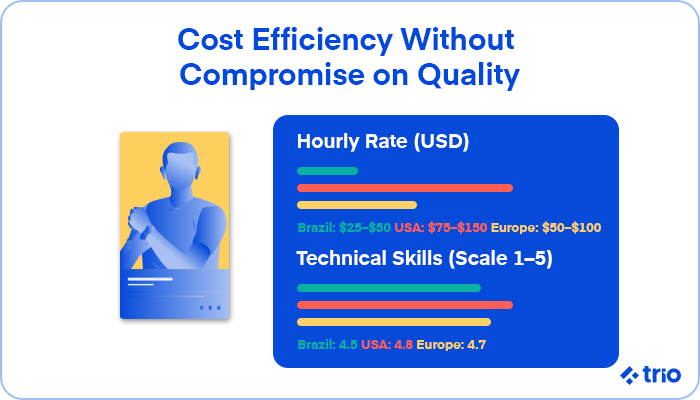
A cost comparison of software development hourly rates and technical skills across Brazil, the USA, and Europe.
Brazilian developers offer competitive rates while maintaining high technical skills.

3. Cultural Compatibility

The cultural compatibility of Brazilian developers with North American and European businesses is another big plus.

Their work ethic, adaptability, strong English proficiency, and commitment to meeting deadlines make them reliable and professional team members.

Many remote developers from Brazil are also already accustomed to working on international teams and are able to use their understanding of how to optimize their remote workflows to help your existing team optimize their processes.

We’ve also noticed that many Brazilian developers are able to take feedback very well, leading to an even more innovative work environment.

General team diversity is another factor you may want to consider here. Research consistently suggests that teams with varied cultural perspectives tend to make better decisions and catch blind spots earlier.

Bringing Brazilian developers into a predominantly North American team adds that kind of diversity without the communication friction that often comes with hiring from very different time zones or cultural contexts.

4. Excellent Technical Proficiency

We have already mentioned the quality of Brazilian education, and how software development has been made attractive, resulting in a large talent pool, but it is important to emphasise that technical proficiency.

Brazilian developers are a fantastic resource if you are looking to grow your tech team.

If you’re looking to hire developers with a mix of technical expertise and creativity, we have found that Brazilian talent stands out.

Brazilian developers have a wide skill set, whether they are front-end developers, back-end developers, or have full-stack capabilities.

The most in-demand programming languages for Brazilian developers include:

  • Python for data science, machine learning, and back-end development.
  • JavaScript for creating interactive, user-friendly web applications.
  • Java for building robust, enterprise-level solutions.

Many Brazilian developers also have expertise in mobile app development, DevOps, blockchain, financial technology, and artificial intelligence, making them versatile assets for any company.

These skills are bolstered by experience in frameworks like React, Angular, and Node.js.

We have found that a combination of these is essential for making them capable of handling a wide range of software development projects, building everything from dynamic web applications to enterprise-level systems.

Also, if you need to leverage specific technologies, such as cloud technologies, we have often found that Brazilian developers are skilled in platforms like AWS, Azure, and Google Cloud.

The result is simple; no matter who you are looking for, it is likely that you will find someone with the required skillset in Brazil.

5. Strong Soft Skills

While technical skills are crucial, soft skills often determine how well a remote developer integrates into your team.

Brazilian developers are known for their strong communication skills, as well as additional soft skills like time management.

Brazilian developers are also known for their ability to solve problems creatively.

Their ability to think critically and adapt to challenges makes them indispensable in collaborative environments.

There is a concept in Brazilian culture called jeitinho, which translates roughly as “finding a way.” It describes the Brazilian tendency to look for creative solutions when faced with obstacles rather than stopping at the problem.

This, of course, spills over into their software engineering work.

Many Brazilian developers also have experience working on diverse projects with companies from all over the world, which enhances their problem-solving abilities and allows them to bring fresh perspectives to the table.

Part of what drives this is that working for an international company, especially a North American one, carries genuine professional appeal in Brazil.

6. Time-Zone Alignment

Remote work has been made more and more possible thanks to technologies like video calls and communication software, including opening the door for companies to hire globally.

Brazil’s time zone proximity to North America makes real-time collaboration simple by removing issues that are usually associated with working in different time zones.

Most of Brazil operates on GMT-3 to GMT-5, which puts it within one to two hours of US Eastern Time and within three hours of US Central Time.

You can still have meetings and collaborate in real-time while making use of a variety of tools to take care of any asynchronous work that is conducted in the few hours that working hours don’t overlap.

For a team running daily standups, sprint planning sessions, client calls, or dealing with complex development that requires constant unblocking, that overlap makes synchronous work genuinely practical.

This, coupled with Brazil’s growing reputation as a tech powerhouse, ensures that its developers remain highly sought after.

Nearshoring vs. Offshoring: What’s the Difference?

Before committing to a hiring approach, it helps to understand the difference between nearshoring and offshoring, the two most common hiring types you’ll encounter when hiring remote workers.

The two terms are often used interchangeably but carry meaningfully different tradeoffs.

Nearshoring means partnering with talent in a nearby region, typically one that shares a similar time zone and cultural orientation.

If you have a U.S. company, then Brazil sits squarely in this category. The time zone overlap, shared working norms, and relatively easy travel access all make collaboration feel closer to working with a domestic team than with a fully remote offshore partner.

Offshoring, on the other hand, involves hiring from much more distant locations, often in Asia or Eastern Europe, or even Africa.

The cost savings can be slightly higher, but the distance means you have to deal with fewer overlapping hours and a higher risk of communication breakdowns.

If you want the kind of real-time collaboration that agile development depends on, nearshoring through Brazil tends to offer a better balance than offshoring further afield.

Success Stories: Global Companies That Have Hired in Brazil

The idea of hiring from Brazil might be daunting, but it is important to note that several major companies have done so very successfully.

Companies like Google and Microsoft both have engineering teams in some of Brazil’s big tech hubs, like São Paulo, and continue to actively hire for different roles.

Startups that originated inside Brazil also tell a compelling story about the kinds of developers that you might find there, especially in niche sectors like fintech.

Nubank became one of the most valuable digital banks in the world, and Wildlife Studios grew into one of the largest mobile game developers globally, both fueled by Brazilian engineering talent. 

Why Consider Latin American Software Developers?

If Brazil specifically doesn’t suit your needs, many other Latin American countries have established a reputation for having many skilled software developers, meaning you could still take advantage of the cost-benefits of nearshoring.

Although there are many reasons for this, let’s look at the most popular.

Just like Brazil, the rest of Latin America’s universities and tech programs produce highly skilled engineers who are ready to tackle complex challenges.

Regular participation in hackathons, tech meetups, and conferences ensures that developers in Latin America stay ahead of the curve, bringing fresh perspectives and innovative ideas to the global tech industry.

Governments in the region also invest heavily in technology and innovation, creating a supportive environment for growth.

While the specifics here can vary from region to region, and you absolutely need to do your due diligence, there are some pretty universal benefits of hiring from Latin America that offer several advantages:

  • Time Zone Alignment: Even when the Latin American countries are several time zones away from your North American city, they will still be relatively similar, especially in comparison to African or Indian developers.
  • Cultural Compatibility: Developers from Latin America share many values with Western businesses
  • Cost Efficiency: Some Latin American countries have a lower cost of living than others, but all are quite cost-effective

Related Reading: Everything About Software Outsourcing in Latin America

How to Effectively Recruit Brazilian Remote Developers?

If you think that hiring from LATAM is a good fit for you, there are a couple of things you need to be aware of before you start the recruitment process.

What is the recruitment process for hiring Brazilian remote developers?

Recruiting Brazilian developers involves several steps.

Start by defining the skills and experience you need in your development team, then use trusted platforms like Trio to find candidates who match your requirements.

You could always look for these developers on your own using platforms like Toptal or Upwork, but going through Trio simplifies the process by connecting you with pre-vetted professionals, saving you time and effort.

The next step is to evaluate candidates through portfolio assessments, coding tests, project simulations, and interviews.

While it can be tempting to skip any of these steps, they are all quite important to ensure that the developers have not only the technical, but also the soft skills necessary for your team.

Once you have determined that they have the required skills, you can start the official hiring process and move to onboarding your developers, making sure that they are a good fit for your team.

How can companies find and hire suitable candidates?

Finding suitable candidates can be a challenge, especially when hiring internationally. If you aren’t familiar with the market, you may run into issues because of a lack of relationships and pre-existing connections.

Trio makes finding the right LATAM developers easy by providing access to a curated pool of highly skilled developers, specializing in the highly complex fintech sector in the U.S. regions.

We handle the vetting process and hand-pick developers based on your specific requirements, so you only get a handful of portfolios, guaranteed to consist only of candidates who are a perfect match for your needs.

Related Reading: How to Outsource Developers in Argentina

What role does effective communication play in remote work?

Effective communication is the backbone of successful remote work.

Brazilian developers, known for their excellent interpersonal skills and their English proficiency, excel in maintaining clear and concise communication. Many of them are also familiar with the unique requirements of remote work.

This ensures a smooth workflow and prevents misunderstandings that can delay projects.

Challenges to Be Aware Of When Outsourcing to Brazil

Brazil offers considerable advantages, but you need to be aware of the challenges you may encounter before making your final decisions.

The most common ones we see are navigating complex tax laws and ensuring compliance with local labor regulations.

Brazil’s legal framework includes the Consolidação das Leis do Trabalho (CLT), which outlines labor rights and employment regulations, and the Brazilian Civil Code, which governs contractual relationships.

Our clients used to approach us largely because of issues related to laws just like these.

Recent reforms have introduced more flexibility around outsourcing practices, but understanding the rules around contractor classification, IP ownership, payment terms, and more still requires care.

Of course, one of the easiest ways to get around this challenge specifically is to work with a firm like Trio.

Since we are based in the United States, we handle the legal and compliance side on your behalf.

Language is worth mentioning, too. The vast majority of Brazilian developers working in international contexts are fluent in English, but in less experienced or less internationally-oriented teams, communication gaps can occasionally show up.

How to Vet and Evaluate Potential Brazilian Software Developers?

What if you decide that you don’t want to go through a company like Trio and want to vet and evaluate developers on your own? There are a couple of criteria you should be prepared to consider, and tools that can help you through the process.

What criteria should you use to vet developers?

We have already discussed how you should start by evaluating their technical skills through coding tests or project simulations.

Reviewing a candidate’s portfolio or source code from previous projects can provide insights into their coding style, problem-solving abilities, real-world experience in your niche, and the overall quality of their work.

A developer’s source code is particularly valuable for understanding how they approach real-world challenges. Clean, well-documented code indicates a developer who values maintainability and teamwork.

What aspects should you consider when choosing an outsourcing partner?

A staffing firm is a great way to get around assessing a developer yourself, but there are still some things you need to look out for:

  • The quality of their talent is even more important than the size of the talent pool they are able to provide. Smaller, more curated networks with rigorous screening tend to produce better long-term results.
  • Real client references and verifiable success stories are a great indicator of the services you will receive, so make sure to check external sources.
  • Consider how they handle mismatches. Can they replace a developer quickly if things do not work out? What does that process look like in practice?
  • What is their approach to security and compliance? If your business operates under specific data handling or access control requirements, like the kind that is required in fintech and healthcare, the partner needs to be able to accommodate those from day one.

How can a candidate’s skills be assessed effectively?

There is no single right way to assess a candidate’s skills, but you can start with coding challenges and project-based tests. This can be done in the candidate’s own time, but there is value in an in-person technical interview. 

These methods give you a clear picture of how candidates approach problems, and how they work when they aren’t certain.

The problem with all of these methods is that you either need to have some coding knowledge of your own or you need to hire someone with the knowledge to do the assessment for you.

What tools can help in evaluating tech talent?

Several tools can help streamline the evaluation process, such as HackerRank and Codility for coding tests or applicant tracking systems (ATS) for managing candidates.

You could also start by reviewing a candidate’s GitHub profile, which can provide valuable insights into their coding style, past projects, and overall contributions to the tech community.

Conclusion

Overall, Brazilian software developers offer an incredible combination of technical skill, affordability, English proficiency, and even cultural compatibility, making them a smart choice for a variety of businesses.

Whether you’re building an MVP from scratch or scaling your team, Brazilian developers might be a strategic move to help you reach your goals.

To find the right people for your project, talk to us.

Frequently Asked Questions

How much does it cost to hire a Brazilian software developer?

The cost to hire a Brazilian software developer can be around 40–50% less than hiring an equivalent engineer in the US or Europe. The exact figure depends on the skillset you are looking for, but at Trio, our senior fintech specialists range from $40-$90 per hour.

Are Brazilian developers fluent in English?

Yes, English fluency is common among Brazilian tech professionals, particularly those with experience in international projects.

What time zone are Brazilian developers in?

Most Brazilian developers are in time zones between GMT-3 and GMT-5, which overlaps significantly with US Eastern and Central working hours and makes real-time collaboration easy.

What technologies do Brazilian software developers specialize in?

Brazilian developers commonly specialize in technologies and frameworks like Python, JavaScript, Java, React, Angular, and Node.js, as well as cloud platforms.

Is hiring a Brazilian developer the same as outsourcing?

Hiring a Brazilian developer is not necessarily the same as outsourcing. Many companies hire Brazilian developers through a staff augmentation model, where the developer integrates directly into your existing team.

Unlock the Secrets to Hiring Top Talent

Don’t Miss This Opportunity! Streamline your hiring process with Trio’s comprehensive guide.

Share this article
With over 10 years of experience in software outsourcing, Alex has assisted in building high-performance teams before co-founding Trio with his partner Daniel. Today he enjoys helping people hire the best software developers from Latin America and writing great content on how to do that!
A collage featuring a man using binoculars, a map pin with a man's portrait in the center, and the Brazilian flag fluttering in the wind against a blue background with coding script overlaid.

Brazil's Best in US Tech: Elevate Projects with Elite Developers

Harness the Vibrant Talent of Brazilian Developers: Elevate Your Projects with Trio’s Elite Tech Teams, Pioneering Innovation and Trusted for Global Success

Master Outsourcing and Hiring Developers

Download our free ebook to access expert advice on outsourcing and hiring top-tier software developers. Equip yourself with the knowledge to make informed decisions and drive your projects to success.